

All the Pretty Little Horses
 USA
USA Lyrics
Go to sleep, little baby.
When you wake you shall have
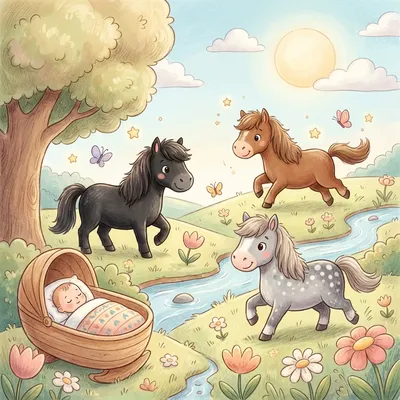
All the pretty little horses.
Blacks and bays, dapples and grays,
Coach and six little horses.
Hush-a-bye, don't you cry,
Go to sleep, little baby.
History and Meaning
This is a traditional American lullaby widely believed to be of African-American origin, with deep roots in the era of American slavery, and while its exact origins are not definitively known, variants of the song appeared in early 20th-century folk collections (including Maud McKnight Lindsay's 1903 story "A White Dove"), suggesting its presence in oral traditions dating back to the 19th century or earlier. The lullaby is strongly associated with enslaved Black women, often referred to as "mammies," who were compelled to care for their enslavers' white children, sometimes at the expense of their own offspring who were neglected or sold away, with scholar Dorothy Scarborough documenting in her 1925 study "On the Trail of Negro Folk-Songs" that such lullabies were sung by enslaved women to the white children in their charge. The lyrics commonly feature soothing promises to the child of "all the pretty little horses," often describing their various colors like "blacks and bays, dapples and grays," with a gentle melody meant to soothe a child to sleep. However, some versions of the lullaby contain darker verses, such as those collected by John and Alan Lomax in their 1934 work, which include imagery of a "po' lil lambie" with "Buzzards and flies / Picking out its eyes"—lines interpreted as a poignant reflection of the harsh realities and emotional turmoil experienced by enslaved mothers, particularly the pain of separation from their own children. In 1971, Angela Davis characterized "All the Pretty Little Horses" as an "authentic slave lullaby," reflecting the profound sorrow of Black mothers forced to nurture white children while their own faced hardship.