
Eeny, Meeny, Miny, Moe


Lyrics
Eeny, meeny, miny, moe,Catch a tiger by the toe.If he hollers, let him go,Eeny, meeny, miny, moe.
History and Meaning
"Eeny, meeny, miny, moe" is a popular children's counting-out rhyme used to select a person or thing in games. The rhyme exists in various forms and languages and has been used on playgrounds since at least the 1880s.
Origins
Folklorists suggest that the rhyme may have emerged from ancient Celtic counting rituals or traditional sheep-counting scores. One theory links the nonsense syllables to the Anglo-Cymric Score, a historical counting system used by shepherds, fishermen, and weavers in Britain. In this system, numbers like one, two, three, and four were pronounced as "hevera, devera, dick, figgit" or similar variations, which could have evolved into "eeny, meeny, miny, moe."
A more dramatic theory suggests the rhyme dates back to ancient Druid rituals where counting was used to choose a human sacrifice. However, historians generally find little evidence to support the sacrifice theory, viewing it as a popular legend rather than a documented fact. The earliest confirmed print version of the rhyme in English was recorded in 1888 in the United States, though it was noted to be common in England as well.
Meaning & Lyric Variations
Over the years, the rhyme has undergone significant shifts. The modern, child-friendly version features the line "Catch a tiger by the toe." In the nineteenth and early twentieth centuries, the American version of the rhyme frequently featured a highly offensive racial slur. By the mid-twentieth century, this version was widely rejected and replaced with words like "tiger," "piggy," or "tinker" to make it safe and appropriate for children. Similar counting-out rhymes exist in other languages, such as French, German, and Danish, suggesting a shared European heritage of playground decision-making games.
How do you play Eeny, Meeny, Miny, Moe?
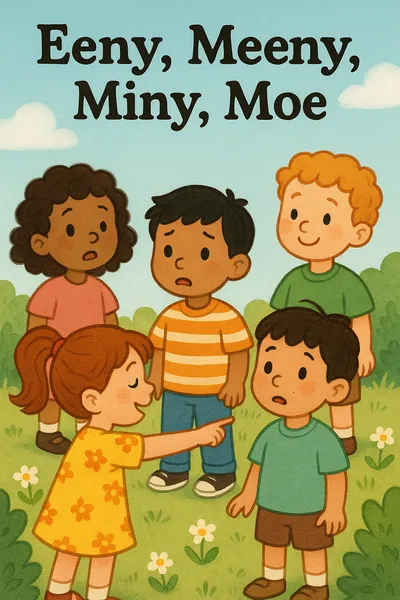
To play the game, a leader points to each person or object in a circle on each beat of the chant. The person or object pointed to on the final syllable of the word "moe" is selected, either to be "it" in a game of tag or to be eliminated, depending on the rules of the game.
What is the origin of Eeny, Meeny, Miny, Moe?
The exact origin is uncertain, but the earliest English print version was documented in 1888. It likely evolved from traditional British sheep-counting scores, such as the Anglo-Cymric Score.
Music Video
If the player is unavailable, watch this video on YouTube.
Lyrics from nurseryrhymes.info