

Frère Jacques
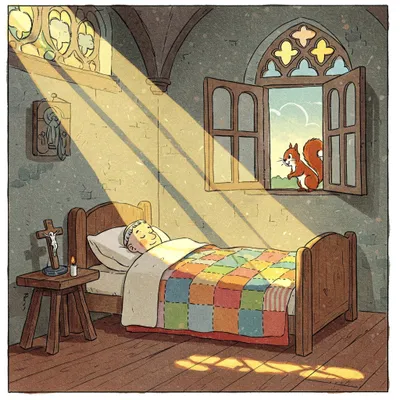
 1780
1780  France
 French Nursery Rhyme
Original Lyrics
Dormez-vous? Dormez-vous?
Sonnez les matines! Sonnez les matines!
Din, din, don. Din, din, don.
English Translation
Brother John, Brother John?
Morning bells are ringing, morning bells are ringing!
Ding, dang, dong. Ding, dang, dong.
Translation Notes
Vocabulary
Frère — brother; when used before a name, "Frère" is the title for a monk or friar (similar to "Brother" in English)
Jacques — James (the French equivalent of the English name James)
Dormez-vous — "Are you sleeping?" - Dormez = sleep (formal/plural form of the verb dormir) - vous = you (formal/plural)
Sonnez — ring! (imperative/command form of sonner, "to ring")
Les matines — matins; the first of the canonical hours in Christian tradition, prayers sung at midnight or before dawn
Ding, dang, dong — onomatopoeia representing the sound of church bells ringing
Grammar Notes
Imperative Mood: "Sonnez les matines!" uses the imperative form to give a command. In French, the imperative is formed using the present tense without the subject pronoun, creating an urgent, direct quality.
Formal Address: The song uses "vous" (the formal/plural "you") rather than "tu" (informal "you"). This was standard in traditional songs and when addressing monks, even in familiar situations.
Question Formation with Inversion: "Dormez-vous?" demonstrates question formation through subject-verb inversion, a more formal structure than modern conversational French but common in songs, literature, and traditional speech.
Definite Articles: "Les matines" uses the definite article "les" (the) because matins refers to a specific, established prayer time in monastic tradition.
History and Meaning
"Frère Jacques" is arguably one of the most universally recognized children's songs in the world, known in English as "Brother John" or "Are You Sleeping?" This deceptively simple French nursery rhyme tells the story of a monk named Jacques who has overslept and needs to wake up to ring the bells for matins, the early morning prayers. The song's enduring appeal lies not just in its charming narrative but in its perfect structure as a round (or canon), making it an ideal introduction to harmony for children and adults alike. Despite its global familiarity, the song's precise origins remain partially shrouded in mystery, with recent scholarship suggesting surprising connections to the renowned composer Jean-Philippe Rameau.
Origins
While "Frère Jacques" has long been considered an anonymous folk song, musicologist Sylvie Bouissou's research suggests the melody may have been composed by Jean-Philippe Rameau (1683-1764), one of France's most important Baroque composers. The earliest known version of the melody appeared around 1780 in a manuscript titled "Recueil de Timbres de Vaudevilles" (collection of vaudeville tunes), held as manuscript 300 in the Bibliothèque Nationale in Paris. Intriguingly, this early version carried the title "Frère Blaise" rather than "Frère Jacques."
The first actual publication of the melody occurred in 1811 in a collection called "Recueil de Capelle." However, the words and music were not published together until 1869 in Paris, meaning that for nearly sixty years, the melody circulated separately from its now-famous lyrics.
The transformation from "Frère Blaise" to "Frère Jacques" and the precise authorship of the lyrics remain historical mysteries. Various theories have emerged over the years—including speculation that the song satirized Dominican friars known for their comfortable lifestyles, or that it was written about a specific Frère Jacques Baulot—but none of these theories have solid historical evidence supporting them.
Meaning & Interpretation
The lyrics present a straightforward scenario: someone (or several people) is trying to wake Brother Jacques, a monk who has overslept his duty to ring the bells for matins. In Christian monastic tradition, matins are prayers sung at midnight or in the very early morning hours, before dawn. Monks were expected to rise from sleep to perform this liturgical duty, and Brother Jacques's failure to do so would have been a playful dereliction of responsibility.
The French lyrics create urgency through repetition: - "Frère Jacques, Frère Jacques" (calling his name twice to wake him) - "Dormez-vous? Dormez-vous?" (asking twice if he's still asleep) - "Sonnez les matines! Sonnez les matines!" (commanding him twice to ring the bells) - "Ding, dang, dong! Ding, dang, dong!" (the sound the bells should be making)
Interestingly, the popular English version "Are You Sleeping, Brother John?" alters the meaning somewhat. The English lyrics suggest Brother John is being awakened by the morning bells, rather than being commanded to ring them himself—a subtle but significant shift in the song's narrative.
Cultural Significance
"Frère Jacques" has transcended its French origins to become one of the world's most translated children's songs, appearing in dozens of languages across every continent. Its simple melody and repetitive structure make it instantly accessible to speakers of any language, requiring minimal adaptation.
The song serves as a perfect example of how a piece of French culture has been absorbed into global children's repertoire, often without the singers knowing its French origins. In many countries, children learn this song in multiple languages, making it a gateway to multilingual appreciation and an early lesson in how melody can cross linguistic boundaries while carrying different linguistic details.
Beyond its educational use, "Frère Jacques" has influenced classical music composition. Perhaps most famously, Gustav Mahler quoted the melody in the third movement of his Symphony No. 1 (completed 1888), transforming it into a minor key to create a haunting, funeral-march effect—a brilliant demonstration of how the same tune can evoke entirely different emotions through harmonic reinterpretation.
Musical Structure: The Round
"Frère Jacques" is traditionally sung as a round (also called a canon), a musical form where multiple voices or groups sing the same melody but start at different times. The staggered entries create natural harmony as the overlapping lines interact.
The song works beautifully in two, three, or four parts: 1. First group starts singing from the beginning 2. Second group enters when the first group reaches "Dormez-vous?" 3. Third group (optional) enters when the first group reaches "Sonnez les matines" 4. Fourth group (optional) enters when the first group reaches "Ding, dang, dong"
This structure makes "Frère Jacques" an ideal first exposure to polyphonic singing for children. Unlike more complex harmonies that require different parts singing different notes, a round allows everyone to sing the same melody while still creating rich, satisfying harmonies.
Educational Value
The song serves multiple educational purposes:
Introduction to Harmony: As one of the simplest and most effective rounds in existence, it teaches the concept of polyphonic music without requiring singers to learn different parts.
Language Learning: The repetitive structure, simple vocabulary, and clear pronunciation make it ideal for teaching French to children and adults.
Cultural Literacy: As one of the world's most recognizable songs, knowing "Frère Jacques" provides cultural common ground across linguistic and national boundaries.
Morning Routine Context: The song's content about waking up and morning responsibilities resonates with children's daily experiences, making it personally relevant.
International Versions
Beyond the English "Are You Sleeping?" (also "Brother John"), the song has been adapted into countless languages:
- German: "Bruder Jakob"
- Spanish: "Martinillo" or "Fray Santiago"
- Italian: "Fra Martino"
- Dutch: "Vader Jacob"
- Russian: "Брат Яков" (Brat Yakov)
Each version maintains the song's essential structure while adapting the name and linguistic details to local contexts, demonstrating the melody's remarkable universality.