

Sur le Pont d'Avignon
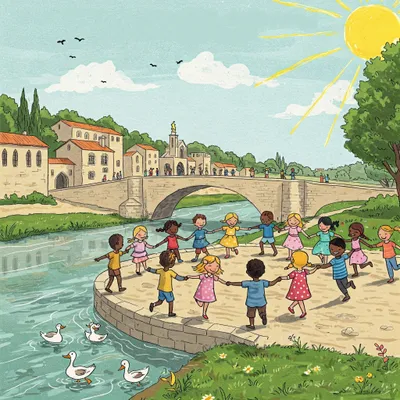
 15th Century
  France
 French Nursery Rhyme
Original Lyrics
L'on y danse, l'on y danse
Sur le Pont d'Avignon
L'on y danse tous en rond.
Les beaux messieurs font comme ça
Et puis encore comme ça.
Les belles dames font comme ça
Et puis encore comme ça.
Les filles font comme ça
Et puis encore comme ça.
Les musiciens font comme ça
Et puis encore comme ça.
English Translation
We're all dancing, we're all dancing
On the bridge of Avignon
We all dance in circles.
The fine gentlemen go like this (bow)
And then again like this.
The beautiful ladies go like this (curtsy)
And then again like that.
The young girls go like this (salute)
And then like that.
The musicians go like this (they all bow to women)
And then like that.
Translation Notes
Vocabulary
Sur — on, upon
Le pont — the bridge
Avignon — a city in southeastern France, on the Rhône River; former seat of the Papacy (1309-1377)
L'on — literary/euphonic form of "on" (one, we, people); the "l'" is added for better sound flow after certain words
y — there (adverbial pronoun indicating "in/at/on that place")
danse — dance (from the verb danser)
tous — all, everyone
en rond — in a circle, in a round
font comme ça — do like this - font = they do/make (third person plural of faire) - comme = like, as - ça = this, that (informal form of cela)
Les beaux messieurs — the fine gentlemen (beaux = handsome/fine)
Les belles dames — the beautiful ladies
Grammar Notes
Euphonic "L'on": The pronoun "on" (meaning "one," "we," or "people") becomes "l'on" after certain words for phonetic smoothness. This is purely stylistic and most common in literary language and songs. "L'on y danse" sounds more melodious than "on y danse."
The Adverbial Pronoun "Y": "Y" replaces a previously mentioned location (in this case, the bridge). "L'on y danse" literally means "one dances there," with "y" referring back to "le pont d'Avignon."
Inversion for Emphasis: In "Tous en rond" (all in a circle), the word order emphasizes the collective, circular nature of the dance.
The Phrase "Font comme ça": This construction uses "faire" (to do/make) with "comme" (like) plus a demonstrative. It's a common French idiom for mimicking or imitating: "They do like this."
History and Meaning
"Sur le Pont d'Avignon" is one of France's most beloved children's songs, celebrating a legendary medieval bridge that once spanned the mighty Rhône River in the southern French city of Avignon. The song's cheerful melody and circular dance movements have made it a staple of French childhood for over 150 years, teaching generations of children about French history and geography through play. Interestingly, the song contains a delightful historical inaccuracy—people almost certainly didn't dance "on" the narrow bridge, but rather "under" it on the riverbanks. Yet this poetic license has immortalized both the song and the ruined bridge, transforming the Pont Saint-Bénézet into one of France's most recognizable landmarks and a UNESCO World Heritage site.
Origins
The bridge itself—officially known as Pont Saint-Bénézet—was constructed between 1177 and 1185, according to legend at the divine inspiration of a young shepherd named Bénézet. The story tells that Bénézet, later canonized as Saint Bénézet (who is now the patron saint of engineers), was commanded by God to build a bridge across the Rhône. To prove his divine mission to skeptical local authorities, he miraculously lifted and moved an enormous stone that many men could not budge.
The resulting bridge was a medieval engineering marvel: approximately 920 meters long with 22 arches and 4 meters wide, linking Avignon to Villeneuve-lès-Avignon on the opposite bank. It served as a crucial crossing point between Languedoc and Provence and functioned as a strategic border post for collecting tolls between the Papal State and the Kingdom of France.
However, the Rhône proved a formidable adversary. Repeated flooding gradually destroyed sections of the bridge over the centuries, and by the 17th century, repairs had become too costly and technically challenging. The bridge was abandoned, leaving only four arches and a small chapel (dedicated to Saint Bénézet) still standing today—the romantic ruins that visitors now flock to see.
The song itself dates back to the 15th or 16th century in its earliest form, but its modern version and widespread popularity came through the work of composer Adolphe Adam in the mid-19th century. Adam incorporated the melody into his operettas "L'Auberge pleine" (The Full Inn) in 1853 and "Sur le Pont d'Avignon" in 1876, transforming a regional folk tune into an international phenomenon.
Meaning & Interpretation
The song is a "ronde mimée"—a mime round or circle dance—that describes various characters dancing "on the Bridge of Avignon." Each verse introduces a different social class or profession, showing how people from all walks of life come together in dance:
- Les beaux messieurs (the fine gentlemen) bow "like this"
- Les belles dames (the beautiful ladies) curtsy "like this"
- Les militaires (the soldiers) salute "like this"
- Les musiciens (the musicians) play "like this"
- Les blanchisseuses (the washerwomen) scrub "like this"
This democratic vision of people from different social strata—from aristocrats to working-class washerwomen—all dancing together reflects the egalitarian spirit of folk celebrations, where social hierarchies temporarily dissolved in communal joy.
Cultural Significance
"Sur le Pont d'Avignon" has become far more than a children's song—it's a cultural ambassador for France, taught in French language classes worldwide and performed at international gatherings. The song has elevated the ruined bridge from a forgotten medieval relic to one of France's most iconic monuments. Tour guides in Avignon readily acknowledge that the song's fame has made the fragmentary bridge a major tourist attraction, drawing visitors who want to see the setting of the famous chan son.
The bridge and its chapel are now protected as part of the UNESCO World Heritage site "Historic Centre of Avignon: Papal Palace, Episcopal Ensemble and Avignon Bridge," designated in 1995.
Beyond tourism, the song serves an educational purpose, teaching children about: - French medieval history and engineering - The geography of southern France and the Rhône River - Social structures in historical France - The relationship between folk culture and historical monuments
The Song's Historical Inaccuracy
One of the most charming aspects of "Sur le Pont d'Avignon" is that scholars agree the lyrics are historically inaccurate—but in the most delightful way. Evidence strongly suggests that dancing took place sous le pont (under the bridge) on the Île de la Barthelasse island or on the riverbanks, not sur le pont (on the bridge) itself.
The original bridge was only 4 meters wide—far too narrow for safe dancing, especially with no railings and the dangerous Rhône River flowing beneath. The area under the bridge's arches, however, would have provided shelter and a natural gathering space for festivals and celebrations.
So why does the song say "sur le pont"? Likely for reasons of euphony and alliteration—"sur le pont" simply sounds better in French than "sous le pont," with its repeated "s" sounds creating a more pleasing musical rhythm. This poetic license has proven so successful that the incorrect version has completely superseded historical reality in popular imagination. As is often the case with folk songs, a good melody and singable lyrics trump factual accuracy.
Performance Tradition
"Sur le Pont d'Avignon" is traditionally performed as a circle dance, making it a social and participatory experience:
- Children hold hands in a circle and move clockwise or counterclockwise during the chorus
- During the "Sur le Pont d'Avignon, l'on y danse, l'on y danse" refrain, everyone dances in the circle
- During each verse ("Les beaux messieurs font comme ça"), children stop and mime the appropriate action:
- Gentlemen bow
- Ladies curtsy
- Soldiers salute
- Musicians pretend to play instruments
- Washerwomen scrub clothes
The "comme ça" (like this) portions invite improvisation and creativity, allowing children to invent their own gestures or elaborate on traditional ones. This makes each performance unique and encourages imaginative play.
Educational Value
The song serves multiple pedagogical purposes:
French Language Learning: The repetitive structure, clear pronunciation, and simple vocabulary make it ideal for beginning French students. The phrase "l'on y danse" introduces learners to the pronoun "on" and the adverb "y."
Cultural Literacy: Children learn about a specific French landmark and its history, connecting language learning to geography and medieval history.
Social Skills: As a group circle dance, it teaches cooperation, timing, and following multi-step instructions.
Creative Expression: The mime portions encourage children to embody different characters and social roles, developing empathy and imagination.
The Bridge Today
Today, only four of the original 22 arches remain standing, jutting partway into the Rhône before ending abruptly—a hauntingly beautiful ruin that has become a symbol of Avignon itself. The small Romanesque chapel perched on one of the piers houses relics associated with Saint Bénéz et. Visitors can walk along the remaining section of the bridge and imagine the medieval pilgrims, merchants, and travelers who once crossed the mighty Rhône on this marvel of 12th-century engineering, forever linked to a song about dancing that probably never happened there.