
Alle Meine Entchen
 Germany
 German Nursery Rhyme
Original Lyrics
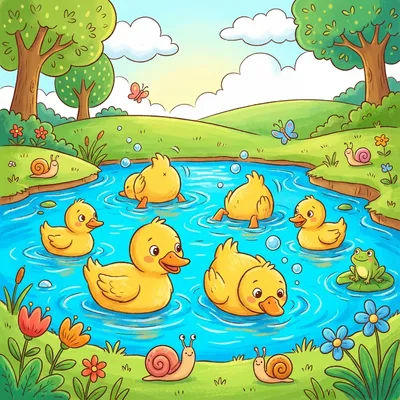
Schwimmen auf dem See,
Schwimmen auf dem See,
Köpfchen in das Wasser,
Schwänzchen in die Höh.
English Translation
Swim on the lake,
Swim on the lake,
Little heads in the water,
Little tails in the air.
Translation Notes
Vocabulary
Alle — all, every
meine — my (possessive pronoun, feminine plural form matching Entchen)
Entchen — little ducks, ducklings - Base word: Ente (duck) - The -chen suffix creates the diminutive form and makes the noun neuter: das Entchen
schwimmen — to swim (infinitive form; here used as plural verb "swim")
auf — on, upon (preposition)
dem See — the lake (masculine dative singular after the preposition auf)
Köpfchen — little heads - Base word: Kopf (head) - das Köpfchen (neuter diminutive)
in — in, into (preposition)
das Wasser — the water (neuter accusative singular, showing motion into)
Schwänzchen — little tails - Base word: Schwanz (tail) - das Schwänzchen (neuter diminutive)
die Höh — the heights, the air - Poetic shortening of die Höhe (the height) - Used for metrical purposes in the song
Grammar Notes
The Diminutive Suffix "-chen": German uses -chen (and sometimes -lein) to create diminutive forms, indicating smallness, affection, or cuteness. Adding -chen: 1. Makes the noun smaller/cuter in meaning 2. Always makes the noun grammatically neuter (das), regardless of the original gender 3. Often adds an umlaut to the stem vowel (Kopf → Köpfchen; Schwanz → Schwänzchen)
Examples from the song: - die Ente (the duck) → das Entchen (the little duck) — feminine to neuter - der Kopf (the head) → das Köpfchen (the little head) — masculine to neuter - der Schwanz (the tail) → das Schwänzchen (the little tail) — masculine to neuter
This suffix appears constantly in German children's language, stories, and songs, creating an affectionate, gentle tone.
Dative vs. Accusative with "auf" and "in":
The song beautifully demonstrates a fundamental German grammar concept—the difference between location (dative) and motion (accusative):
"Schwimmen auf dem See" (Swim on the lake) - auf + dem (dative masculine) - Dative case indicates a location: the ducks are swimming at/on the lake (where they are, not where they're going)
"Köpfchen in das Wasser" (Heads in the water) - in + das (accusative neuter) - Accusative case indicates motion toward/into: the heads go into the water (directional movement)
This distinction—dative for location, accusative for motion—is one of German's most important grammatical features, and "Alle meine Entchen" demonstrates it naturally in a children's context.
Word Order: The song uses standard German declarative word order (Subject-Verb-Object/Prepositional Phrase), making it grammatically straightforward and an excellent model for language learners.
History and Meaning
"Alle meine Entchen" (All My Little Ducks) is one of Germany's most cherished children's songs, holding a cultural status comparable to "Twinkle, Twinkle, Little Star" or "Mary Had a Little Lamb" in English-speaking countries. This simple, delightful rhyme describes dabbling ducks swimming on a lake, dipping their heads underwater to feed while their tails point comically upward—a charming observation of nature that has captivated German children for over 150 years. Beyond its lyrical appeal, the song's exceptionally simple melody, consisting primarily of ascending and descending scale notes, makes it the traditional first piece taught to children learning piano, recorder, or other instruments in German-speaking regions. Despite its ubiquity, the song's authorship remains somewhat mysterious, with attribution often given but not definitively proven.
Origins
The melody of "Alle meine Entchen" is believed to have originated in the mid-18th century as a folk tune, circulating orally before being written down. The lyrics appeared later, in the 19th century, though the precise details of their creation remain unclear.
The song is frequently attributed to Ernst Anschütz (1780-1861), a German lyricist, poet, and composer known for writing numerous children's songs. Many sources credit him with both the words and the melody. However, scholars have noted that "Alle meine Entchen" does not appear in his 1824 "Musikalisches Schulgesangbuch" (Musical School Songbook), which casts some doubt on this attribution. The lack of direct documentary evidence makes the authorship question difficult to resolve conclusively.
The first confirmed appearance of "Alle meine Entchen" as a children's rhyme came in 1859, when it appeared in Wilhelm Raabe's novel Die Kinder von Finkenrode (The Children of Finkenrode). Later, in 1891, Gustav Eskuche published a version in his collection Hessische Kinderliedchen (Little Hessian Children's Songs).
Other names that occasionally appear in connection with the song include Wilhelm Raabe and Gustav Eskuche themselves, though again without firm substantiation. The most likely scenario is that "Alle meine Entchen" emerged from the folk tradition, with the melody predating the lyrics, and various individuals contributing to its development and popularization throughout the 19th century.
Meaning & Interpretation
The rhyme presents a vivid, observational portrait of duck behavior, depicted with charming simplicity:
"Alle meine Entchen / Schwimmen auf dem See" (All my little ducks / Swim on the lake)
"Köpfchen in das Wasser / Schwänzchen in die Höh" (Little heads in the water / Little tails in the air)
This describes "dabbling"—the feeding behavior of surface-feeding ducks (like mallards), which tip themselves head-down in shallow water to reach aquatic plants and insects, leaving their rear ends pointing skyward. It's a comical sight familiar to anyone who has watched ducks, and the rhyme captures it perfectly with affectionate language using the diminutive "-chen" suffix throughout.
Over time, additional verses featuring other farm animals have become common:
- Täubchen (little doves) cooing
- Hühner (chickens) pecking
- Gänschen (little geese) honking and waddling
These expanded versions transform the song into a broader catalog of farm animal behaviors, making it both a nature observation lesson and a playful introduction to animal sounds and movements.
Cultural Significance
In German-speaking countries, "Alle meine Entchen" occupies a special place in childhood culture. It's often among the very first songs children learn, right alongside the alphabet and basic counting rhymes. Parents sing it to infants, preschool teachers use it in circle time, and music instructors rely on it as an essential teaching tool.
The song's cultural importance extends beyond mere popularity. It represents a shared childhood experience across generations of German speakers—grandparents, parents, and children all know the same simple melody and words, creating intergenerational bonds. The image of ducks with their tails in the air has become an iconic symbol of German children's folklore.
Beyond German-speaking regions, the song has been translated into many languages and remains cherished internationally, though it holds particular significance in German cultural identity.
Musical Structure and Educational Use
The melody of "Alle meine Entchen" is pedagogically brilliant in its simplicity. It consists primarily of ascending and descending major scale degrees (approximately C-D-E-F-G-G-A-A-A-A-G...), with minimal rhythmic complexity and a narrow melodic range perfect for young voices and beginning instrumentalists.
This simplicity makes it the archetypal first song for children learning musical instruments in Germany:
Recorder (Blockflöte): The melody uses only a few notes, perfectly matching the first notes children learn (typically G, A, B, later adding C, D).
Piano: The notes lie comfortably under small hands, usually played with one finger per note in the five-finger position.
Voice: The narrow range suits children's vocal capabilities, and the repetitive structure makes it easy to memorize.
The song teaches fundamental musical concepts: - Stepwise melodic motion (moving to adjacent notes) - Simple rhythmic patterns - Musical phrases and repetition - The relationship between melody and lyrics
Performance as Circle Game
"Alle meine Entchen" is frequently performed as a circle game or action song, where children act out the animals' behaviors:
- Ducks: Children waddle in a circle, then bend forward (heads down) while sticking their bottoms up (tails in the air)
- Doves: Flap arms like wings and coo
- Chickens: Peck at imaginary ground
- Geese: Waddle with arms as wings, honking
This kinesthetic element reinforces language learning, connects words to physical movements, and makes the song an engaging, multi-sensory educational experience.