
Backe backe Kuchen
 Germany
 German Nursery Rhyme
Original Lyrics
Der Bäcker hat gerufen
Wer will guten Kuchen backen
Der muss haben sieben Sachen
Eier und Schmalz
Butter und Salz
Milch und Mehl
Safran macht den Kuchen gehl!
English Translation
The baker has called
Whoever wants to bake good cake
Must have seven things
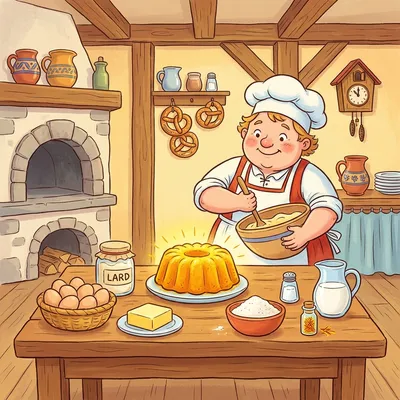
Eggs and lard
Butter and salt
Milk and flour
Saffron makes the cake yellow!
Translation Notes
Vocabulary
Backe — bake! (imperative singular form of the verb backen, "to bake")
der Kuchen — the cake
der Bäcker — the baker (from backen with the agent suffix -er and umlaut: a → ä)
hat gerufen — has called - hat = has (auxiliary verb from haben) - gerufen = called (past participle of rufen, "to call")
wer — whoever, who (relative pronoun)
will — wants (from wollen, modal verb meaning "to want")
gut — good; guten = good (accusative masculine singular)
muss — must (modal verb from müssen)
haben — to have (infinitive)
sieben — seven (number)
Sachen — things (plural of Sache, "thing/matter")
Ingredients: - Eier = eggs - Schmalz = lard (rendered animal fat) - Butter = butter (in some versions, replacing lard) - Zucker = sugar - Salz = salt - Milch = milk - Mehl = flour - Safran = saffron
macht — makes (third person singular of machen, "to make")
gehl — yellow (archaic spelling; modern: gelb)
Grammar Notes
Imperative Form: "Backe, backe Kuchen" uses the imperative form of backen. The repetition ("Backe, backe") creates rhythm and emphasis, making the command feel playful rather than strict.
Perfect Tense: "Der Bäcker hat gerufen" uses the perfect tense (present perfect), formed with the auxiliary verb hat (has) plus the past participle gerufen (called). This is the standard past tense in spoken German.
Archaic Word Order: "Der muss haben sieben Sachen" displays older German word order, placing the infinitive haben before the direct object sieben Sachen. Modern German would say "Der muss sieben Sachen haben" (He must have seven things), with the infinitive at the end of the clause. The older word order is preserved in the song for metrical and rhyming purposes.
Archaic Spelling: "Gehl" is an older spelling of gelb (yellow). The archaic form was retained specifically because it rhymes perfectly with Mehl (flour), creating a satisfying rhyme: "Mehl" / "gehl." This demonstrates how songs often preserve older language forms that have disappeared from everyday speech.
Umlaut Formation: The relationship between backen (to bake) and Bäcker (baker) demonstrates the German pattern of umlaut change (a → ä) when forming agent nouns with the suffix -er. This is a productive pattern in German: fahren (to drive) → Fahrer (driver); tragen (to carry) → Träger (carrier).
History and Meaning
"Backe, backe Kuchen" (Bake, Bake a Cake) is one of Germany's most enduring children's songs, a clapping rhyme that has taught generations of German children about baking, counting, and traditional ingredients. Dating back to around 1840 in eastern Germany, the song captures a fascinating slice of social history: the practice of communal baking, where a village baker would call out to neighbors that his commercial oven—still warm after baking bread—was available for them to bake their own cakes. The song lists seven specific ingredients, including the luxurious saffron, indicating that this was a recipe for a special occasion cake rather than everyday bread. This charming rhyme continues to be a staple of German childhood, often performed with clapping games and pretend mixing motions that make it both educational and delightfully interactive.
Origins
"Backe, backe Kuchen" originated around 1840, primarily in the Saxony and Thuringia regions of eastern Germany. While the precise author remains unknown—as is common with folk songs passed down through oral tradition—the song quickly spread throughout German-speaking regions and has remained continuously popular for nearly two centuries.
The song emerged during a time when baking was much more communal than it is today. Most homes did not have their own ovens, and even those that did found it economically impractical to heat a large oven just for a single cake. Professional bakers operated large ovens for making bread, and once they finished their commercial baking, the residual heat in these massive brick ovens was perfect for baking cakes at a lower temperature. The baker would signal—sometimes with a horn, bell, or simply by calling out—that the oven was ready for community members to bring their prepared cake batter.
This social practice of shared oven use is captured in the line "Der Bäcker hat gerufen" (The baker has called). The song thus documents not just a recipe, but an entire social and economic system of resource-sharing that characterized village life in 19th-century Germany.
Meaning & Interpretation
The rhyme is structured as both an instruction and a celebration of baking:
"Backe, backe Kuchen, der Bäcker hat gerufen" (Bake, bake a cake, the baker has called)
This opening establishes the scenario: it's baking time, and the baker has announced that his oven is ready.
"Wer will guten Kuchen backen, der muss haben sieben Sachen" (Whoever wants to bake a good cake must have seven things)
This line emphasizes the importance of having all the necessary ingredients to create a quality cake—not just any cake, but a good one. The number seven adds a memorable, almost magical quality, making it easy for children to remember the ingredient count.
The Seven Ingredients: 1. Eier (eggs) - für binding and richness 2. Schmalz (lard) or Butter - for fat and flavor 3. Zucker (sugar) - for sweetness 4. Salz (salt) - essential for enhancing flavor 5. Milch (milk) - for moisture 6. Mehl (flour) - the structural foundation 7. Safran (saffron) - for its precious golden color
The final line, "Safran macht den Kuchen gehl!" (Saffron makes the cake yellow!), highlights the most expensive and luxurious ingredient, one that transforms an ordinary cake into something special and visually beautiful.
Cultural Significance
"Backe, backe Kuchen" reflects the profound importance of baking in German cultural identity. Germany remains famous worldwide for its bread culture (Brotkultur) and its extraordinary variety of cakes and pastries (Kaffee und Kuchen tradition). This song connects modern German children to that culinary heritage, teaching them that baking is not just a practical skill but a cherished cultural tradition.
The song also embodies values of community cooperation and resource-sharing. The image of neighbors bringing their cake batters to the communal baker represents a social cohesion that characterized village life—people depended on each other and shared resources for mutual benefit.
Today, even though nearly every German home has an oven, "Backe, backe Kuchen" remains enormously popular, sung in kindergartens, playgroups, and homes. It's often one of the first songs children learn, right alongside "Alle meine Entchen." The song has been recorded by countless children's artists and appears in virtually every German children's songbook.
Historical Context: The Ingredients
The seven ingredients listed in the song tell us much about historical German baking and social class:
Saffron: Once more common in European baking before vanilla became widely available and affordable, saffron was a luxury spice imported from the Mediterranean. Its inclusion signals that this is a special cake for celebrations, not everyday food. The line "Safran macht den Kuchen gehl" emphasizes the saffron's role in creating the golden-yellow color that signified a rich, festive cake.
Schmalz (Lard): Before butter became affordable for ordinary people, rendered animal fat (lard) was the standard baking fat in German cooking. Some modern versions substitute butter, reflecting changing tastes and the greater availability of dairy products.
The number Seven: The "sieben Sachen" (seven things) may also have symbolic significance. Seven has long been considered a magical or sacred number in European folklore, appearing in fairy tales, proverbs, and children's rhymes. Structuring the recipe around seven ingredients gives it a memorable, almost ritualistic quality.
Performance Tradition
"Backe, backe Kuchen" is traditionally performed as a clapping and action song:
Clapping pattern: Children clap their hands rhythmically, often in pairs, clapping their own hands together and then their partner's hands.
Mixing motions: During the verse about ingredients, children often pretend to crack eggs, stir batter, and pour ingredients.
The final "gehl": The word "gehl" (yellow) at the end is often sung with special emphasis, sometimes with children shouting it triumphantly and spreading their arms wide to show how wonderful the yellow cake will be.
These physical elements make the song a multi-sensory learning experience, combining language acquisition, motor skill development, musical training, and social cooperation.
Educational Value
The song teaches children:
Counting and Math: Explicitly mentions "sieben Sachen" (seven things), teaching children to count and enumerate items in a meaningful context.
Vocabulary: Introduces food and baking vocabulary in a memorable way.
Sequencing: Understanding that baking requires gathering ingredients in preparation for a process.
Community Values: The concept of shared resources and cooperative problem-solving (multiple families using one baker's oven).
Cultural Heritage: Connects children to German baking traditions and historical ways of life.