
Hänschen Klein
 Germany
 German Nursery Rhyme
Original Lyrics
Ging allein
In die weite Welt hinein
Stock und Hut
Steht ihm gut
Ist gar wohlgemut
Aber Mutter weinet sehr
Hat ja nun kein Hänschen mehr
Wünsch dir Glück
Sagt ihr Blick
Kehr' nur bald zurück
English Translation
Went alone
Into the wide world
Walking stick and hat
Suit him well
He is quite cheerful
But mother cries a lot
She has no little Hans anymore
Wishing you luck
Says her glance
Just come back soon
Translation Notes
Vocabulary
Hänschen — Little Hans (Hans is the German equivalent of "John"; -chen makes it diminutive/affectionate: "Johnny")
klein — little, small
ging — went (past tense of gehen, "to go")
allein — alone
in die weite Welt hinein — into the wide world - weit = wide, far - Welt = world - hinein = into (with emphasis on entering)
der Stock — walking stick, cane
der Hut — hat
steht ihm gut — suits him well - stehen = to stand; idiomatically "to suit" - ihm = him (dative) - gut = well, good
wohlgemut — cheerful, in good spirits - wohl = well - Mut = courage, spirit - A compound adjective meaning cheerfully confident
weinet — cries (archaic/poetic form of weint, from weinen = to cry)
sehr — very, greatly
hat ja nun kein... mehr — has no... anymore - ja = indeed, after all (adds emotional emphasis) - nun = now - kein = no, none - mehr = more, anymore
wünsch dir Glück — I wish you luck (shortened from ich wünsche dir Glück)
der Blick — gaze, look, glance
sagt — says (third person singular of sagen)
Kehr' nur bald zurück — Just come back soon - Kehr' = contracted form of kehre (imperative of zurückkehren, "to return") - nur = just, only (here conveying "please") - bald = soon - zurück = back
Grammar Notes
Diminutive -chen: "Hänschen" demonstrates the productive German diminutive suffix -chen, which: 1. Makes nouns smaller/more affectionate 2. Always makes the resulting noun grammatically neuter (das) 3. In this case, transforms the name "Hans" (masculine) into "Hänschen" (neuter)
When Hans returns as an adult in the extended version, he's called "Hans groß" (Big Hans), marking his transformation from child to man.
Contracted Imperative: "Kehr' nur bald zurück" shows poetic contraction. The full imperative form would be "Kehre nur bald zurück," but the final -e is dropped for metrical purposes, indicated by the apostrophe. This practice is common in German poetry and songs.
Archaic Verb Forms: "Weinet" is an older conjugation of weinen (to cry). Modern German would use "weint," but the -et ending is preserved for poetic effect and to maintain the song's 19th-century flavor.
Stock und Hut / Steht ihm gut: This construction uses the singular verb "steht" (suits) even though two items are mentioned (stick and hat). The two items are treated as a unit—the ensemble of traveling gear—rather than as separate items requiring a plural verb.
"Wünsch dir Glück": This is an elliptical construction, dropping the pronoun ich (I) at the beginning. The full sentence would be "Ich wünsche dir Glück," but in informal/emotional speech and songs, the subject pronoun is often omitted.
Inverted Word Order: "Sagt ihr Blick" (says her gaze) uses inverted word order for poetic/rhythmic purposes. Modern German would more typically use "Ihr Blick sagt," but the inverted order emphasizes "sagt" and maintains the rhyme scheme.
History and Meaning
"Hänschen klein" (Little Hans) is one of Germany's most emotionally resonant children's songs, telling the poignant story of a young boy who sets out to explore the wide world, leaving his heartbroken mother behind. Written by Franz Wiedemann, a Dresden teacher, in 1860, the song captures universal themes of growing up, independence, maternal love, and the bittersweet necessity of letting children find their own path. The original version told an extended narrative where Hans leaves as a boy and returns years later as a grown man, but a shorter version that became popular around 1900 focuses on Hans's quick return home after realizing his mother's distress. Set to a melody dating back to 1784, "Hänschen klein" remains a staple of German childhood, teaching profound lessons about separation, identity, and the enduring bonds of family.
Origins
The lyrics of "Hänschen klein" were written by Franz Wiedemann (1821-1882), a schoolteacher from Dresden, and first published in 1860 in his collection "Alte Lieder, neue Worte" (Old Songs, New Words), which appeared within a larger work titled "Samenkörner für Kinderherzen" (Seeds for Children's Hearts). As the collection's title suggests, Wiedemann was adapting new words to older melodies—a common practice in 19th-century children's literature.
The melody itself has an even longer history, originating from a dance tune documented in a 1784 music manuscript by Heinrich Nicol Philipp zu Seibis. This charming tune has proven remarkably versatile, also serving as the melody for the English-language Mother Goose rhyme "Lightly Row," among other children's songs across different languages.
Wiedemann's original version was considerably longer than the version most German children know today, telling a complete narrative arc: young Hans leaves home to seek his fortune in the world, spends years abroad gaining experience and maturity, and eventually returns as a grown man ("Hans groß" - Big Hans) to be reunited with his family. This extended version emphasized the Bildungsroman theme—a young person's journey to adulthood through experience and self-discovery.
Around 1900, a shorter, two-stanza version became widely popular, particularly in kindergartens. This abridged version changed the narrative emphasis: instead of a long transformative journey, Hans quickly changes his mind and returns home when he realizes how much his departure has hurt his mother. This version prioritizes themes of maternal attachment and childhood homesickness over the coming-of-age narrative.
Meaning & Interpretation
The song's core narrative is deceptively simple but emotionally complex:
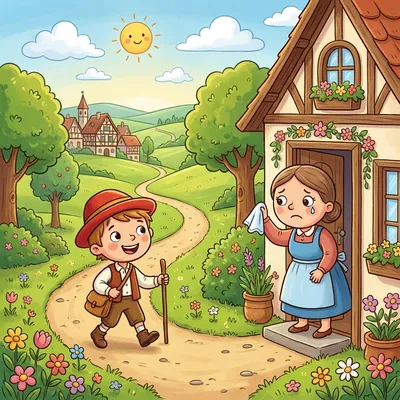
Hänschen klein / Ging allein / In die weite Welt hinein (Little Hans / Went alone / Into the wide world)
Stock und Hut / Steht ihm gut / Ist gar wohlgemut (Walking stick and hat / Suit him well / He is quite cheerful)
This opening establishes Hans as cheerful and optimistic, equipped with the traditional symbols of a traveler—a walking stick (stock) and hat. These items represent his readiness for adventure and his transition toward independence and adulthood. The "weite Welt" (wide world) is a common German expression for venturing out on one's own, carrying connotations of both excitement and uncertainty.
Aber Mutter weinet sehr / Hat ja nun kein Hänschen mehr (But mother cries greatly / She has no little Hans anymore)
This verse introduces the emotional counterweight to Hans's adventure: his mother's grief. The phrase "kein Hänschen mehr" (no little Hans anymore) carries a double meaning—she has lost both her child's physical presence and, symbolically, his childhood itself.
"Wünsch dir Glück!" / Sagt ihr Blick / "Kehr' nur bald zurück!" ("I wish you luck!" / Says her gaze / "Just come back soon!")
The mother's blessing contains both encouragement and longing. Her words wish him well, but her eyes betray her true desire—for his swift return.
In Wiedemann's original longer version, Hans does indeed return after years away, having grown into "Hans groß" (Big Hans), a mature adult shaped by his experiences. The reunion celebrates both his successful journey to manhood and the enduring love between parent and child.
In the shorter kindergarten version, Hans almost immediately reconsiders, realizing he cannot bear to cause his mother such pain, and returns home directly. This version emphasizes filial devotion and the powerful bond between mother and child.
Cultural Significance
"Hänschen klein" reflects the traditional German concept of Wanderjahre (journeyman years or traveling years), a practice where young craftsmen—having completed their apprenticeship but before becoming master craftsmen—would travel from town to town, working under different masters to broaden their skills and experience. This tradition dates back to medieval guilds and continued well into the 19th century.
The song captures the emotional reality behind this social custom: the necessity of leaving home to grow and learn, balanced against the pain of separation. It validates both the young person's desire for independence and the parent's natural grief at letting go.
The song remains widely taught in German schools and kindergartens today, often serving as a starting point for discussions about: - Growing up and increasing independence - Homesickness and separation anxiety - The parent-child relationship - Identity transformation (Hänschen → Hans; child → adult) - The balance between exploring the world and honoring family bonds
Interestingly, "Hänschen klein" has even entered popular culture in unexpected ways. In the German-dubbed version of Stanley Kubrick's 1968 film 2001: A Space Odyssey, the computer HAL 9000 sings this song as it is being deactivated—a poignant choice that emphasizes themes of regression to childhood and the loss of consciousness.
The Two Versions: Different Messages
The existence of two distinct versions—Wiedemann's original extended narrative and the shorter kindergarten version—reflects different educational philosophies:
The Original (Long) Version emphasizes: - The value of experience and travel - The journey to maturity - The cyclical nature of leaving and returning - Acceptance of necessary separation - The transformation from child to adult
The Short (Kindergarten) Version emphasizes: - The strength of maternal love - The importance of home - Quick homesickness and return - The child's emotional dependence - Reassurance that leaving home is reversible
Modern German children often learn the short version first, with the longer version sometimes introduced in later elementary grades for older children who can better understand coming-of-age themes.