

Chanda Mama Dur Ke
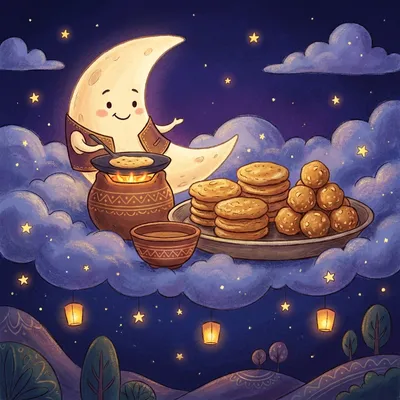

Hindi Nursery Rhyme
Original Lyrics
Hindi script
चंदा मामा दूर के,पुए पकाएं बूर के।आप खाएं थाली में,मुन्ने को दें प्याली में।
Romanized (pronunciation)
Chanda mama dur ke,Pue pakayen boor ke.Aap khayen thaali mein,Munne ko den pyaali mein.
English Translation
Moon Uncle far away,Cooking sweet fritters made with sugar.You eat from a big plate,Give the little one a small bowl.
Translation Notes
Vocabulary
चंदा (chanda) - moon, the affectionate form of चाँद (chaand) मामा (mama) - maternal uncle, the mother's brother दूर (dur) - far, distant पुए (pue) - sweet fried fritters, a pancake-like sweet बूर (boor) - coarse unrefined sugar, also written बूरा (boora) पकाएं (pakayen) - let them cook, may they cook आप (aap) - you, the respectful form खाएं (khayen) - let them eat, may they eat थाली (thaali) - the large round metal plate used for a full meal मुन्ने (munne) - little one, an affectionate word for a small boy को (ko) - to (marks the recipient) दें (den) - let them give, may they give प्याली (pyaali) - a small bowl or cup
Note the deliberate pairing of थाली and प्याली. They rhyme, they are both eating vessels, and the whole point of the last two lines is the difference in their size.
Grammar Notes
Postpositions come after the noun: Hindi places its relationship words behind the noun rather than in front. थाली में (thaali mein) is literally "plate in," and प्याली में (pyaali mein) is "bowl in." English puts "in" first; Hindi puts it last.
The को marker: in मुन्ने को दें (munne ko den), को marks who receives the action, like English "to." It also triggers a change in the noun: मुन्ना (munna) becomes मुन्ने (munne) before को, which is the oblique case.
के for "of" and "made of": दूर के (dur ke, "of far away") and बूर के (boor ke, "of sugar") both use के to link something to its origin or material. Repeating it at the end of both opening lines is what gives the rhyme its rocking, two-beat sound.
Respectful verb forms in an odd place: आप खाएं and दें use the आप (respectful "you") forms, the same register an adult would use with an elder. A child is addressing the moon politely, as you would a visiting uncle. The forms are subjunctive, closer to "may you eat" or "let him give" than to a plain command, which keeps the line as a wish rather than an instruction.
Line-by-Line Translation
चंदा मामा दूर के (Chanda mama dur ke) - "Moon Uncle, from far away"
- चंदा (chanda) = moon
- मामा (mama) = maternal uncle
- दूर (dur) = far
- के (ke) = of, from
पुए पकाएं बूर के (Pue pakayen boor ke) - "cooks sweet fritters made of sugar"
- पुए (pue) = sweet fritters
- पकाएं (pakayen) = may cook
- बूर (boor) = unrefined sugar
- के (ke) = of, made of
आप खाएं थाली में (Aap khayen thaali mein) - "You eat from a big plate"
- आप (aap) = you (respectful)
- खाएं (khayen) = may eat
- थाली (thaali) = large metal plate
- में (mein) = in
मुन्ने को दें प्याली में (Munne ko den pyaali mein) - "and give the little one his in a small bowl"
- मुन्ने (munne) = little one
- को (ko) = to
- दें (den) = may give
- प्याली (pyaali) = small bowl
- में (mein) = in
History and Meaning
"Chanda Mama Dur Ke" turns the moon into a favourite uncle. In Indian families the mama, your mother's brother, is the relative who spoils you, so the rhyme puts him up in the sky cooking sugary fritters and passing a small bowl down to the child below. Four lines, one image, and a mild complaint about portion sizes that every toddler understands immediately.
Origins
The quatrain printed above is traditional. It circulated orally as a lullaby long before anyone recorded it, and it belongs to a large family of rural North Indian jingles for small children that were never written down or attributed.
What made it universal was a film. In 1955 the Hindi film Vachan included a lullaby built on this material, with lyrics credited to Prem Dhawan, music by Ravi, and a recording by Asha Bhosle that became one of the best-known children's songs in South Asia. Sudhir, translating the song for the Hindi film archive Atul's Song A Day, describes it as "loosely based on time worn jingles and lories for toddlers, that abound the folk music in rural India". That is the relationship: the folk verse came first, the film gave it a tune, a professional recording, and a national audience.
The distinction matters for what you will find on this page. Prem Dhawan's film verses, written in 1955 and still in copyright, are not reproduced here. Only the traditional quatrain is, which is the part almost everyone actually sings and the part that predates the film.
It also means this page carries no year. 1955 dates the film song, not the rhyme, and nobody knows how old the folk verse is. Putting 1955 in the rhyme's date field would misfile a lullaby of unknown age as a 1950s composition.
Meaning
The rhyme is a small domestic scene, not a description of the night sky. Chanda Mama is cooking पुए (pue), sweet fried fritters, using बूर (boor, a coarse unrefined sugar). Then comes the joke: he eats his from a थाली (thaali), the full-sized metal plate an adult gets, and the child is handed a प्याली (pyaali), a little bowl.
Read one way, that is generosity: the moon has noticed the child and sent something down. Read another way, and this is how children tend to hear it, it is a gentle grievance. The grown-up got the big plate again. The rhyme does not resolve which reading is right, and the affection in it depends on both being available at once.
What it is not is a moral lesson. English-language summaries of this rhyme often claim it teaches children about sharing. Nothing in the four lines instructs the child to do anything. It describes an uncle handing out unequal portions, which is a description of family life rather than a lesson about it.
Why is the moon a "mama" and not a "chacha"?
Because Hindi kinship terms are specific, and only one of them fits. A mama is your mother's brother. A chacha is your father's brother. In the North Indian joint family the chacha traditionally lived in the same household and shared in paternal authority, which included discipline. The mama lived elsewhere, in your mother's family home, and turned up as a visitor bearing sweets and presents with no responsibility for correcting your behaviour.
That is the relative the moon resembles: distant, appearing at intervals, associated with treats, never once telling you off. The rhyme's first two words do a lot of work, and no English translation of "uncle" carries any of it.
Is Chanda Mama Dur Ke from a movie?
Partly. The four-line verse most families sing is traditional and older than any film. The version that made it famous is from the 1955 Hindi film Vachan, sung by Asha Bhosle with music by Ravi and lyrics credited to Prem Dhawan, which extended the folk verse into a full film lullaby. So a parent singing it to a child is singing folk material; a person humming the tune is almost certainly humming the film.
What does Chanda Mama Dur Ke mean?
"Moon Uncle, far away, is cooking sweet fritters with sugar. You eat yours off a big plate, and give the little one his in a small bowl." It personifies the moon as the child's maternal uncle, cooking sweets in the sky and sending a portion down.
Cultural Significance
This is one of the two or three rhymes that function as a default lullaby across Hindi and Urdu-speaking South Asia, sung in Pakistan and in the diaspora as well as across India. Its usefulness comes from being slow: unlike most nursery rhymes it is not a game or a counting drill, it is paced for a child who is supposed to fall asleep.
It also does something quietly sophisticated. Making the moon a relative rather than an object gives a child a first way of relating to something enormous and far off, and it does it through a kinship term the child already knows from their own family. The moon is not explained, it is introduced.
Lyrics from nurseryrhymes.info