

Machli Jal ki Rani Hai
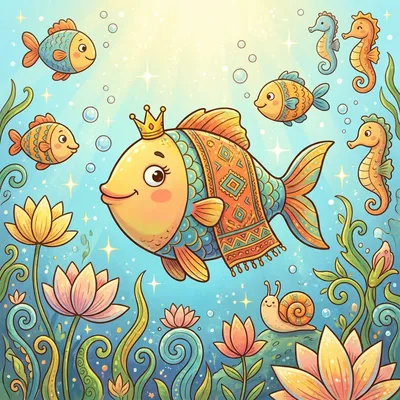

Hindi Nursery Rhyme
Original Lyrics
Hindi script
मछली जल की रानी है,जीवन उसका पानी है।हाथ लगाओ तो डर जाएगी,बाहर निकालो तो मर जाएगी।
Romanized (pronunciation)
Machli jal ki rani hai,Jeevan uska pani hai.Haath lagao toh dar jayegi,Bahar nikalo toh mar jayegi.
English Translation
Fish is the queen of water,Water is her life.If you touch her, she will get scared,If you take her out of the water, she will die.
Translation Notes
Vocabulary
मछली (machli) - fish (feminine noun) जल (jal) - water, the formal or literary word पानी (pani) - water, the everyday word रानी (rani) - queen जीवन (jeevan) - life (masculine noun) हाथ (haath) - hand लगाओ (lagao) - touch, apply (imperative) बाहर (bahar) - outside, out निकालो (nikalo) - take out, remove (imperative) डर (dar) - fear मर (mar) - die तो (toh) - then, in that case
Note that the rhyme uses both words for water: the literary जल in line one and the ordinary पानी in line two. That is not clumsiness, it is what makes the couplet rhyme (rani/pani) while keeping the first line elevated enough to justify a queen.
Grammar Notes
Feminine agreement: मछली (machli) is a feminine noun, so every verb about her takes the feminine ending. That is why the lines end जाएगी (jayegi) and not जाएगा (jayega). A child singing this is absorbing gender agreement before ever being taught the rule.
उसका agrees with what is owned, not the owner: in जीवन उसका पानी है, उसका (uska) is masculine because it agrees with जीवन (jeevan, life, masculine), even though the possessor is the feminine fish. Hindi possessives match the thing possessed. Had the line been उसकी जान (uski jaan), it would take the feminine उसकी.
Imperative plus तो as a conditional: Hindi builds "if you do X, then Y" without an explicit "if." The imperative लगाओ (touch) followed by तो (then) carries the whole condition: "touch her, and she will be frightened." Both third and fourth lines use this pattern, which is part of why the rhyme sounds so direct.
Compound verbs: डर जाएगी and मर जाएगी pair a main verb (डर, fear; मर, die) with जाना (to go). The जाना does not mean "go" here; it marks the action as complete and sudden. The difference is roughly between "she fears" and "she gets frightened."
Line-by-Line Translation
मछली जल की रानी है (Machli jal ki rani hai) - "Fish is the queen of water"
- मछली (machli) = fish
- जल (jal) = water
- की (ki) = of, belonging to (feminine, agreeing with रानी)
- रानी (rani) = queen
- है (hai) = is
जीवन उसका पानी है (Jeevan uska pani hai) - "Water is her life"
- जीवन (jeevan) = life
- उसका (uska) = her, his, its (masculine, agreeing with जीवन)
- पानी (pani) = water
हाथ लगाओ तो डर जाएगी (Haath lagao toh dar jayegi) - "If you touch her, she will get scared"
- हाथ (haath) = hand
- लगाओ (lagao) = touch, apply
- तो (toh) = then, if
- डर (dar) = fear
- जाएगी (jayegi) = will become (feminine future)
बाहर निकालो तो मर जाएगी (Bahar nikalo toh mar jayegi) - "If you take her out, she will die"
- बाहर (bahar) = outside, out
- निकालो (nikalo) = take out, remove
- मर (mar) = die
- जाएगी (jayegi) = will become (feminine future)
History and Meaning
"Machli Jal ki Rani Hai" (Fish is the Queen of Water) is usually the first poem a Hindi-speaking child ever memorises. It takes four lines to crown the fish, then take the crown back: she rules the water, but touch her and she panics, lift her out and she dies. Almost every Indian adult can still recite it, and almost nobody can tell you who wrote it.
Origins
Nobody knows. That is the honest answer, and it is worth stating plainly, because a confident-sounding origin story for this rhyme has spread widely online and does not hold up.
The rhyme circulates as traditional. Mama Lisa's World, which collects children's songs with contributor credits, files it simply as a traditional poem from India that most children pick up at school or from their parents, with no author and no date attached.
The named attributions all trace back to one place: the comment thread under a 2007 blog post of the rhyme. Three different people claimed it there, years apart:
- A 2012 comment credits Ramesh Bhai, born 1921, founder of the Bal Mandir School in Shakti Nagar, Delhi, and dates the writing to the 1950s.
- A 2010 comment credits Ramkrishna Sharma, known as Khaddarji, principal of Birla Public School in Pilani, and identifies him as the commenter's grandfather.
- A 2008 comment says only that the writer was the commenter's father, without naming him.
None of the three offers a book, a date of publication, or any documentary evidence. The Ramesh Bhai version is the one that escaped into wider circulation, and it now appears across Indian content sites and search summaries stated as flat fact, complete with details that appear nowhere in the original comment. That is how an unsourced claim hardens: repetition, not evidence.
So the fish is traditional until someone produces a printed source. Four-line verses like this one spread through classrooms and grandmothers long before anyone thinks to copyright them, and multiple teachers writing near-identical quatrains about a fish is entirely plausible. It is also possible that one of the three claims is true. There is simply no way to tell from the record that exists.
For that reason this page carries no year. A wrong date is worse than no date.
Meaning
On the surface it is a lesson in leaving wild things alone, delivered without a word of moralising. The rhyme never says "be kind to animals." It states two facts about consequences and lets a four-year-old draw the line: your hand frightens her, your curiosity kills her.
The word doing the heavy lifting is रानी (rani), queen. Calling a small fish a queen sets up the reversal that the second half delivers. She is sovereign, but only inside the water. Her whole kingdom is also the one thing she cannot survive leaving. That is a surprisingly precise idea to fit into four lines of nursery verse, and it is why the rhyme keeps getting read as being about more than fish.
Those wider readings are interpretation, not history. The fish out of water is a natural image for anyone displaced from the place that sustains them, and Indian commentators have applied it to homesickness, to migration, and to children pushed out of environments where they were thriving. The rhyme supports that reading comfortably. It does not require it, and there is no evidence any author intended it.
Who wrote Machli Jal Ki Rani Hai?
No verified author is known. The rhyme is treated as traditional. Three separate people have claimed authorship for a relative in the comments of a single 2007 blog post, and the most-repeated of those claims, naming a Delhi schoolteacher called Ramesh Bhai, rests on that comment alone with no supporting publication. Search results and Indian news explainers that name an author confidently are recycling that thread, not citing a source.
What does Machli Jal Ki Rani Hai mean?
Literally: "The fish is the queen of the water, water is her life. If you touch her she will be frightened, if you take her out she will die." It is a four-line warning about handling a fish, and by extension about interfering with any creature in the place it belongs.
Why do some versions end with "so jayegi"?
Because "mar jayegi" means "she will die," and not every adult wants that in a toddler's first poem. Mama Lisa's World records a variant used by Indian American families that swaps the last word for सो जाएगी (so jayegi), "she will sleep." The fish gets a nap instead of a death.
Softening the ending changes what the rhyme does. The original works precisely because the consequence is final and the child understands it is final. The sleeping version keeps the rhythm and the rhyme, and loses the point. Both are sung.
Cultural Significance
The rhyme's real position in Indian life is as a first text. It is short enough for a two-year-old, its rhyme scheme is exact (rani/pani, jayegi/jayegi), and its vocabulary is made of words a child already owns: fish, water, hand, outside. Teachers reach for it because it does several jobs at once, teaching pronunciation, feminine verb agreement, and a piece of ecology in twenty-two words.
It travels well beyond Hindi-speaking households too. For diaspora families it is often the poem chosen to keep a child's Hindi alive, which is exactly why the "so jayegi" variant exists: a rhyme in active use gets edited by the people using it.
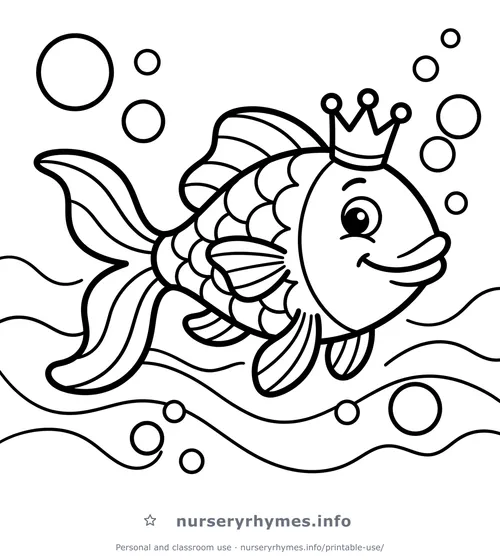
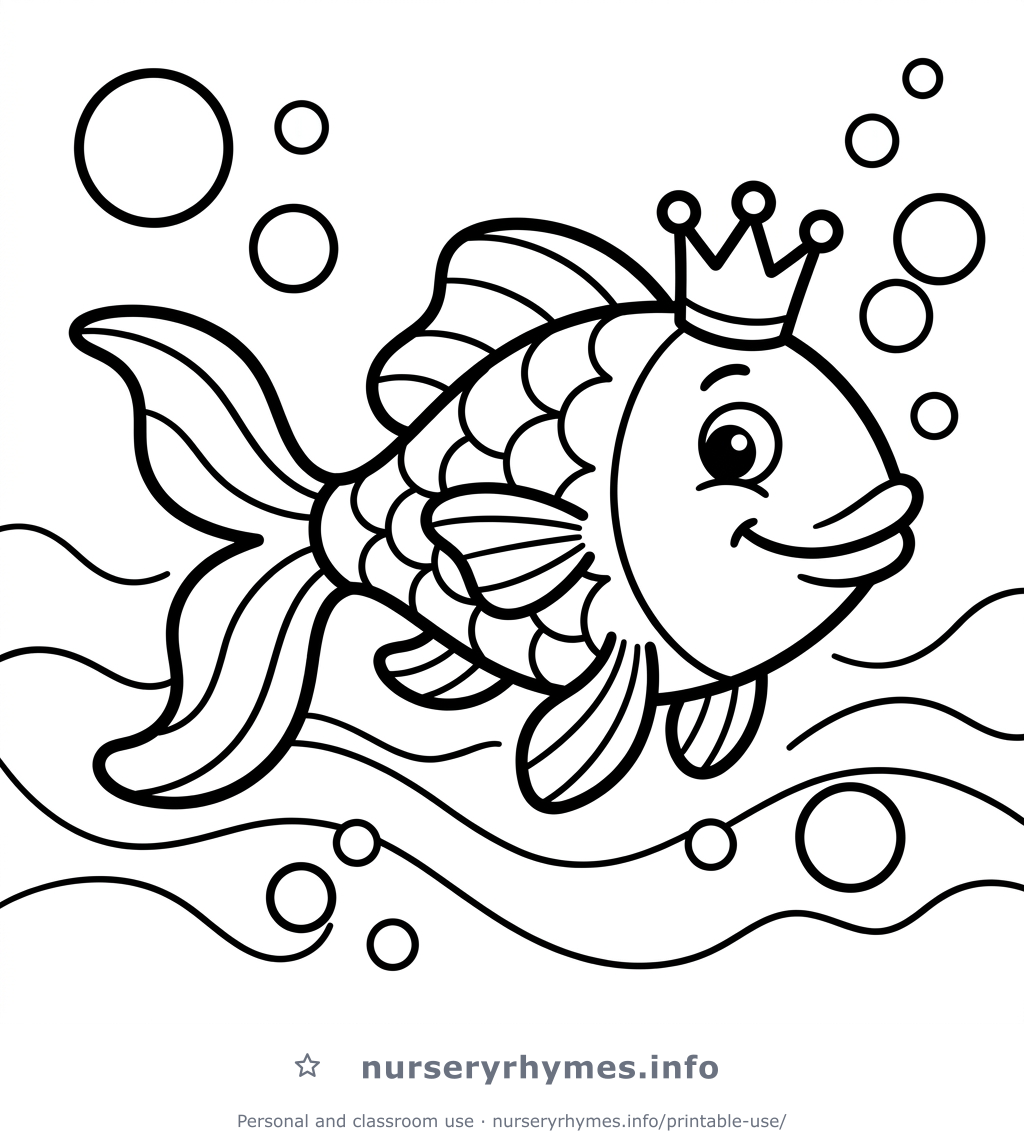
Free Printable Coloring Page
Print this Machli Jal ki Rani Hai coloring sheet for free and let little ones bring it to life with crayons or pencils.
Full-resolution PNG · Fits the paper size selected in your print dialog · Personal and classroom use
Lyrics from nurseryrhymes.info