

An Mhaighdean Mhara
 Ireland
 Irish Nursery Rhyme
Original Lyrics
Bhí mé lá breá samhraidh
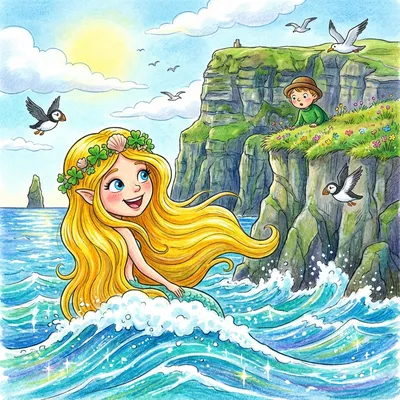
Chonaic sé an mhaighdean mhara
Ar bharr na dtonn ag gáirí
Sí bhí:
Á bhí á bhí á bhó
Á bhí á bhí á bhó
Á bhí á bhí á bhó
A mhaighdean mhara an chúil fhada
Bhí a folt fada buí go talamh
Agus súile mar an spéir ghorm
Ba bhreá liom í a fheiceáil arís
Ach d'imigh sí le sruth na taoide
English Translation
I was on a fine summer's day
I saw the mermaid
On top of the waves laughing
She went:
Ah bee ah bee ah boh
Ah bee ah bee ah boh
Ah bee ah bee ah boh
Oh mermaid with the long hair
Her long yellow hair reached the ground
And eyes like the blue sky
I'd love to see her again
But she went away with the tide
Translation Notes
Grammar Notes
Genitive Case Irish nouns change form in the genitive case: - an charraig (the rock) → na carraige (of the rock) - an tonn (the wave) → na dtonn (of the waves, with eclipsis)
Lenition Initial consonants soften after certain words: - maighdean (maiden) → an mhaighdean (the maiden, after article) - mara (sea) → mhara (of the sea, in genitive)
Progressive Aspect The progressive is formed with ag + verbal noun: - ag gáirí = laughing (literally "at laughing")
Vocabulary
An mhaighdean mhara = The sea maiden/mermaid (literally "the maiden of the sea") Bruach = Edge, bank, shore Carraig = Rock, cliff Ard/áirde = High (áirde is genitive form) Tonn = Wave Barr = Top, crest Ag gáirí = Laughing Folt fada buí = Long golden hair Súile = Eyes Spéir ghorm = Blue sky Sruth na taoide = The tide's current Selkie = Seal-person (from Scots Gaelic)
History and Meaning
"An Mhaighdean Mhara" (The Sea Maiden or The Mermaid) is a hauntingly beautiful traditional Irish song that draws on one of the most enduring narratives in Celtic folklore—the story of a supernatural sea creature who marries a mortal, has children, and ultimately returns to the ocean. This ancient tale explores themes of divided loyalties, inevitable destiny, and the heartbreak of separation.
Origins
The narrative at the heart of "An Mhaighdean Mhara" is ancient and widespread throughout Northwestern Europe, particularly in Celtic regions. These selkie and mermaid stories have been part of Irish oral tradition for over a thousand years, especially in coastal communities where the sea was both life-giver and threat. The specific song is particularly associated with County Donegal, a region in northwest Ireland renowned for its rich Gaelic heritage and strong preservation of traditional Irish language and culture.
The story follows a common pattern found throughout Irish and Scottish folklore: a man encounters a sea maiden (sometimes identified as a selkie, or seal-woman) and steals her magical skin or cloak, trapping her on land. Unable to return to the sea without it, she marries the man and raises a family. However, her longing for the ocean never fades, and when she eventually rediscovers her hidden skin, she must return to her true home beneath the waves, leaving her human family behind.
One notable version of "An Mhaighdean Mhara" comes from the singing of Áine Uí Laoi in County Donegal, where the song takes the form of a conversation between the sea maiden and her daughter, Máire. In this rendition, the mother explains her sorrowful departure after finding the seal skin she lost years before. Another version, recorded by Ennis from Síle Mhicí, tells of a mermaid named Méirí Shinídh who was trapped on land after a fisherman stole her cloak. They married and had two children, Máire Bhruinnil and Pádraig Bán. When the daughter discovers the cloak, the mother must retrieve it and return to the sea, though she sometimes returns to comb her daughter's hair—a tender detail that emphasizes the enduring bond between mother and child despite the separation.
The song has been recorded by various artists since the mid-20th century, including Kitty Gallagher's 1951 rendition, and later by renowned Irish traditional groups like Clannad and Altan, helping to preserve this piece of intangible cultural heritage for new generations.
Meaning & Interpretation
At its core, "An Mhaighdean Mhara" is a lament for loss and separation. The song explores the painful tension between competing identities and loyalties: the sea maiden must choose between her human family on land and her supernatural origins in the ocean. The story suggests that one cannot deny one's true nature indefinitely—the call of the sea proves irresistible, and return becomes inevitable.
The sorrowful nature of the song stems from the sea maiden's forced departure from her children and husband. She is not cruel or uncaring; rather, she is caught between two worlds, neither of which she can fully abandon. This theme resonates deeply with the Irish experience of emigration and diaspora, where families have been separated by circumstances beyond their control, torn between love for those left behind and the pull of necessity or destiny.
Some interpretations suggest the song has lullaby qualities and was traditionally sung to comfort children who had lost their mothers, helping them understand grief through the framework of ancient storytelling. The image of the mermaid returning to comb her daughter's hair suggests that love transcends separation and that departed mothers continue to care for their children in unseen ways.
The legend also reflects the close relationship between coastal communities and the sea. For people whose lives and livelihoods depended on the ocean, the sea represented both nourishment and danger, familiarity and mystery—a duality perfectly embodied in the figure of the sea maiden who belongs to both worlds but fully to neither.
Cultural Significance
"An Mhaighdean Mhara" is an important part of Ireland's sean-nós (old-style) singing tradition, particularly in Irish-speaking regions of Donegal. Sean-nós is characterized by unaccompanied singing with elaborate ornamentation, where the singer interprets the melody with great personal expression. Each singer brings their own emotional depth to the story, making every performance unique.
The song connects modern Irish children to their maritime mythology and ancestral storytelling traditions. In Irish folklore, merrows (from "muir" meaning sea and "oigh" meaning maid) are supernatural beings who live beneath the waves. Irish feminine merrows were often described as beautiful and benevolent, unlike the dangerous sirens of some other cultures, though their appearance could foretell storms or disasters at sea.
The story of "An Mhaighdean Mhara" has inspired other works, most notably the 1995 film "The Secret of Roan Inish," which draws on the oral tradition of selkies in the west of Ireland and incorporates elements of this ancient tale, bringing it to international audiences.