
An Poc ar Buile
 Ireland
 Irish Nursery Rhyme
Original Lyrics
Pice im dhóid is mé ag dul i meitheal
Cé chasfaí orm i gcúmar ceoidh
Ach pocán crón is é ar buile
Aililiú puilliliú, aililiú tá an poc ar buile
Aililiú puilliliú, aililiú tá an poc ar buile
Do ritheamar trasna trí ruilleogach
Is do ghluais an comhrac ar fud na muinge
Is treascairt do bhfuaireas ó thaobh an chnoic
Thug an pocán crón fá deara dhom tuisleadh
English Translation
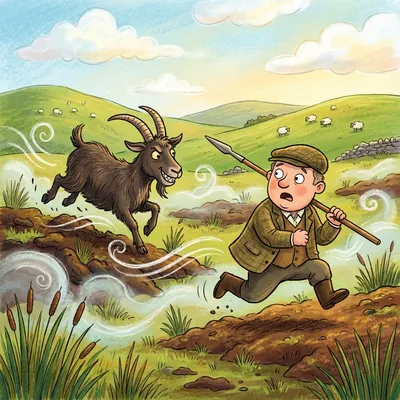
A pike in my hand going to a work party
Who should I meet in a misty hollow
But a dark puck goat and he was mad
Aililiú puilliliú, aililiú the puck is mad
Aililiú puilliliú, aililiú the puck is mad
We ran together through the soggy rushes
And the battle moved across the bog
I got a beating from the side of the hill
The dark puck goat made me stumble
Translation Notes
Grammar Notes
Verbal Noun Construction Irish uses "ar" + possessive pronoun + verbal noun to express progressive past: - Ar mo ghabháil dom = As I was going (literally "on my going to me") This construction is distinctive to Irish and has no direct English equivalent.
Compound Prepositions Irish prepositions merge with pronouns: - i + mo → im (in my) - im dhóid = in my fist
Lenition Initial consonants soften after certain words: - Droichead becomes Dhroichead after "chun" - dóid becomes dhóid after "im"
Vocabulary
Poc/pocán = Buck goat, male goat; also metaphorically: something stubborn or mischievous Ar buile = Mad, wildly excited, furious Ar mo ghabháil = As I was going Siar = West, westward Chun = To, towards Droichead = Bridge Pice = Pike (long pole or weapon) Im dhóid = In my fist Crón = Dark, swarthy, dark-colored Aililiú puilliliú = Nonsense refrain (vocables, untranslatable exclamations of joy) Aonach an Phobail = Puck Fair (literally "The Fair of the People") Gaeilge = Irish language Céilí = Traditional Irish social dance gathering Seisiún = Traditional music session
History and Meaning
"An Poc ar Buile" (The Mad Puck Goat) is one of the most famous and beloved Irish-language songs, celebrated worldwide for its energetic rhythm, humor, and irrepressible spirit. The song tells the comic story of a wild billy goat running amok through the hills of County Kerry, leaping over walls, charging through bogs, and outwitting everyone who tries to capture it. Its catchy nonsense refrain "aililiú puilliliú" has made it a favorite at traditional music sessions, céilís (social dances), festivals, and in Irish-language classrooms.
Origins
"An Poc ar Buile" has deep roots in Irish culture and is intimately connected to the Puck Fair (Aonach an Phobail), one of Ireland's oldest and most distinctive festivals, held annually in the town of Killorglin, County Kerry. The Puck Fair dates back over 400 years, with traditions possibly extending to pre-Christian Celtic fertility rites and harvest celebrations
.
A popular legend connects both the song and the fair to a dramatic historical event during Cromwell's invasion of Ireland in the 17th century. According to the story, a wild mountain goat (poc) broke away from its herd and ran frantically down into Killorglin, alerting the townspeople to the approaching army. Warned by the unusual behavior of this "mad goat," the inhabitants took cover and survived the attack. To commemorate this life-saving intervention, the people of Killorglin began the tradition of capturing a wild goat each August, crowning it "King Puck" (An Poc Rí), and displaying it on a high scaffold in the town square for three days, where it presides over the fair's festivities.
While the current lyrics of "An Poc ar Buile" were written in the 1940s by Dónall Ó Mulláin, they were a rejuvenation and adaptation of an older song called "An Boc ar Buile," which referred to a man or "buck" rather than a goat. The earlier version reportedly concerned a darker incident involving a landlord attempting to exercise "droit du seigneur" (the supposed feudal right of a lord to sleep with a tenant's bride). Ó Mulláin transformed this troubling narrative into a humorous story about a wild goat, making it more suitable for children and general audiences while retaining the theme of untamed defiance.
The song gained enormous popularity in the 1960s after being recorded by the legendary singer Seán Ó Sé, accompanied by composer Seán Ó Riada and Ceoltóirí Chualann (later to become The Chieftains). This recording became one of the first "pop record hits" in the Irish language, playing a crucial role in the revival of traditional Irish music and demonstrating that Gaeilge (Irish language) could thrive in contemporary popular music. Seán Ó Sé became so associated with the song that he earned the affectionate nickname "An Pocar" (The Goat).
Since then, "An Poc ar Buile" has been covered by countless artists, including The Chieftains, Planxty, and numerous traditional and contemporary Irish musicians, making it one of the most recognized Irish-language songs in the world.
Meaning & Interpretation
At its surface level, "An Poc ar Buile" is a rollicking comic tale of rural misadventure. The narrator heads westward toward O'Mordha's Bridge with a pike in hand, intending to help with farm work, when he encounters a wild, dark-colored billy goat that proceeds to chase and overpower him. The vivid imagery describes the goat's chaotic rampage through the Kerry countryside—leaping stone walls, splashing through bogs, and eluding all attempts at capture.
The term "poc" refers specifically to a male goat (billy goat), while "ar buile" means "mad," "furious," or "wildly excited." In Irish idiom, "poc" is often used metaphorically for something or someone stubborn, mischievous, or unpredictable. The song captures the Irish rural experience where encounters with livestock could be both frightening and absurd, creating comedy from everyday agricultural life.
However, "An Poc ar Buile" carries deeper symbolic meaning. The mad, ferocious, untameable goat is often understood as representing the indomitable spirit of the Irish people—wild, resilient, impossible to capture or control, and defiantly independent. This patriotic interpretation views the song as a fighting song celebrating Irish resistance to oppression throughout history. The goat's refusal to be caught mirrors the Irish people's refusal to be fully conquered or subdued, despite centuries of colonization.
The transformation from the darker original "An Boc ar Buile" (about a man/buck and landlord abuses) to the humorous goat version can be seen as a characteristically Irish coping mechanism—converting pain and oppression into humor and celebration, finding joy and defiance even in difficult circumstances.
Cultural Significance
"An Poc ar Buile" exemplifies Irish storytelling at its finest, blending humor with vibrant rural imagery and subtle cultural resistance. The song has become an essential part of Irish cultural education, regularly taught in Gaelscoileanna (Irish-language schools) and used to engage children with the Irish language through its memorable rhythm and playful narrative.
Children particularly love acting out the chase between the man and the mad goat, making it a favorite for school performances and language learning activities. The nonsensical refrain "aililiú puilliliú" gives children license to make joyful noise while practicing Irish pronunciation and rhythm.
At the Puck Fair itself, which continues to this day, "An Poc ar Buile" is inevitably performed, linking the song directly to the living tradition it celebrates. The fair remains a unique cultural event where a wild mountain goat is genuinely captured, crowned, and honored—a remarkable surviving example of ancient Irish customs. The three-day fair includes traditional music, dancing, street performers, and market stalls, attracting visitors from around the world.
The song's fast tempo and rollicking melody make it a staple at traditional music sessions (seisiúin) throughout Ireland and the Irish diaspora. Its energy and catchiness transcend language barriers, allowing non-Irish speakers to participate in the joy of performance even if they don't understand every word.
Educational Value
"An Poc ar Buile" offers multiple educational benefits:
- Language learning: The repetitive structure and memorable refrain help students internalize Irish vocabulary and grammar patterns
- Cultural connection: The song links learners directly to Kerry traditions, the Puck Fair, and Irish folklore
- Historical awareness: Understanding the song's origins teaches about Cromwellian Ireland and rural Irish life
- Musical tradition: Learning the song introduces students to sean-nós (old-style) singing traditions and traditional Irish music
- Humor appreciation: The comic narrative teaches that learning language can be fun and entertaining