
Báidín Fheidhlimí
 Ireland
 Irish Nursery Rhyme
Original Lyrics
Báidín Fheidhlimí 's Feidhlimí ann
Báidín Fheidhlimí d'imigh go Gabhla
Báidín Fheidhlimí 's Feidhlimí ann
Báidín bídeach, báidín beosach
Báidín bóidheach, báidín Fheidhlimí
Báidín díreach, báidín deontach
Báidín Fheidhlimí 's Feidhlimí ann
English Translation
Feidhlim's little boat with Feidhlim in it
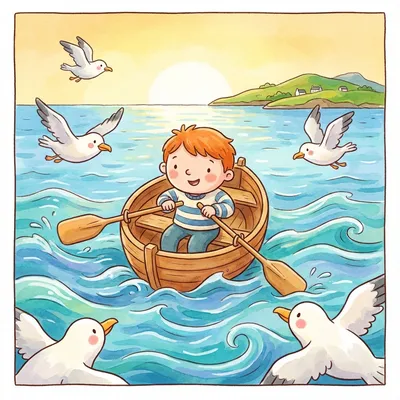
Feidhlim's little boat has gone to Gola
Feidhlim's little boat with Feidhlim in it
A tiny boat, a lively boat
A beautiful boat, Feidhlim's boat
A straight boat, a willing boat
Feidhlim's little boat with Feidhlim in it
Translation Notes
Grammar Notes
The Diminutive Suffix -ín Irish uses the suffix "-ín" to indicate smallness or affection: - bád (boat) → báidín (little boat) - beag (small) → beagín (tiny little one)
This diminutive form is extremely common in children's songs and when speaking affectionately about people, animals, or objects.
The Genitive Case To show possession, Irish changes the form of the possessor noun: - Feidhlimí (Feidhlim, nominative) → Fheidhlimí (of Feidhlim, genitive) - The initial 'F' is lenited (softened) by adding 'h'
So "Báidín Fheidhlimí" literally means "little boat of Feidhlim."
Past Tense Formation - d'imigh = went, has gone (from the verb "imeacht," to go/depart) - The d' prefix appears before vowel-initial past tense forms
Vocabulary
Báidín = Little boat (from bád + diminutive -ín) Fheidhlimí = Of Feidhlim (genitive case, lenited) Feidhlim/Phelim = Traditional Irish male name D'imigh = Went, has gone Go = To (indicating destination) Gabhla = Gola (island off County Donegal) Oileán Thoraí = Tory Island (remote island off northwest Donegal) Beagín beag = Very tiny, tiny little one Beoga = Lively, animate Álainn = Beautiful, charming Díreach = Straight (also means honest, upright) Toilteanach = Willing, voluntary, compliant Gaeltacht = Irish-speaking region Gaelscoil = Irish-language school (plural: Gaelscoileanna)
History and Meaning
"Báidín Fheidhlimí" (Feidhlim's Little Boat) is one of the most beloved Irish children's songs, originating from the Gaeltacht (Irish-speaking) region of County Donegal in northwest Ireland. The song's simple, repetitive structure and gentle, rocking rhythm mirror the motion of a small boat on the waves, making it perfect for young children. For generations, it has been one of the first songs taught in Irish-language schools, introducing children to Gaeilge through music while connecting them to Ireland's maritime heritage.
Origins
"Báidín Fheidhlimí" is a traditional song from County Donegal, particularly associated with the Gaeltacht areas of Gweedore and the Rosses. The song recounts a journey from the Donegal mainland to Gola Island (Gabhla in Irish), and in some versions continuing onward to remote Tory Island—both small islands off the rugged northwest coast.
The song is believed to refer to a historical figure: Feilimí Cam Ó Baoill, a 17th-century chieftain of the Rosses region in County Donegal. According to tradition, Feilimí was fleeing from his arch-enemy, Maolmhuire an Bhata Bhuí Mac Suibhne, and took to his small boat to escape. He first sailed to Gola Island, but seeking an even more inaccessible refuge, he continued his desperate journey to Tory Island, one of Ireland's most isolated inhabited islands.
The narrative takes a tragic turn in fuller versions of the song: Feilimí's little boat was wrecked on the treacherous rocks surrounding Tory Island, and some accounts suggest he drowned in the attempt. This darker historical backstory contrasts sharply with the gentle, affectionate way the song is typically performed today, demonstrating how traditional songs can evolve over time, with tragic adult ballads transforming into innocent children's songs.
The song has been passed down orally through generations and has been recorded by numerous Irish artists, including Na Casaidigh, Sinéad O'Connor, Emmet Spiceland, and John Spillane, each bringing their own interpretation to this piece of Irish musical heritage.
Meaning & Interpretation
On the surface, "Báidín Fheidhlimí" tells the simple story of a small boat making a journey across the water. The chorus affectionately describes the boat with a series of endearing adjectives: it's tiny ("beagín beag"), lively ("beoga"), charming ("álainn"), straight (well-built), and willing (reliable)—all qualities that make the little vessel seem almost like a beloved pet or family member.
For children, the song is typically presented as an innocent story about a boat's journey, possibly belonging to a child named Feidhlim on an imaginary voyage. The rhythmic rocking of the melody mimics the motion of waves, making it both soothing and engaging for young listeners. Parents often sing it as a lullaby or a gentle daytime song, and the diminutive forms (báidín for "little boat") give it an affectionate, endearing quality typical of Irish children's songs.
However, knowing the song's possible historical origins adds a layer of poignancy for adult listeners. The "willing little boat" becomes a symbol of courage in the face of danger, and the journey to increasingly remote islands represents a desperate flight from persecution. This duality—innocence for children, deeper meaning for adults—is characteristic of many traditional songs that have survived across centuries.
The song also reflects the centrality of boats and seafaring in Irish coastal culture. For communities in Donegal and throughout Ireland's western seaboard, small boats (báid) were essential for transportation, fishing, and communication between islands and mainland. The affectionate personification of the boat honors the vital role these vessels played in daily life.
Cultural Significance
"Báidín Fheidhlimí" holds a special place in Irish cultural education. It is invariably one of the first songs taught to children in Gaelscoileanna (Irish-language schools) and in Irish-speaking homes, particularly in Donegal but throughout Ireland. Its simple vocabulary, repetitive structure, and memorable melody make it ideal for language acquisition.
The song connects children to specific places in Ireland—Gola Island and Tory Island—instilling geographical knowledge along with linguistic skills. Gola Island, while no longer permanently inhabited (the last year-round residents left in 1965), remains a powerful symbol of Irish island life, and Tory Island continues to maintain a small Irish-speaking community, preserving ancient traditions and folklore.
The tune is often performed in a lively waltz or slide rhythm, making it suitable for both singing and instrumental arrangements. At traditional music sessions, céilís, and Irish cultural events worldwide, "Báidín Fheidhlimí" creates a sense of shared heritage, connecting the Irish diaspora to their ancestral homeland.
Educational Value
The song offers multiple educational benefits:
- Language learning: The repetitive structure reinforces Irish vocabulary and pronunciation
- Cultural geography: Children learn about real Irish islands and maritime communities
- Musical concepts: The regular rhythm develops musical awareness and timing
- Heritage preservation: Singing the song connects children to centuries-old traditions
- Emotional expression: The gentle, rocking melody helps children develop musical sensitivity
Teachers often use the song as a springboard for lessons about Irish island life, boat-building, seafaring traditions, and Donegal history and culture.