
Beidh Aonach Amárach
 Ireland
 Irish Nursery Rhyme
Original Lyrics
Cén mhaith duit siúd, a mhamaí, mura mbeidh mé ann?
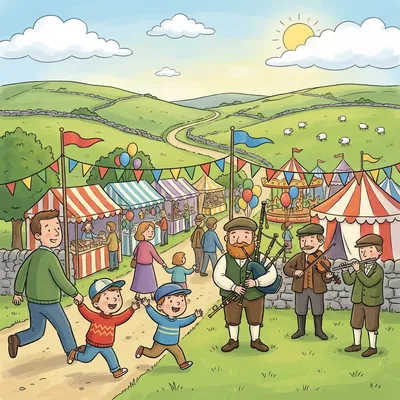
Beidh píobairí ann is lucht ceoil ar gach taobh
Beidh sé ina lá breá geal gréine
Má bhíonn sé féin ina lá
Tiocfaidh mo stóirín slán, slán, slán
Tiocfaidh mo stóirín slán, slán, slán
Tiocfaidh mo stóirín slán
Is ní bheidh buaireamh ar mo chroí níos mó
English Translation
What good is that to you, mammy, if I won't be there?
There'll be pipers there and musicians on every side
It will be a fine bright sunny day
If it's a day at all
My darling will come home safe, safe, safe
My darling will come home safe, safe, safe
My darling will come home safe
And there'll be no worry on my heart anymore
Translation Notes
Grammar Notes
The Future Tense Irish has a distinct future tense formed differently from the present: - tá (is) → beidh (will be) - téann (goes) → rachaidh (will go) - tagann (comes) → tiocfaidh (will come)
Eclipsis (Urú) Certain words cause the initial consonant of the following word to be "eclipsed" by another consonant. The eclipsing consonant is written before the original consonant, but the eclipsed one is pronounced: - i + Contae → i gContae (pronounced "gon-tae") - mura + beidh → mura mbeidh (pronounced "muh myeh")
The Genitive Case Irish uses the genitive case to show possession or relationship: - an Chlár (Clare, nominative) → an Chláir (of Clare, genitive) - The lenition (h-addition) also marks the genitive
Vocabulary
Beidh = Will be (future tense of "tá") Aonach = Fair, gathering, market (ancient Irish assemblies) Amárach = Tomorrow I gContae an Chláir = In County Clare Mura = If not, unless Mbeidh = Will be (eclipsed form after "mura") Ann = There (in existence, present) Gréasaí = Shoemaker, cobbler Píobairí = Pipers (plural of "píobaire") Ceol = Music Damhsa = Dancing, dance Margadh = Market Naíonra = Irish-language preschool (plural: naíonraí) Gaelscoil = Irish-language school (plural: Gaelscoileanna)
History and Meaning
"Beidh Aonach Amárach" (There'll Be a Fair Tomorrow) is a charming traditional Irish folk song that captures the excitement, romance, and social importance of traditional fairs in rural Ireland. The song is frequently taught to children learning Irish Gaelic, both for its memorable melody and its glimpse into Irish social history.
Origins
While the precise author of "Beidh Aonach Amárach" remains unknown, the song's historical roots are believed to extend back to the troubadour and trouvère traditions that emerged in 12th-century France and subsequently spread throughout Europe. The song exemplifies a venerable style often characterized as a "love debate" or dialogue between a daughter and her mother regarding matters of the heart—a theme that appears across many cultures' folk traditions.
The song is set in County Clare, a region in western Ireland renowned for its traditional music heritage and vibrant cultural life. Clare remains a center of Irish musical culture to this day, particularly associated with traditional music sessions, festivals, and sean-nós (old-style) singing.
Irish fairs (aonach) have ancient origins, with some dating back to medieval times or even earlier Celtic gatherings such as Lughnasadh, the ancient harvest festival. These fairs were held at specific times throughout the year and served as vital economic and social hubs for rural communities scattered across the Irish countryside.
The renowned Irish singer Joe Heaney (1919-1984), one of the greatest voices in sean-nós singing, was known for teaching this song to his students, helping to preserve it for future generations. The song holds particular cultural significance and is frequently utilized in educational environments, children's choral festivals, and Irish language learning programs.
Meaning & Interpretation
The narrative of "Beidh Aonach Amárach" centers on a young girl—typically described as only ten or eleven years old—seeking her mother's permission to attend the fair in County Clare the following day. However, the fair itself is merely the setting for the song's deeper theme: the girl's budding romantic feelings for a local shoemaker (gréasaí).
With all the intensity and certainty of young love, the girl declares her deep affection for the shoemaker, expressing her wish to marry him and stating emphatically that she would prefer him over any army officer—a significant statement, as soldiers and officers often represented higher social status and economic security. Her choice of a humble craftsman over a prestigious military man reflects genuine affection over practical consideration.
The mother's response is both tender and practical: she tells her daughter that she is too young, advising her to wait until she is thirteen years old before making such life-changing decisions. This gentle parental wisdom acknowledges the daughter's feelings while urging patience and maturity.
The song beautifully captures universal themes: the impatience of young love, the wisdom of parental guidance, the tension between heart and head, and the timeless conflict between youthful passion and mature prudence. The fair serves as a liminal space—a place of possibility, romance, and adventure outside the ordinary routine of rural life.
Cultural Significance
Fairs in Ireland were central to rural Irish life for centuries, serving multiple vital functions:
- Economic centers: Markets for livestock, produce, and handcrafted goods
- Social gatherings: Opportunities to meet friends, neighbors, and family from distant areas
- Matchmaking venues: Important sites for arranging marriages and courtships
- Entertainment hubs: Featuring pipers, musicians, dancers, storytellers, and performers
- Information exchanges: Places to hear news, share stories, and exchange information
The references to "píobairí" (pipers) in the song reflect the central importance of traditional music in Irish culture. No fair was complete without music and dancing—these elements transformed purely economic transactions into celebratory community events where Irish culture was performed and reinforced.
The song's emotional core—a child pleading to attend the fair and the unspoken understanding that loved ones who went would return safely—speaks to the mixture of excitement and separation that fairs brought to rural families. While parents and older siblings attended the fair, younger children might be left behind, hence the longing and anticipation expressed in the song.
Today, traditional fairs still occur across Ireland, though their character has evolved significantly. Modern fairs often blend traditional livestock trading with contemporary entertainment, tourism, and cultural celebration. Historic fairs like the Puck Fair in Killorglin continue to attract thousands of visitors. "Beidh Aonach Amárach" preserves the memory of when these gatherings were the absolute highlights of rural social life, teaching children about Irish traditional culture, community bonds, and the rhythms of agricultural society.
Educational Value
The song is widely used in Irish-language education for several reasons:
- Future tense practice: The title itself demonstrates the future tense ("beidh" = will be)
- Cultural knowledge: Introduces children to Irish social history and fair traditions
- Dialogue structure: The back-and-forth between mother and daughter is engaging for learners
- Memorable melody: The tune helps students internalize Irish words and phrases
- Emotional resonance: The relatable theme of wanting something and being told to wait connects with children's experiences