
Bó Bheag
 Ireland
 Irish Nursery Rhyme
Original Lyrics
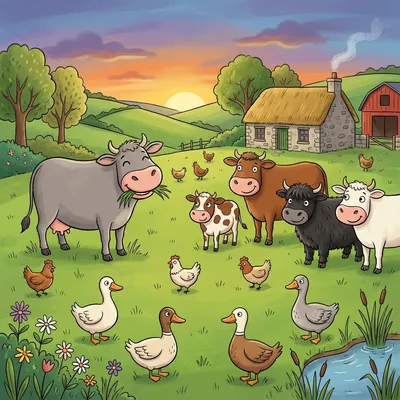
Bó dhubh, bó bhán
Bó ghlas ag ithe féir
San áit a bhfásann an féar
Cearca beaga agus lachain mhóra
Gé ghlas ag dul abhaile
Tá an lá ag imeacht
Agus tá an oíche ag teacht
English Translation
Black cow, white cow
A grey cow eating grass
In the place where the grass grows
Little hens and big ducks
A grey goose going home
The day is leaving
And the night is coming
Translation Notes
Grammar Notes
Lenition (Séimhiú) In Irish, adjectives following feminine nouns are lenited by adding 'h' after the initial consonant: - bó (cow, feminine noun) + beag → bó bheag - bó + mór → bó mhór - bó + dubh → bó dhubh - bó + bán → bó bhán - bó + glas → bó ghlas
Lention softens the pronunciation: "bh" and "mh" are pronounced like "v" or "w" depending on surrounding vowels.
The Progressive Form (An Aimsir Láithreach Leanúnach) Irish uses "ag" + verbal noun to express ongoing action: - ag ithe = eating (literally "at eating") - ag ól = drinking - ag rith = running - ag canadh = singing
The Genitive Case (An Tuiseal Ginideach) The object of certain verbal nouns appears in the genitive case: - féar (grass, nominative) → féir (of grass, genitive) - "Ag ithe féir" = eating (of) grass
Vocabulary
Bó = Cow (feminine noun; plural: ba) Be ag = Small, little Mór = Big, large Dubh = Black Bán = White Glas = Green, grey (also means "blue" in some contexts) Ag ithe = Eating (progressive aspect) Féar = Grass (nominative) Féir = Of grass (genitive) Naíonra = Irish-language preschool Gaelscoil = Irish-language primary school Gaeltacht = Irish-speaking region Bóín Dé = Ladybird (literally "God's little cow") Brehon Law = Ancient Irish legal system (Dlí na mBreithiún)
History and Meaning
"Bó Bheag" (Little Cow) is a traditional Irish children's song that serves as a perfect introduction to the Irish language for young learners. Through simple, repetitive descriptions of cows in different sizes and colors, the song teaches fundamental vocabulary, essential grammar patterns, and connects children to Ireland's deep agricultural heritage—all while being fun and memorable to sing.
Origins
Unlike some Irish songs with documented authors and specific historical origins, "Bó Bheag" belongs to the category of traditional teaching songs passed down orally through generations, particularly within Irish-speaking (Gaeltacht) communities and Irish-language educational settings. The song's exact origins are not formally documented, suggesting it emerged organically from the practical needs of Irish language educators and parents seeking engaging ways to teach children.
The word "bó" (cow) holds deep significance in Irish history and culture. For millennia, Ireland was primarily an agricultural society, and cows were not merely livestock but symbols of wealth, prosperity, and social status. In ancient Irish law (Brehon Law), which governed Ireland until the 17th century, fines, compensations, and prices were often measured in cows ("bó"). A person's wealth was calculated in cattle, and many Irish surnames derive from cattle-related words.
This cultural importance of cattle made cows a natural subject for children's songs, ensuring that even the youngest members of Irish society understood the animals central to their community's survival and prosperity. The endearing term "bó bheag" (little cow) reflects the affectionate relationship Irish farming families had with their livestock, treating them almost as members of the household.
Interestingly, the Irish word for ladybird is "Bóín Dé," which literally translates to "God's little cow," illustrating how the term "little cow" is used endearingly in Irish culture to describe small, beneficial creatures. This linguistic connection demonstrates the cow's symbolic importance extending beyond the farmyard into broader cultural metaphors.
Meaning & Interpretation
"Bó Bheag" presents a series of simple contrasting images: little cow and big cow (bó bheag, bó mhór), black cow and white cow (bó dhubh, bó bhán), and concludes with a cow eating grass (bó ghlas ag ithe féir). These straightforward descriptions serve multiple educational purposes while painting a familiar rural scene.
For children growing up in agricultural Ireland, these images would have been immediately recognizable from daily life. Cows in fields, cows of different colors and sizes, cows grazing on grass—these were the ordinary sights of childhood in rural Ireland. The song transforms everyday observation into language learning, grounding abstract vocabulary in concrete, visual experiences.
The color "glas" in Irish interestingly means both "green" and "grey," reflecting the Irish landscape's subtle gradations of color—particularly the grey-green hues of the Irish countryside in certain lights and weather conditions. A "bó ghlas" could be interpreted as either a grey cow or a greenish-grey cow, though in the context of "ag ithe féir" (eating grass), the association with green is natural.
The progressive action "ag ithe féir" (eating grass) introduces movement and verb forms, expanding beyond simple noun-adjective pairs to show cows engaging in their natural behavior. This subtle progression in grammatical complexity makes the song an excellent educational tool.
Cultural Significance
"Bó Bheag" reflects Ireland's agricultural heritage and the central role farming played in Irish life for thousands of years. While modern Ireland has become increasingly urbanized and its economy diversified, traditional songs like this maintain connections to rural traditions and help all Irish children—whether from cities or countryside—understand their cultural roots.
The song is commonly used in naíonraí (Irish-language preschools) and the early years of Gaelscoileanna (Irish-language schools), where children learn through songs, stories, and play conducted entirely in Irish. This immersive approach, using simple, repetitive songs like "Bó Bheag," helps children acquire language naturally through familiar contexts and enjoyable activities.
The song represents the gentle, nature-focused approach characteristic of Irish children's education, rooted in the rural landscape and traditional farming culture. Many Irish children's songs feature farm animals—cows, sheep, ducks, geese, horses—reflecting the agricultural rhythms that structured Irish life for generations.
Educational Value
"Bó Bheag" is particularly valuable for language learning because it efficiently teaches multiple concepts:
- Vocabulary building: Animal names (bó = cow), sizes (beag/mór = small/big), colors (dubh/bhán/glas = black/white/grey-green)
- Lenition patterns: Adjectives following the feminine noun "bó" are systematically lenited (bheag, mhór, dhubh, bhán, ghlas)
- Progressive aspect: The construction "ag ithe" demonstrates ongoing action
- Genitive case: "Féir" (of grass) shows the genitive form of "féar" (grass)
- Pronunciation practice: The repetitive structure allows children to practice challenging sounds like "bh" and "mh"
The rhythm and repetition make the song memorable, allowing children to internalize grammar patterns without explicit instruction. They learn intuitively that adjectives following "bó" get an "h" added, laying groundwork for understanding lenition—one of Irish's most important grammatical features.