

Cailín na Gruaige Doinne
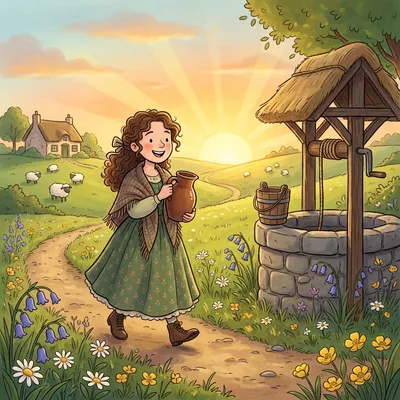
 Ireland
 Irish Nursery Rhyme
Original Lyrics
Cá bhfuil tú ag dul chomh moch?
Ag dul go dtí an tobar
Le mo chrúiscín a líonadh le h-uisce
Ó ró mo chailín donn
Ó ró mo chailín aerach
Ó ró mo chailín donn
Tá mo chroí istigh i ngrá leat
Tá do shúile mar an spéir ghorm
Tá do ghruaig mar an ór buí
Is dá mbeinn im' fhear saibhir
Ba tú mo stór is mo mhian
English Translation
Where are you going so early?
Going to the well
To fill my jug with water
Oh my brown-haired girl
Oh my merry girl
Oh my brown-haired girl
My heart is in love with you
Your eyes are like the blue sky
Your hair is like the yellow gold
And if I were a wealthy man
You'd be my treasure and my desire
Translation Notes
Grammar Notes
The Vocative Case (An Tuiseal Gairmeach) Irish has a special grammatical case for directly addressing people: - cailín (girl, nominative) → a chailín (oh girl, vocative) - The particle a introduces the vocative and causes lenition (adding 'h')
Genitive Construction To describe someone by a characteristic, Irish uses genitive construction: - na gruaige doinne = of the brown hair (literally) - gruaig (hair, nominative) → gruaige (of hair, genitive) - donn (brown) → doinne (brown, genitive feminine)
Questions with Eclipsis Question words containing certain consonants cause eclipsis: - fuil (are, from "tá") → cá bhfuil (where are) - The bh is inserted before f and pronounced "w"
Purpose Construction Irish shows purpose (in order to/for the purpose of) with a + verbal noun: - a líonadh = to fill, for filling - mo chrúiscín a líonadh = to fill my jug
Vocabulary
Cailín = Girl (plural: cailíní) Gruaig = Hair Donn/dhonn = Brown, dark (lenited form) Folt = Hair (poetic/literary term) Fada = Long Buí = Yellow, golden Súile = Eyes (plural of "súil") Gorm/ghorm = Blue, green (lenited form) Spéir = Sky Cá bhfuil = Where are (question form with eclipsis) Ag dul = Going (progressive aspect) Chomh moch = So early Tobar = Well (water source) Crúiscín = Little jug, pitcher (diminutive of "crúisc") A líonadh = To fill Aisling = Vision, dream; vision poem genre Ór = Gold Ros = Rose (botanical); headland Sean-nós = Old style (particularly of unaccompanied singing)
History and Meaning
"Cailín na Gruaige Doinne" (The Girl with the Brown Hair) is a traditional Irish love song that has been cherished for generations, both as a slow air (instrumental melody) and as a sung piece expressing longing and devotion. Often simplified and adapted for children, the song introduces young learners to traditional Irish romantic poetry while teaching descriptive vocabulary and the gentle beauty of the Irish language.
Origins
"Cailín na Gruaige Doinne" belongs to the rich tradition of Irish folk songs, with its composer attributed as "Traditional," indicating that it emerged from Ireland's oral tradition rather than being composed by a single known author. The song has been passed down through
generations of Irish singers, particularly in Gaeltacht (Irish-speaking) regions, and has been recorded by numerous acclaimed artists including The Chieftains, whose version dates back to 1964, and renowned piper Liam O'Flynn.
The "brown-haired girl" or "dark-haired girl" (cailín donn) is an archetypal figure in Irish romantic poetry and song, appearing in countless traditional pieces. Ireland's literary tradition, from medieval bardic poetry through to modern sean-nós singing, has long celebrated physical beauty through specific descriptive conventions—praising hair color (particularly dark or golden hair), eye color (blue or grey), rosy cheeks, and graceful bearing.
There is a related but distinct song titled "Cailín na Gruaige Báine" (The Fair-Haired Girl), attributed to Seaghán Bán Mac Grianna from Ranafast, Donegal, which is sometimes confused with "Cailín na Gruaige Doinne." Both songs follow similar thematic patterns, demonstrating how traditional Irish songs often exist in multiple variants celebrating different types of beauty.
Meaning & Interpretation
"Cailín na Gruaige Doinne" is fundamentally a love song expressing admiration and longing for a beautiful young woman. The song reflects traditional Irish rural courtship customs, where young people might meet at communal gathering places such as holy wells, crossroads, local fairs, or while performing daily chores like fetching water from the village well.
The image of a girl going to the well (tobar) to fetch water with her jug (crúiscín) represents daily life in rural Ireland before modern plumbing, when water was drawn from community wells, natural springs, or rivers. These water-gathering trips provided socially acceptable opportunities for young women to leave their homes and for young men to encounter them—hence the frequent appearance of wells and water sources in Irish courtship songs.
In Irish poetic tradition, specific physical features carry symbolic and aesthetic meaning. Brown or dark hair (gruaig dhonn) represents the classic Irish coloring and is praised as both beautiful and distinctively Irish. Blue eyes (súile gorma) and rosy cheeks complete the traditional portrait of Irish beauty. Some versions use imagery comparing the beloved's hair to gold (ór buí) and eyes to the blue sky (spéir ghorm)—classic Gaelic romantic metaphors that teach children the language's poetic possibilities.
While the song contains romantic themes of courtship and admiration, it is presented in such a gentle, respectful, and innocent way that it remains appropriate for children. The focus on descriptive beauty and respectful address models how traditional Irish culture expressed romantic interest through carefully crafted, poetic language rather than direct declaration.
Cultural Significance
"Cailín na Gruaige Doinne" connects to deeper strands of Irish literary tradition, particularly the aisling (vision poem) genre that flourished in Irish poetry from the 17th through 19th centuries. In aisling poetry, Ireland itself was often personified as a beautiful woman—famous incarnations include Róisín Dubh (Little Dark Rose or Dark Rosaleen) and Caitlín Ní Uallacháin (Cathleen Ní Houlihan)—who appeared to the poet in a vision, representing Ireland's suffering under colonization and hope for liberation. While "Cailín na Gruaige Doinne" is a simpler love song, it echoes these deeper cultural associations where describing a beautiful dark-haired woman carries layers of national and cultural meaning.
The song is taught in Gaelscoileanna (Irish-language schools) and is popular in Irish traditional music sessions. Its slow, lyrical melody makes it suitable for either singing or instrumental performance, and it serves as an excellent introduction to traditional Irish slow airs—a distinctive musical form characterized by ornamented, expressive melodies that allow singers or musicians to display their emotional interpretation.
Educational Value
For children learning Irish, "Cailín na Gruaige Doinne" offers multiple benefits:
- Descriptive vocabulary: Learning words for physical features, colors, and beauty
- Vocative case practice: Addressing someone directly (a chailín = oh girl)
- Poetic language: Exposure to metaphorical and descriptive Irish expression
- Cultural literacy: Understanding traditional Irish aesthetic values and courtship customs
- Musical heritage: Connecting to the sean-nós tradition and slow air performance
- Historical context: Learning about pre-modern Irish rural life (water wells, community gathering)