

Dúlamán
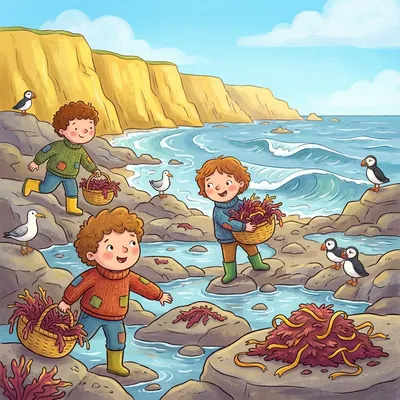

Irish Nursery Rhyme
Original Lyrics
Dúlamán na binne buí, dúlamán GaelachDúlamán na farraige, b'fhearr a bhí in Éirinn
Tá ceann buí óir ar an dúlamán gaelachTá dhá chluais mhaol ar an dúlamán gaelach
Góide a thug na tíre, dúlamán na binne buíArsa an dúlamán gaelach
Rachaimíd síos i lár na dtrá, dúlamán na binne buíAg cruinniú na dúlam
English Translation
Seaweed from the yellow cliff, Irish seaweedSeaweed from the ocean, the best in Ireland
There's a golden yellow head on the Irish seaweedThere are two blunt ears on the Irish seaweed
What brings you to the shore, seaweed from the yellow cliffSays the Irish seaweed
We'll go down into the middle of the beach, seaweed from the yellow cliffGathering the seaweed
Translation Notes
What Irish vocabulary is featured in the song?
Dúlamán = Seaweed, particularly dulse or channel wrack; colloquially can mean "dimwit" Dulse = Edible red seaweed (Palmaria palmata) Binn = Peak, cliff Buí = Yellow Na binne buí = Of the yellow cliff Gaelach = Irish, Gaelic Maorach = Shellfish-related; a type of edible seaweed B'fhearr = Was better, was best (past copula + comparative) In Éirinn = In Ireland (genitive case) Tonn = Wave Carraig = Rock, cliff Trá = Beach, shore Taoide íseal = Low tide Muir = Sea Cósta = Coast Feamainn = Seaweed (general term) Gaeltacht = Irish-speaking region
History and Meaning
"Dúlamán" is a love song disguised as a conversation between two kinds of seaweed. Behind the work-song surface, the edible seaweed wants to marry the daughter of the dye-seaweed, and the father is having none of it. Clannad made the song world-famous in 1976, but it goes back centuries, to the women and children who gathered seaweed off the rocks of the Atlantic coast at low tide.
What are the origins of the song Dúlamán?
"Dúlamán" is a traditional song from Ireland's coastal communities, with deep roots in the oral tradition of Gaeltacht regions, particularly along the Atlantic coast where seaweed harvesting was a vital part of subsistence living. The word "dúlamán" itself is Irish for "channel wrack" or "dulse," referring to edible seaweed species, particularly Palmaria palmata (dulse), which grows abundantly on rocky shores.
The song gained international prominence in 1976 when the Irish band Clannad, from Gweedore, County Donegal, released their third studio album titled "Dúlamán" with the traditional song as its opening track. Clannad's haunting arrangement, featuring close harmonies and atmospheric instrumentation, played a crucial role in popularizing the song during the 1970s folk revival. The album is often regarded as the peak of Clannad's early, more traditional sound, before they later moved toward more contemporary styles.
Clannad initially focused on rearranging traditional Irish songs sung in Irish Gaelic, bringing ancient melodies to new audiences while preserving the language and cultural heritage. Other artists who have performed "Dúlamán" include Altan, another renowned traditional group from Donegal, ensuring the song's continued presence in Irish music sessions and festivals worldwide.
The song's origins likely date back several centuries, emerging from the lived experience of coastal communities where seaweed gathering was essential work, often performed by women and children at low tide. The rhythmic, repetitive nature of the song would have helped coordinate work and pass the time during this labor-intensive activity.
What is the meaning and interpretation of the lyrics?
At its surface level, "Dúlamán" describes the harvesting of seaweed from the rocky shores and cliffs ("na binne buí," meaning the yellow cliffs) of Ireland's Atlantic coast. The lyrics reference two types of seaweed: "Dúlamán gaelach" (Irish seaweed, used for dyeing cloth) and "Dúlamán maorach" (an edible variety). These two types of seaweed also serve as personified characters in the song's narrative.
The song contains a playful courtship story woven throughout the seaweed imagery. In the fuller versions of the song, Dúlamán Maorach wishes to marry the daughter of Dúlamán Gaelach. Despite the father's objections, the couple elopes, creating a humorous romantic subplot that would have entertained workers during long hours of harvesting.
Interestingly, some interpretations suggest deeper satirical meaning. In the Ulster dialect, "dúlamán" can also mean "dimwit" or "idiot," potentially adding a layer of social commentary or humor to the song's traditional narrative. This double meaning allows the song to work both as a straightforward work song and as a more subversive piece of folk humor.
The refrain "b'fhearr a bhí in Éirinn" (the best that was in Ireland) expresses pride in Irish seaweed and, by extension, in Irish coastal traditions and the resourcefulness of Irish communities who made use of every natural resource available to them.
What is the cultural significance of dulse harvesting in Ireland?
Coastal Irish communities have harvested seaweed for over 1,500 years, with the earliest written mention by an Irish monk dating back over 1,400 years. Dulse and other seaweeds served multiple vital purposes:
Food Source: Dulse was eaten fresh, dried, or cooked, providing essential nutrients, particularly during times of scarcity. It remains popular in parts of Ireland, particularly County Down, where it is sold as a snack or culinary ingredient.
Fertilizer: Seaweed enriched poor coastal soils, allowing communities to grow crops in otherwise unproductive land. It was particularly valuable for potato cultivation.
Medicine and Animal Feed: Various seaweeds were used in traditional remedies and as nutritious livestock feed.
Dyeing: Certain varieties produced dyes for coloring cloth and yarn.
Traditional Harvesting Methods: Dulse harvesting remains largely unchanged from ancient practices. Harvesters work at low tide, using shears or scissors to cut mature fronds just above the holdfast (the part anchoring the seaweed to rocks), leaving the base intact to allow regrowth. Sustainable practices dictate harvesting no more than one-third of any plant. After collection, dulse is rinsed in clean seawater and dried on racks, either through solar drying or in dehydrators at controlled temperatures (around 35-40°C), until it achieves a leathery texture. This slow, low-temperature process preserves the seaweed's distinctive smoky flavor, color, and vitamins.
While dulse harvesting continues today, the industry faces challenges. The work is labor-intensive, weather-dependent, and physically demanding, resulting in fewer people willing to engage in this traditional practice despite continued demand for Irish seaweed products.
What is the educational value of Dúlamán for children?
"Dúlamán" teaches children about:
- Coastal ecology: Understanding Ireland's marine environment and edible seaweeds.
- Traditional foodways: How Irish communities used natural resources for survival.
- Maritime heritage: The importance of the sea in Irish cultural and economic life.
- Sustainable harvesting: Traditional ecological knowledge about resource management.
- Work songs: How music coordinated labor and made difficult work more bearable.
- Language preservation: Irish vocabulary related to coastal life and natural resources.
What are the key grammar concepts in the song?
The Genitive Case (An Tuiseal Ginideach) Irish uses the genitive to show possession and relationship:
- an binn (the peak, nominative) → na binne (of the peak, genitive)
- Éire (Ireland, nominative) → in Éirinn (in Ireland, genitive with eclipsis)
The Copula (An Chopail) Irish distinguishes between the copula "is" (for identification and classification) and "tá" (for states and locations):
- Is é... = It is... (identification)
- Tá sé... = He/it is... (state or location)
- b'fhearr = was better/best (past tense copula + comparative adjective)
Lenition in Comparatives The copula in past tense causes lenition:
- is fearr (is better) → b'fhearr (was better)
- The f is lenited to fh (silent) and contracts with the copula.
Lyrics from nurseryrhymes.info