
Ambarabà Ciccì Coccò

Italian Nursery Rhyme
Original Lyrics
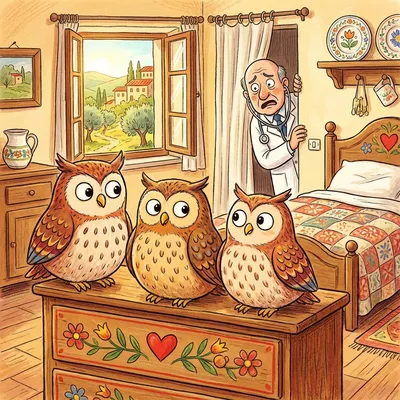
Ambarabà ciccì coccòTre civette sul comòChe facevano l'amoreCon la figlia del dottore;Il dottore si ammalòAmbarabà ciccì coccò!
English Translation
Ambarabà ciccì coccòThree owls on the dresserWho made loveWith the doctor's daughter;The doctor fell illAmbarabà ciccì coccò!
Translation Notes
Vocabulary
Ambarabà ciccì coccò - nonsense words; possibly derived from corrupted ancient Latin
tre - three (number)
civette - owls (literally); also "flirts" or "seductive women" (figurative meaning since Middle Ages)
- Singular: civetta = little owl / flirtatious woman
sul - on the (contraction of su + il)
- Su = on
- Il = the (masculine)
comò - dresser, chest of drawers (from French commode, entered Italian ~1700s)
che - who, that (relative pronoun)
facevano - they made, they did (imperfect tense, third person plural of fare, "to do/make")
l'amore - love (preceded by definite article l')
- Fare l'amore = to make love, to court, to have romantic relations
con - with (preposition)
la figlia - the daughter
del - of the (contraction of di + il)
dottore - doctor
il dottore - the doctor
si ammalò - he fell ill, he became sick
- Reflexive verb from ammalarsi (to fall ill, to become sick)
- Passato remoto (simple past) tense, suggesting a completed action in the past
Grammar Notes
Contractions of Prepositions + Articles: Italian contracts prepositions with definite articles:
- Sul = su (on) + il (the masculine) = on the
- Del = di (of) + il (the masculine) = of the
- Con la = with the (feminine); note con doesn't contract with la
Relative Pronoun "Che": Che (who, that, which) introduces relative clauses: "tre civette... che facevano" (three owls... who made).
Imperfect Tense "Facevano": The imperfect tense (facevano) describes ongoing or habitual past actions: "they were making" or "they used to make." This contrasts with the simple past (si ammalò) which describes a completed action.
Reflexive Verb "Ammalarsi": Italian uses reflexive verbs for many actions affecting oneself:
- Ammalare = to make sick (transitive)
- Ammalarsi = to become sick, to fall ill (reflexive)
- Si ammalò = he became sick (himself)
Passato Remoto "Si ammalò": This is the passato remoto (simple past/preterite), used for completed actions in the distant past or in formal/literary contexts. In modern spoken Italian, passato prossimo (si è ammalato) would be more common, but rhymes often preserve older verb forms.
Definite Article with Body Parts/Possessions: Italian uses the definite article where English uses possessive adjectives: "la figlia del dottore" (the doctor's daughter) rather than "his daughter."
"Fare l'amore": This idiomatic expression literally means "to make the love" but translates as "to make love" or "to court." The use of the definite article (l') is required in Italian.
Circular Structure: The rhyme's return to "Ambarabà ciccì coccò" at the end creates a perfect circle, allowing children to repeat it indefinitely while counting. This circular structure is characteristic of counting-out rhymes across many cultures, ensuring no predetermined endpoint that could advantage or disadvantage particular children.
History and Meaning
"Ambarabà Ciccì Coccò" is Italy's "Eeny, meeny, miny, moe," a counting-out rhyme for deciding who is "it." The words are mostly nonsense, three owls on a dresser, a doctor's daughter, the doctor falling ill, but they have drawn serious attention: one linguist traces the opening line to garbled Latin, and Umberto Eco wrote a whole essay treating the rhyme as an alien artifact to be decoded.
Origins and Etymology
The precise origin of "Ambarabà Ciccì Coccò" remains uncertain, but linguistic and cultural evidence suggests it may be several centuries old, with possible roots extending back to ancient Rome. The rhyme belongs to the genre of filastrocche, Italian counting-out rhymes used by children in games to determine who will take a particular role or go first.
The most intriguing aspect is the seemingly nonsensical opening: "Ambarabà ciccì coccò." For generations, Italian children simply accepted these as meaningless syllables chosen for their rhythmic and musical qualities. However, in a 2003 linguistic study, scholar Vermondo Brugnatelli proposed a fascinating etymology: the phrase may derive from the ancient Latin "HANC PARA AB HAC QUIDQUID QUODQUOD," which roughly translates to "prepare this (hand) from this other (which is counting)" or "repair this (hand) from that other (that is counting)."
If Brugnatelli's hypothesis is correct, this would directly connect the rhyme to its historical use in counting games, where children would point to each participant in turn, moving from "this hand" to "that hand" while counting. The Latin phrase would have been progressively corrupted through centuries of oral transmission by children who didn't understand Latin, eventually becoming the musical nonsense syllables we know today. This linguistic transformation, from meaningful Latin to pure sound, would demonstrate how children's oral traditions preserve rhythms and phonetic patterns even while losing original semantic content.
The presence of "comò" (dresser/chest of drawers) in the rhyme provides a terminus post quem (earliest possible date): the word "comò" entered Italian from French around the 1700s, suggesting that the current version of the rhyme, at least the "tre civette sul comò" portion, likely dates to no earlier than the 18th century, though earlier versions may have existed with different imagery.
The earliest known literary attestation of the rhyme with its current words dates to 1972, though oral tradition clearly predates this by many generations.
Meaning & Interpretation
While "Ambarabà Ciccì Coccò" is primarily functional, designed for counting games rather than storytelling , its seemingly absurd narrative has attracted scholarly interpretation:
"Ambarabà ciccì coccò" Possibly corrupted ancient Latin for counting preparation (see Origins above); functions as musical nonsense syllables
"Tre civette sul comò" (Three owls on the dresser)
This surreal image introduces the rhyme's bizarre world. The word "civetta" in Italian has a double meaning: it literally means "owl" (specifically a little owl), but since the Middle Ages, it has also been used figuratively to describe a seductive or coquettish woman. Some interpretations suggest the "three owls" might actually represent three perfume bottles on a dresser, subtly alluding to femininity, vanity, and seduction within what appears to be a children's rhyme, a coded adult joke hidden in plain sight.
Why owls rather than other animals? Owls have long been associated with both wisdom and mischief in European folklore, making them perfect protagonists for a whimsical rhyme.
"Che facevano l'amore / Con la figlia del dottore" (Who made love / With the doctor's daughter)
This provocative line has sparked debate. A recent online rumor suggested the original text contained "che facevano timore alla figlia del dottore" (who frightened the doctor's daughter) instead of "facevano l'amore" (made love). However, this has been thoroughly debunked: the earliest literary attestation (1972) already uses "l'amore," and the "timore" version appeared only as an unsubstantiated Wikipedia edit in 2019.
In the context of children's rhymes, "facevano l'amore" should likely be understood more innocently than its literal translation suggests, perhaps meaning "courted" or "flirted with" rather than explicit sexual activity. The double meaning of "civette" as both owls and seductive women enriches this interpretation.
"Il dottore si ammalò" (The doctor fell ill)
The narrative reaches its conclusion: the doctor, presumably the father, fell ill. Is this from stress over his daughter's romantic entanglements? From the shock of discovering owls (or seductive women) in his house? From jealousy? The rhyme doesn't say, leaving the cause-and-effect relationship delightfully ambiguous.
The circular structure: The rhyme then loops back to "Ambarabà ciccì coccò," creating an infinite cycle perfect for counting games.
Umberto Eco's Analysis
The famous Italian writer and semiotician Umberto Eco (1932-2016) dedicated a paradoxical semiotic essay to "Ambarabà Ciccì Coccò" in his 1992 work "Il secondo diario minimo" (The Second Minimal Diary). Eco's essay analyzed the rhyme as if it were an expression of an alien culture whose language and customs we must decode.
Eco highlighted the rhyme's progression from:
- Obscure, invented words ("Ambarabà ciccì coccò") that resist interpretation
- Surreal imagery (three owls on furniture) that defies everyday logic
- Narrative sequence (owls make love with doctor's daughter, doctor falls ill) that, while seemingly illogical, follows a recognizable cause-and-effect pattern
Eco's analysis demonstrated how the rhyme creates its own internal logic and world, one that children accept without question. The juxtaposition of nonsense, surrealism, and narrative structure makes the rhyme both meaningless (as a pure counting device) and rich with interpretive possibility (as a cultural artifact).
Cultural Significance
"Ambarabà Ciccì Coccò" has been passed down through oral tradition for generations, creating powerful continuity in Italian childhood culture. Its enduring popularity stems from several factors:
Perfect Counting Structure: The rhyme's rhythm and syllable pattern make it ideal for pointing to each child in turn, with the circular structure allowing indefinite repetition until someone is selected.
Memorability: The nonsense syllables, unusual imagery, and narrative absurdity make the rhyme extremely memorable, precisely because it doesn't make conventional sense.
Oral Tradition: Like "Eeny, meeny, miny, moe" in English or "Am, stram, gram" in French, the rhyme has survived entirely through children teaching it to other children, demonstrating the power of oral transmission.
Cultural Touchstone: Virtually every Italian knows this rhyme, creating shared cultural memory across regions and generations.
Scholarly Interest: The rhyme has attracted serious academic attention (Brugnatelli's linguistic analysis, Eco's semiotic essay), elevating a children's game into an object of scholarly inquiry.
Variations
While the most common version uses "tre civette" (three owls), regional and personal variations exist:
- "Tre galline sul comò" (three hens on the dresser)
- "Tre scimmiette sul comò" (three little monkeys on the dresser)
These variations maintain the rhyme's structure while substituting different animals, though the owl version remains dominant throughout Italy.
Lyrics from nurseryrhymes.info