

Funiculì Funiculà
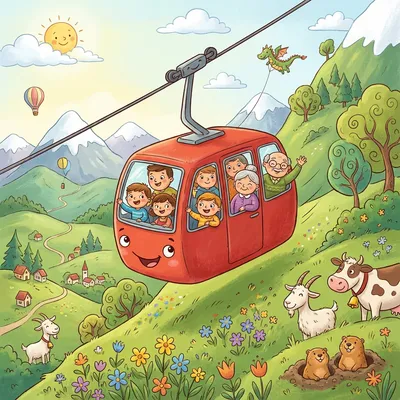


Italian Nursery Rhyme
Original Lyrics
Jammo, jammo, 'ncoppa, jammo ja',Funiculì, funiculà!
English Translation
Let's go, let's go, up we go, let's go now,Cable car, cable car!
Translation Notes
Vocabulary
jammo - let's go 'ncoppa - on top, up there ja' - let's go (abbreviation of jammo)
Grammar Notes
The lyrics are in Neapolitan, the language of Naples, which sounds quite different from standard Italian.
Neapolitan vs standard Italian: jammo is the Neapolitan form of andiamo (let's go). The dialect reshapes many everyday words, so a standard-Italian speaker recognises the song but would not write it this way.
Dropped sounds (the apostrophe): 'ncoppa (up there, on top) begins with an apostrophe because a sound has been clipped off the front, from something like in coppa. Neapolitan trims the starts and ends of words constantly, which is why so much of the song is dotted with apostrophes.
Shortening for rhythm: ja' is jammo cut short to fit the skipping beat. Songs lean on these little contractions to keep the line dancing.
History and Meaning
"Funiculì, Funiculà" started life as a jingle. When a funicular railway opened on the slopes of Mount Vesuvius in 1880, nervous tourists kept climbing the volcano on foot rather than trust the new cable car, so a composer and a journalist wrote this bouncing Neapolitan song to coax them aboard. It worked far too well: the advert outlived the railway and became one of the most recognisable tunes in the world.
Origins
The song was composed in 1880 by Luigi Denza, with Neapolitan lyrics written by the journalist Peppino Turco. Interestingly, the song was originally created as a promotional advertisement. The funicular railway on Mount Vesuvius had recently opened, but tourists and locals were hesitant to use the new technology, preferring to climb the volcano on foot or by donkey. Turco and Denza wrote the song to reassure the public and encourage them to ride the cable car. The song debuted at the Piedigrotta festival in Naples in 1880 and became a global sensation, selling over a million copies of sheet music in its first year.
Meaning & Interpretation
The lyrics are written in the Neapolitan dialect of Italian. They describe the excitement of traveling up to the summit of the volcano, leaving the ground behind to look at the beautiful city of Naples below. The title "Funiculì, Funiculà" is a play on the word "funicular," mimicking the sound of the cable car ascending the tracks. The song's cheerful tone reflects the nineteenth-century fascination with industrial progress and modern transportation.
What is the meaning of the title "Funiculì, Funiculà"?
The title is a playful variation of the word "funicular," which refers to a cable railway system. The song was written to celebrate the launch of the funicular railway on Mount Vesuvius, and the title mimics the sound of the ascending train.
Who composed the music for "Funiculì, Funiculà"?
The music was composed by Italian composer Luigi Denza in 1880. Denza was a prominent classical and popular composer from Naples who wrote hundreds of songs, but "Funiculì, Funiculà" remains his most enduring work.
Lyrics from nurseryrhymes.info