
Stella Stellina


Italian Nursery Rhyme
Original Lyrics
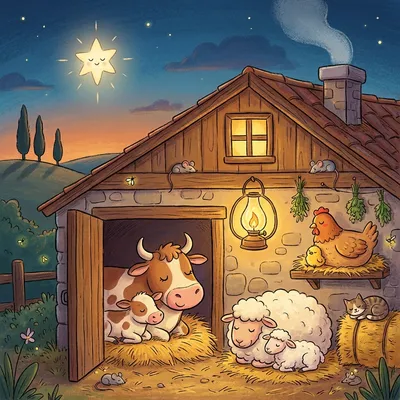
Stella, stellina,La notte s'avvicina.La fiamma traballa.La mucca è nella stalla.La mucca e il vitello,La pecora e l'agnello,La chioccia e il pulcino.Ognuno ha il suo bambino.Ognuno ha la sua mamma.E tutti fan la nanna!
English Translation
Star, little star,The night is approaching.The flame is flickering.The cow is in the stable.The cow and the calf,The sheep and the lamb,The mother hen and the chick.Each one has their little one.Each one has their mom.And everyone goes to sleep!
Translation Notes
Vocabulary
Stella, stellina = Star, little star (stellina is a diminutive form expressing affection) La notte s'avvicina = The night is approaching (from "avvicinarsi," to draw near) La fiamma traballa = The flame flickers/wavers La mucca = The cow È nella stalla = Is in the stable Il vitello = The calf La pecora = The sheep L'agnello = The lamb La chioccia = The mother hen (specifically a hen with chicks) Il pulcino = The chick Ognuno = Everyone, each one Il suo bambino = Their little one/baby La sua mamma = Their mom E tutti fan la nanna = And everyone goes to sleep (nanna is baby talk for sleep) Nel cuore della mamma = In their mother's heart
Grammar Notes
The diminutive "-ina": stella is "star," and stellina is its small, tender form, "little star." Italian adds -ino/-ina to make a word sound smaller and dearer, exactly the gentle tone a lullaby wants.
Reflexive verbs: la notte s'avvicina means "the night draws near." The verb is avvicinarsi (to approach), and the s' in front is a squeezed-down si, the reflexive marker, so the night is pictured bringing itself closer.
"Fan" (a clipped verb): e tutti fan la nanna means "and everyone goes to sleep." Fan is a shortened fanno (they do/make), trimmed to keep the line's rhythm. Fare la nanna literally "to do the sleep" is the cosy Italian way to say a little one is going to bed.
Mother-and-young pairs: the song lines up animal families, mucca and vitello (cow and calf), pecora and agnello (sheep and lamb), chioccia and pulcino (hen and chick). Italian, like English, often has a completely separate word for the baby animal, handy vocabulary tucked inside a bedtime song.
History and Meaning
Stella Stellina is the Italian goodnight song, the one parents let drop to a whisper as a child's eyes finally close. It watches night fall over a farm and puts every animal to bed beside its mother, the cow with her calf, the ewe with her lamb, the hen with her chick, until everyone, animals and children alike, is asleep. Unusually for a nursery song, we know exactly who wrote it: the poet Lina Schwarz, back in 1904.
What are the origins of Stella Stellina?
Unlike many traditional nursery rhymes whose origins are lost to time, Stella Stellina has a well-documented history. The lullaby was written by Lina Schwarz (1876 to 1947), an Italian poet, translator, and children's author affectionately known as "Aunt Lina" (Zia Lina). The song was first published in 1904 in her collection titled Il libro dei bimbi (The Book of Children).
Lina Schwarz dedicated much of her career to creating literature for children, publishing collections of lullabies, nursery rhymes, songs, and poems. Her work made significant contributions to Italian children's literature during the early twentieth century, a period when children's poetry was gaining recognition as an important literary genre. Stella Stellina later appeared in various school anthologies and educational books, including I Quindici, helping to cement its place in Italian cultural memory.
While some sources suggest the lullaby's themes and gentle rhythm reflect folk traditions from northern Italy, Schwarz's authorship is firmly established. Although it is a relatively modern addition to the canon of Italian children's songs, its simple structure makes it feel very traditional.
What is the meaning of Stella Stellina?
The lyrics of Stella Stellina evoke a peaceful bedtime scene as darkness falls and the "little star" (stella stellina) appears in the evening sky. The opening lines describe a flickering flame (la fiamma traballa), likely referring to a candle or lamp being dimmed for the night, creating an intimate, cozy atmosphere perfect for settling down to sleep.
The heart of the lullaby focuses on various farm animals returning to their shelters with their young: the cow (la mucca) is in the stable with her calf (il vitello), the sheep (la pecora) with her lamb (l'agnello), and the mother hen (la chioccia) with her chick (il pulcino). Some variations also include a cat with her kittens, expanding the theme of maternal care across different creatures.
The concluding verses deliver the lullaby's central message: "Ognuno ha il suo bambino. Ognuno ha la sua mamma. E tutti fan la nanna" (Everyone has their little one. Everyone has their mom. And everyone goes to sleep). Some versions add the tender line "nel cuore della mamma" (in their mother's heart), emphasizing the warmth and safety provided by maternal love.
This universal message reassures children that they are not alone in needing rest and comfort. Every living creature, from the smallest chick to human children, has a mother who cares for them and a safe place to sleep. The lullaby gently normalizes bedtime and separation anxiety by showing that all babies, whether human or animal, sleep peacefully knowing their mothers are near.
What is the cultural significance of Stella Stellina?
For over a century, Stella Stellina has been an integral part of Italian bedtime rituals. Italian parents, grandparents, and caregivers have sung this lullaby to calm restless children and create a peaceful transition from the activity of day to the stillness of night. The song's enduring popularity speaks to its emotional effectiveness and its perfect balance of simplicity and depth.
The lullaby is often one of the first songs Italian children learn, and many adults report powerful nostalgic associations with hearing it in their own childhoods. This intergenerational continuity creates a sense of connection across time, as parents sing to their children the same words their parents sang to them.
Stella Stellina is sometimes compared to "Twinkle, Twinkle, Little Star" due to its star imagery, but it is a distinctly Italian creation with its own character and message. The Italian adaptation of "Twinkle, Twinkle, Little Star" is "Brilla Brilla La Stellina," a different song entirely.
What is the educational value of Stella Stellina?
Beyond its function as a sleep aid, Stella Stellina offers several educational benefits for young children:
- Vocabulary building: The lullaby introduces children to names of farm animals and their young (cow/calf, sheep/lamb, hen/chick).
- Nature awareness: Children learn about the natural world and the relationships between mother animals and their offspring.
- Emotional security: The repeated theme of maternal care helps children feel safe and loved.
- Language rhythm: The gentle, repetitive structure helps Italian children develop an ear for their language's natural rhythms.
- Empathy development: By recognizing that all creatures need rest and care, children develop compassion for other living things.
The lullaby's agricultural imagery also connects urban Italian children to their country's rural traditions, maintaining cultural links to Italy's farming heritage even as society has become increasingly urbanized.
What is the musical character of the lullaby?
Stella Stellina has been set to various gentle melodies over the years, all designed to create a dreamy, calming ambiance. The song's meter and rhythm naturally lend themselves to slow, soothing musical settings that help lull children to sleep.
The lullaby is typically sung very softly and slowly, with the singer often getting progressively quieter as the song continues, mirroring the child's gradual descent into sleep. Many parents report singing the final lines almost in a whisper, as if sharing a secret with their drowsing child.
Lyrics from nurseryrhymes.info