

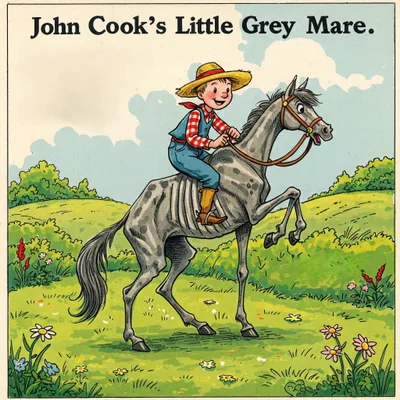
John Cook Had a Little Grey Mare
 1784
1784  England
 Lyrics
Her back stood up, and her bones they were bare; he, haw, hum!
John Cook was riding up Shuter's bank; he, haw, hum!
And there his nag did kick and prank; he, haw, hum!
John Cook was riding up Shuter's hill; he, haw, hum!
His mare fell down, and she made her will; he, haw, hum!
The bridle and saddle were laid on the shelf; he, haw, hum!
If you want any more you may sing it yourself; he, haw, hum!
History and Meaning
This traditional English nursery rhyme has strong geographical roots in South London, specifically referencing Shooter's Hill at Blackheath. The name originates from medieval England when all adult men were required to practice archery with bows and arrows. Shooter's Hill marks a prominent high point along the ancient Roman road Watling Street, which connected London with settlements in North Kent.
The route became well-known in later centuries as a path for horse-drawn mail coaches, and Charles Dickens famously described mail coaches "lumbering up Shooter's Hill" in his novel "A Tale of Two Cities." The area also had a darker history: Gibbet Field on Shooter's Hill served as a site for public executions, where convicted criminals' bodies were left on display as a warning. Samuel Pepys noted this grim sight in his diary in 1661.
While "John Cook" doesn't appear to be a specific historical figure, the rhyme captures the challenging nature of traversing this steep, historically significant hill. The playful ending—"If you want any more, you may sing it yourself"—invites children to make up their own verses, a common feature in interactive nursery rhymes.