
Little Arabella Miller
 20th century
  USA
USA Lyrics
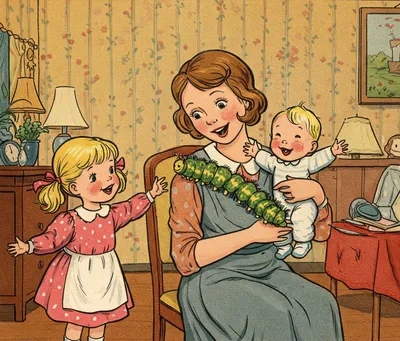
Found a furry caterpillar
First it climbed upon her mother
Then upon her baby brother
"Ugh" said Arabella Miller
"Take away that caterpillar!"
History and Meaning
"Little Arabella Miller" is a popular English nursery rhyme and action song about a girl who finds a caterpillar. While its exact origin remains unknown, Ann Elliott has been cited as a composer for one version.
First Recorded Appearances
The rhyme dates back at least to 1971, when it was mentioned in "Games for the Very Young: Finger Plays and Nursery Games" by Elizabeth Mary Matterson. It appeared again in Dorothy Pinsky's "Finger Plays and Action Verses for Children" in 1977, establishing it as a recognized part of the nursery rhyme tradition by the mid-20th century.
The Familiar Tune
The song is set to the famous melody of "Twinkle, Twinkle, Little Star," which originated as the 18th-century French song "Ah! vous dirai-je, Maman." This shared melody connects "Little Arabella Miller" to a family of nursery rhymes including "Baa, Baa, Black Sheep" and the Alphabet Song.
Variations in Lyrics
The rhyme typically consists of a single verse, though the exact words vary between versions. Common variations include:
- The caterpillar is described as "furry," "fuzzy," "woolly," or "hairy"
- The caterpillar climbs on different family members: mother, brother, baby brother, or grandmother
- Some versions have Arabella saying "Ugh!" while others have "Shoo!"
An Action Song
What makes "Little Arabella Miller" particularly engaging for young children is its use as an action song. Common accompanying movements include:
- Wiggling a finger to represent the caterpillar crawling
- Walking fingers up arms or backs of others when the caterpillar "climbs"
- Making tickling motions during the climbing verses
- Waving hands to shoo away the caterpillar at the end
Extended Versions
Some expanded versions of the song follow the caterpillar's life cycle, continuing the story through its transformation into a chrysalis and emergence as a butterfly. These educational adaptations make the rhyme useful for teaching children about metamorphosis and nature.
Educational Value
Beyond entertainment, the rhyme serves several educational purposes:
- Science: Introduces children to caterpillars and, in extended versions, the life cycle of butterflies
- Body Awareness: The tickling and climbing actions help develop body awareness
- Natural World Respect: Some educators use the rhyme to discuss appropriate interactions with insects, noting that hairy caterpillars can sometimes cause skin irritation
- Social Skills: The rhyme can be used to discuss personal boundaries and asking before touching others