

Little Bo-Peep
 1805
1805  England
 Lyrics
And doesn't know where to find them;
Leave them alone, and they'll come home,
Wagging their tails behind them.
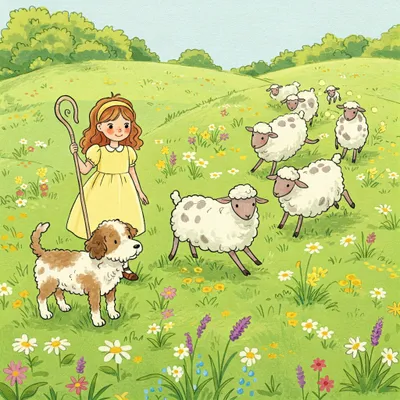
Little Bo-Peep fell fast asleep,
And dreamt she heard them bleating;
But when she awoke, she found it a joke,
For they were still a-fleeting.
Then up she took her little crook,
Determined for to find them;
She found them indeed, but it made her heart bleed,
For they'd left their tails behind them.
It happened one day, as Bo-Peep did stray
Into a meadow hard by,
There she espied their tails side by side,
All hung on a tree to dry.
She heaved a sigh and wiped her eye,
And over the hillocks went rambling,
And tried what she could, as a shepherdess should,
To tack each again to its lambkin.
History and Meaning
"Little Bo Peep" is a well-known English nursery rhyme whose first verse was recorded in a manuscript around 1805, with additional verses appearing in "Gammer Gurton's Garland or The Nursery Parnassus" around 1810.
The Name "Bo-Peep"
The term "bo-peep" has older roots than the rhyme itself. It appeared in the 16th century as a children's game similar to peek-a-boo. Even earlier, in the 14th century, the term was used to describe the punishment of being placed in a pillory—a decidedly darker origin for such a playful word.
The Full Story
While most people know only the first verse about Bo Peep losing her sheep, the complete rhyme tells a more complex story. The sheep eventually return, but they have lost their tails, which are later found "hung on a tree to dry." This gruesome detail adds an unexpectedly dark element to what seems like a simple children's tale.
The Smuggling Theory
One intriguing theory connects the rhyme to 17th-century smuggling activities during the reign of King Charles I. In this interpretation:
- "Bo Peep" refers to customs officers watching from elevated positions
- The "sheep" represent smugglers
- The lost "tails" symbolize contraband that was abandoned to avoid capture
There is even a tower in St Leonards, Sussex, called "Bo Peep" that was reportedly used by customs officers to watch for and imprison smugglers, lending some credibility to this theory.
Symbolism of the Lost Sheep
The lost sheep in the rhyme carry rich symbolic meanings:
- Innocence and Vulnerability: The sheep represent those under one's care
- Responsibility: Bo Peep's loss reflects the weight of stewardship
- Irreparable Damage: The lost tails suggest that some losses cannot be fully recovered, even when what was missing returns
Religious Parallels
Some interpretations draw parallels between Bo Peep's lost sheep and biblical parables, particularly Jesus' parable of the lost sheep, where straying sheep symbolize sinners who are ultimately found and welcomed back into the fold.
A Moral Lesson
The rhyme also functions as a cautionary tale about a shepherd who loses her flock due to inattention—specifically by falling asleep on the job. This simple moral about responsibility has helped the rhyme endure as an educational tool for centuries.