
Nuts in May
 1894
1894  England
 Lyrics
Nuts in May, nuts in May,
Here we go gathering nuts in May,
On a cold and frosty morning.
Who will you have for nuts in May,
Nuts in May, nuts in May,
Who will you have for nuts in May,
On a cold and frosty morning.
We'll have [insert name] for nuts in May,
Nuts in May, nuts in May,
We'll have [insert name] for nuts in May,
On a cold and frosty morning.
Who will you have to take her away,
Take her away, take her away,
Who will you have to take her away,
On a cold and frosty morning.
We'll have [insert name] to take her away,
Take her away, take her away,
We'll have [insert name] to take her away,
On a cold and frosty morning.
History and Meaning
This traditional English singing game was first documented in the latter half of the 19th century, appearing in the Folk-Lore Record in 1881. However, its roots likely extend back to ancient pagan May Day celebrations involving fertility rituals and courtship customs.
The rhyme contains a famous linguistic mystery: the phrase "nuts in May" is almost certainly a corruption of "knots in May." This makes much more sense, as nuts don't ripen in May—they're an autumn harvest. "Knots" refers to posies, bunches, or garlands of hawthorn blossoms, also known as "may-blossom" or "mayflower." Young people would gather these flowers on May Eve to create posies for those they hoped to court, making this a traditional matchmaking activity.
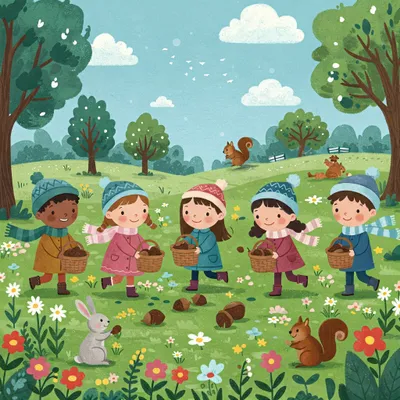
The children's game involves two facing teams who advance and retreat while singing, eventually "pulling" a chosen child from one team to the other, often pairing a boy and girl—echoing those ancient courtship themes. The puzzling line "on a cold and frosty morning" in May likely refers to the very early dawn hours when people would go out to gather the blossoms, though some versions substitute "on a fine summer's morning" or "on a May morning early."