

Peter Peter Pumpkin Eater
 1825
1825  USA
USA Lyrics
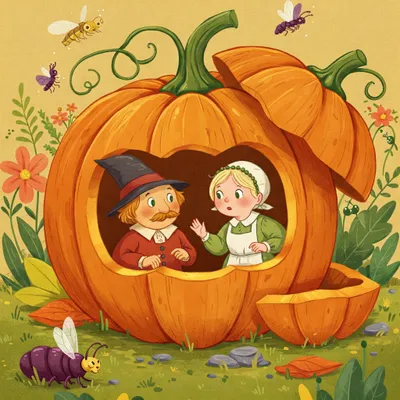
Had a wife but couldn't keep her;
He put her in a pumpkin shell
And there he kept her very well.
History and Meaning
"Peter Peter Pumpkin Eater" is a nursery rhyme that originated in England, with its earliest known printed version appearing around 1797 in London in a publication titled "Infant Institutes, part the first: or a Nurserical Essay on the Poetry, Lyric and Allegorical, of the Earliest Ages," and later making its way to the United States around 1825 in "Mother Goose's Quarto: or Melodies Complete" published in Boston. On the surface, the rhyme tells the story of Peter, who, unable to keep his wife, places her inside a pumpkin shell where he keeps her "very well," with themes often associated with control in marriage and attempting to resolve situations through confinement rather than communication. However, several darker interpretations have emerged over time: one suggests the "pumpkin shell" is a euphemism for a chastity belt used to control an unfaithful wife, while another more grim theory posits that Peter murdered his unfaithful wife and hid her body inside a hollowed-out pumpkin. An older Scottish variant of the rhyme, published in 1868, is more explicit and does not mention pumpkins at all, instead describing Peter putting his wife "i' the wa', and lat a' the mice eat her" ("in the wall, and let all the mice eat her"), which some folklore scholars have linked to historical events such as the imprisonment and death of Maud de Braose in 1210 under King John of England. Despite these dark interpretations, the rhyme remains a staple of children's literature, though its underlying themes continue to provoke discussion about historical attitudes toward marriage and control.