

Pinocchio
 1883
1883  Italy
Italy Story
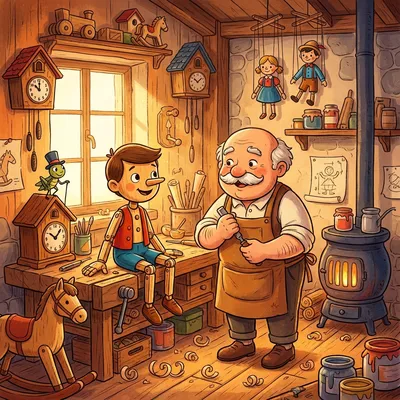
Once upon a time, in a small Italian village, there lived a lonely woodcarver named Geppetto. He had no children, so one evening he carved a little wooden puppet and named him Pinocchio. That night, a Blue Fairy appeared and brought the puppet to life!
"Be good, be brave, and always tell the truth," the Blue Fairy told Pinocchio. "If you prove yourself to be a good boy, you may become a real boy someday!" She assigned a wise little Cricket to be his conscience and guide him.
Geppetto was overjoyed to have a son! He sold his only coat to buy Pinocchio a schoolbook and sent him off to learn. But along the way, Pinocchio was tempted by a sly Fox and Cat who promised him easy riches. He forgot about school and followed them instead.
Poor Pinocchio fell into many troubles because he didn't listen to his conscience. He told lies, and whenever he did, his wooden nose grew longer and longer! He was captured by a puppet master, tricked by villains, and even turned into a donkey when he went to the Land of Toys instead of going to school.
Through it all, the Blue Fairy watched over him. Each time Pinocchio got into trouble, she helped him, and each time he made better choices. He began to learn his lessons.
Then Pinocchio learned that Geppetto had gone to sea searching for him and had been swallowed by a giant whale! Without hesitation, brave Pinocchio dove into the ocean. He swam and swam until he found the whale and was swallowed too!
Inside the whale, Pinocchio found Geppetto, weak but alive. Together they built a fire, and when the whale sneezed from the smoke, they escaped! Pinocchio pulled his father through the stormy sea all the way to shore.
The Blue Fairy was so proud of Pinocchio's bravery and love for his father that she granted his wish. When Pinocchio woke the next morning, he was no longer made of wood. He had become a real boy at last! Geppetto and Pinocchio lived happily together, their little home filled with love and laughter.
History and Meaning
Pinocchio was written by Italian author Carlo Collodi and first published as a serial story in 1881-1883. The tale first appeared in a children's newspaper called "Il Giornale per i Bambini" (The Newspaper for Children).
The original story is darker than most adaptations, with Collodi using it to teach moral lessons about the dangers of laziness, disobedience, and dishonesty. Pinocchio's growing nose when he lies has become one of the most famous images in children's literature.
Walt Disney's 1940 animated film introduced the story to a worldwide audience and softened many of the harsher elements while keeping the core message about becoming a good person through honesty, bravery, and love.
The story teaches that our choices shape who we become. Pinocchio starts as a puppet controlled by his impulses, but through learning to be truthful, brave, and unselfish, he earns the right to become real. True humanity comes from character, not just having a human body.