

Atirei o pau ao gato
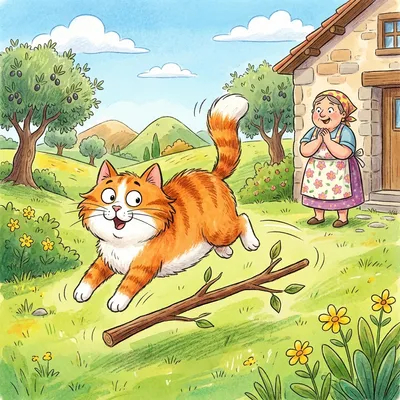
 Portugal/Brazil
 Portuguese Nursery Rhyme
Original Lyrics
Mas o gato-to
Não morreu-reu-reu
Dona Chica-ca
Admirou-se-se
Do berro, do berro
Que o gato deu: Miau!
English Translation
But the cat-cat
Did not die-ie-ie
Dona Chica-ca
Was amazed-azed
At the scream, the scream
That the cat gave: Meow!
Translation Notes
Line-by-Line Translation
Atirei o pau ao gato-to — "I threw the stick to the cat-cat" - Atirei = I threw (past tense of "atirar") - o pau = the stick - ao gato = to the cat - The repetition "-to" at the end is a playful rhythm device common in Portuguese children's songs
Mas o gato-to / Não morreu-reu-reu — "But the cat-cat / Did not die-ie-ie" - Mas = but - não morreu = did not die - The syllable repetition creates a bouncy, musical quality
Dona Chica-ca / Admirou-se-se — "Dona Chica-ca / Was amazed-azed" - Dona Chica = a title and name (Dona is like "Mrs." or "Lady") - Admirou-se = was amazed/surprised (reflexive verb)
Do berro, do berro / Que o gato deu: Miau! — "At the scream, the scream / That the cat gave: Meow!" - berro = scream/yell - que o gato deu = that the cat gave - Miau = Meow (onomatopoeia for cat sound)
History and Meaning
"Atirei o pau ao gato" is a traditional Portuguese nursery rhyme with popular origins, sung in both Portugal and Brazil. The song's authorship is unknown, having been passed down orally through generations of children, which has led to regional variations in its lyrics.
Cultural Significance
The song transmits elements of Portuguese oral tradition and reflects older ways of storytelling through rhyme. Like many traditional folk songs, it has traveled from Portugal to Brazil and other Portuguese-speaking regions, where it has been adapted and preserved as part of the shared cultural heritage.
Origins and Tradition
As one of the oldest and most recognized children's songs in the Portuguese tradition, "Atirei o pau ao gato" belongs to the genre of "cantigas de roda" (circle songs). These are traditional songs associated with children's games where participants hold hands and perform movements or choreographies that correspond to the lyrics.
The simple melody and repetitive structure, with its characteristic syllable doubling (gato-to, morreu-reu-reu), have made it a classic for circle games and children's play. This repetitive quality helps young children learn and remember the song while also creating a playful, bouncy rhythm that encourages participation.
Modern Controversy and Evolution
In recent years, the rhyme has faced criticism due to its original lyrics depicting an act of violence against an animal. This concern for animal welfare has led to numerous adaptations of the song to promote respect and kindness towards animals.
Common modern versions replace "pau" (stick) with "pão" (bread) or "peixe" (fish), and change "não morreu" (didn't die) to "não comeu" (didn't eat). These adaptations reflect evolving social values and a growing awareness of animal protection, aiming to remove violent messages from children's songs while maintaining the melody and cultural importance of the rhyme.
Cultural Context
This is one of the oldest and most recognized Portuguese children's songs, traditionally sung as a circle game ("cantiga de roda"). The repetitive syllables make it fun for children to sing and remember.
Modern Adaptations
Due to concerns about animal welfare, many modern versions replace "pau" (stick) with "pão" (bread) or "peixe" (fish), and change "não morreu" (didn't die) to "não comeu" (didn't eat), removing the violent imagery while maintaining the melody and rhythm.
Modern Adaptations
Due to concerns about animal welfare, many modern versions replace "pau" (stick) with "pão" (bread) or "peixe" (fish), and change "não morreu" (didn't die) to "não comeu" (didn't eat), removing the violent imagery while maintaining the melody and rhythm.