

O meu chapéu tem três bicos
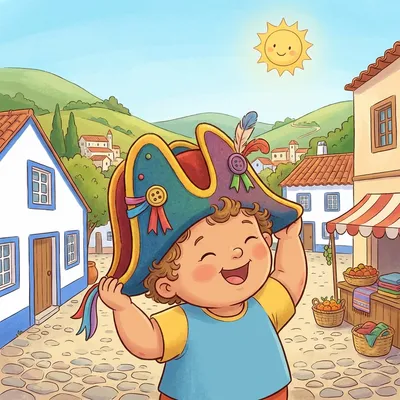
 Portugal
 Portuguese Nursery Rhyme
Original Lyrics
Tem três bicos o meu chapéu.
Se não tivesse três bicos,
O chapéu não era meu.
English Translation
Has three corners my hat.
If it didn't have three corners,
The hat would not be mine.
Translation Notes
Grammar Notes
This song uses the subjunctive mood ("tivesse") when discussing hypothetical situations, which is an important grammatical construction in Portuguese. The conditional consequence ("não era meu") follows naturally.
Line-by-Line Translation
O meu chapéu tem três bicos — "My hat has three corners" - O meu chapéu = my hat - tem = has - três bicos = three corners/points
Tem três bicos o meu chapéu — "Has three corners my hat" - This line reverses the word order for poetic effect and rhythm - The meaning is exactly the same as the first line
Se não tivesse três bicos — "If it didn't have three corners" - Se = if - não tivesse = didn't have (subjunctive mood) - The subjunctive is used here for hypothetical situations
O chapéu não era meu — "The hat would not be mine" - não era = would not be (conditional) - meu = mine
Line-by-Line Translation
O meu chapéu tem três bicos — "My hat has three corners" - O meu chapéu = my hat - tem = has - três bicos = three corners/points
Tem três bicos o meu chapéu — "Has three corners my hat" - This line reverses the word order for poetic effect and rhythm - The meaning is exactly the same as the first line
Se não tivesse três bicos — "If it didn't have three corners" - Se = if - não tivesse = didn't have (subjunctive mood) - The subjunctive is used here for hypothetical situations
O chapéu não era meu — "The hat would not be mine" - não era = would not be (conditional) - meu = mine
History and Meaning
"O meu chapéu tem três bicos" is a traditional Portuguese lullaby and nursery rhyme that is widely known throughout Portugal and Portugal-speaking countries. The song is also popular across Europe, with similar versions existing in many languages.
Origins and Transmission
The history of this song is deeply rooted in oral tradition, having been transmitted from generation to generation through families and communities. Like many traditional children's songs, its exact origins are unknown, and no single author has been identified. This is characteristic of folk songs that emerge from popular culture rather than being composed by known individuals.
The simple melody and repetitive nature of the lyrics have made it accessible and engaging for people of all ages, contributing to its longevity and widespread popularity. The song's structure, with its mirrored lines and logical progression, makes it particularly memorable and easy to teach to young children.
The Three-Cornered Hat
The song references a "chapéu de três bicos," or tricorn hat — a distinctive style of hat that was fashionable in Europe during the 16th and 17th centuries. The tricorn was created by turning up three sides of a round hat brim, forming three distinct points or corners. This style of hat was commonly worn by gentlemen, military officers, and officials during that period.
The reference to this historical hat style in a children's song suggests that the rhyme may have originated during or shortly after the time when such hats were in common use, making it potentially several centuries old.
Educational Value and Classification
Classified as a "lengalenga" (a type of repetitive rhyme or chant), this song serves multiple educational purposes. It helps children learn vocabulary related to clothing and parts of dress, introduces ordinal numbers (three), and demonstrates Portuguese grammatical structures including the subjunctive mood in a natural, memorable context.
The Brazilian version of this song typically replaces "três bicos" with "três pontas" (three points), showing how traditional songs adapt to regional linguistic preferences while maintaining their essential character and melody.
Historical Context
The "chapéu de três bicos" refers to a tricorn hat (tricórnio in Portuguese), a style of hat popular in the 16th and 17th centuries. These hats were formed by turning up three sides of a round hat brim to create three points or corners.
Song Type
This is classified as a "lengalenga" — a type of repetitive rhyme or chant in Portuguese. The simple melody and repetitive structure make it easy for children to learn and remember, while also teaching them about numbers and clothing vocabulary.