

Puss in Boots
 1697
1697  France
 Story
Once upon a time, an old miller passed away, leaving his three sons to divide his humble possessions. The eldest son received the mill, the second son took the donkey, and the youngest son was left with nothing but the miller's cat. "What shall I do with a cat?" the young man sighed sadly.
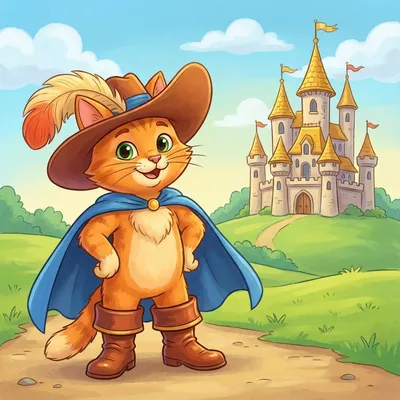
But this was no ordinary cat. "Do not despair, master," said the cat, standing on his hind legs. "Give me a fine pair of boots and a sack, and I shall make your fortune!" Astonished but curious, the young man found a pair of boots and a sack for the clever cat.
The cat, now wearing his splendid boots, set off into the forest. He filled his sack with lettuce and lay very still nearby. Soon, a plump rabbit hopped into the sack to nibble the greens, and the cat quickly caught it. He marched straight to the royal palace and presented the rabbit to the king. "A gift from my master, the Marquis of Carabas," announced Puss with a grand bow.
Day after day, Puss brought gifts to the king—partridges, pheasants, and other fine game—always in the name of his master, the Marquis of Carabas. The king grew quite fond of this generous nobleman he had never met.
One day, Puss learned that the king and his beautiful daughter would be riding along the river. He instructed his master to bathe in the river at a certain spot. When the royal carriage approached, Puss cried out, "Help! Help! The Marquis of Carabas is drowning!" The king, recognizing the name, ordered his guards to rescue the young man and provided him with fine royal clothes.
While the king invited the young man to ride in the royal carriage, Puss ran ahead. He came upon peasants working in the fields and told them, "When the king asks who owns these lands, you must say they belong to the Marquis of Carabas, or you shall be chopped into tiny pieces!" The frightened peasants obeyed.
Puss then arrived at a grand castle belonging to a fearsome ogre. "I have heard," said the clever cat, "that you can transform into any creature. Surely you cannot become something as small as a mouse?" The vain ogre, eager to prove his power, turned himself into a mouse—and Puss promptly pounced upon him and gobbled him up!
When the royal carriage arrived at the castle, Puss welcomed them grandly. "Welcome to the castle of the Marquis of Carabas!" The king was so impressed by the young man's lands and castle that he offered his daughter's hand in marriage. The miller's son and the princess were wed that very day.
And Puss in Boots? He became a great lord and never had to chase mice again—except for his own amusement. They all lived happily ever after.
History and Meaning
"Puss in Boots" (Le Maître Chat ou Le Chat Botté) was written by Charles Perrault and published in his collection "Histoires ou contes du temps passé" in 1697. However, similar tales of clever animal helpers appear in Italian folklore from the 16th century, including Straparola's "The Cat" and Basile's "Cagliuso."
Perrault's version became the definitive telling, establishing the iconic image of the cat wearing boots. The tale was part of a literary movement in 17th-century France that brought folk tales into the salons of the aristocracy, often with witty morals and social commentary.
Symbolism and Meaning
Wit Over Birth: Unlike many fairy tales where heroes are secretly of noble blood, the miller's son remains a commoner who rises through cleverness rather than birthright. The story celebrates intelligence and resourcefulness as paths to success.
The Loyal Helper: Puss represents the devoted servant whose skills elevate his master. In Perrault's era, this reflected the importance of clever advisors and the mutual benefit of loyalty between master and servant.
Appearance and Reality: The tale plays with themes of identity and deception. The "Marquis of Carabas" is an invented title, yet through perception and presentation, the young man becomes truly noble. This raises questions about what makes someone worthy of status.