

Rumpelstiltskin
 1812
1812  Germany
 Story
Once upon a time, in a small village, there lived a poor miller who had a beautiful daughter. One day, the miller found himself before the king and, wishing to appear more important than he was, boasted that his daughter could spin straw into gold. The king, intrigued by such a remarkable claim, ordered the girl to be brought to the palace at once.
The king led the miller's daughter to a room filled with straw and gave her a spinning wheel. "Spin all this straw into gold by morning," he commanded, "or you shall face my displeasure." The poor girl was left alone, weeping, for she had no idea how to accomplish such an impossible task.
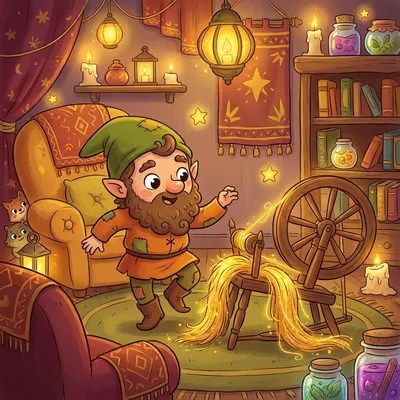
Suddenly, the door creaked open and a peculiar little man appeared. He had a long nose, pointed ears, and wore a tall hat upon his head. "Why do you cry so?" he asked. When she explained her predicament, the little man said, "What will you give me if I spin the straw into gold for you?" The girl offered her necklace, and the little man set to work, spinning all the straw into glittering gold by dawn.
The king was delighted but greedy. He placed the girl in a larger room with even more straw. Again the little man appeared, and this time he took her ring in exchange for his magical spinning. By the third night, the king promised to marry the girl if she could spin one more room of straw into gold.
The strange little man returned, but the girl had nothing left to give. "Then promise me your first child when you become queen," he demanded. Desperate and seeing no other choice, she agreed. The straw became gold, and the miller's daughter became queen.
A year passed, and the queen gave birth to a beautiful baby. She had nearly forgotten her promise when the little man appeared to claim the child. The queen wept and pleaded so pitifully that the little man was moved. "I will give you three days," he said. "If you can guess my name, you may keep the child."
The queen sent messengers throughout the kingdom to gather every name they could find. On the first two nights, she guessed many names—Conrad, Caspar, Melchior, Balthazar—but the little man only laughed and said, "That is not my name!"
On the third day, a messenger returned with a curious tale. Deep in the forest, he had seen a strange little man dancing around a fire, singing: "Today I bake, tomorrow I brew, the next I'll take the queen's child too! Little does she know, the game is mine, for Rumpelstiltskin is my name!"
That night, when the little man appeared, the queen asked innocently, "Is your name perhaps... Rumpelstiltskin?" The little man stamped his foot so hard in anger that it went right through the floor. He pulled and tugged, but could not free himself, and in his fury he tore himself in two and was never seen again. The queen kept her child, and they lived happily ever after.
History and Meaning
"Rumpelstiltskin" was recorded by the Brothers Grimm and published in their collection "Kinder- und Hausmärchen" (Children's and Household Tales) in 1812. The tale has roots in earlier European folklore, with similar stories appearing across many cultures, featuring supernatural beings who offer bargains in exchange for children.
The name "Rumpelstiltskin" likely derives from old German words meaning "little rattle stilt" or "little goblin," suggesting the character's mischievous and supernatural nature. Variations of the tale appear throughout Europe—in England as "Tom Tit Tot," in Scotland as "Whuppity Stoorie," and in similar forms across Scandinavia and Eastern Europe.
Symbolism and Meaning
The Power of Names: The central motif of the story—that knowing someone's true name gives power over them—appears in folklore worldwide. This reflects ancient beliefs about the magical properties of names and the importance of identity.
Consequences of Promises: The tale warns against making rash promises, especially when desperate. The miller's boastful lie sets the entire tragedy in motion, while the queen's hasty bargain nearly costs her what she loves most.
Cleverness Over Strength: The queen ultimately saves her child not through force or magic, but through wit, persistence, and gathering knowledge. This reinforces the value of intelligence and resourcefulness in overcoming seemingly impossible obstacles.