

Sing a Song of Sixpence
 1744
1744  England
 Lyrics
A pocket full of rye.
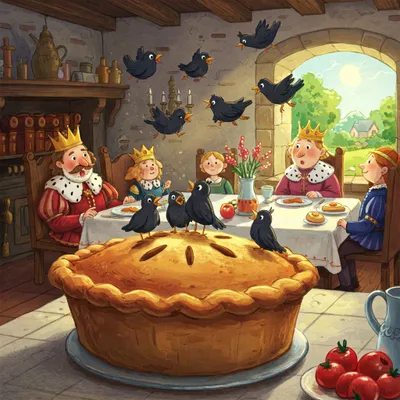
Four and twenty blackbirds
Baked in a pie.
When the pie was opened,
The birds began to sing;
Wasn't that a dainty dish
To set before the king?
The king was in his counting house,
Counting out his money;
The queen was in the parlour,
Eating bread and honey.
The maid was in the garden,
Hanging out the clothes,
When down came a blackbird
And pecked off her nose!
And shortly after that,
there came a little wren,
As she sat upon a chair,
and put it on again.
History and Meaning
"Sing a Song of Sixpence" is a well-known English nursery rhyme with origins that can be traced back to the 18th century, with possible allusions as early as the 17th century. The earliest known printed version appeared around 1744 in "Tommy Thumb's Pretty Song Book" in London, though this initial version differed slightly from the modern one, notably featuring "Four and twenty Naughty Boys, Baked in a Pye" instead of blackbirds—by approximately 1780, the "naughty boys" had been replaced by "birds," and a version with four verses similar to the modern one was extant by 1784. References to "sing a song of sixpence" can be inferred in Shakespeare's "Twelfth Night" (c. 1602) and Beaumont and Fletcher's 1614 play "Bonduca," suggesting the phrase circulated orally before its first printing. The origins are often linked to Tudor culinary practices from the 16th century, where live birds were sometimes placed in pies as a form of elaborate entertainment for banquets—an Italian cookbook from 1549, translated into English in 1598, even contained a recipe for "pies so that birds may be alive in them and fly out when it is cut up," providing a "dainty dish" when the pie was opened at lavish dinners for royalty like Henry VIII. One prominent theory suggests the rhyme is a political allegory related to King Henry VIII's reign and the Dissolution of the Monasteries (1530s), with the "king" representing Henry VIII, the "queen" possibly Catherine of Aragon, the "maid" Anne Boleyn (with the blackbird pecking off her nose symbolizing Anne's execution), and the "blackbirds" interpreted as Catholic monks, church officials displaced during the Reformation, or even deeds to monastic estates presented by black-clad Protestant clergymen. Other interpretations propose cosmological symbolism with the 24 blackbirds representing the 24 hours in a day, the king representing the sun, and the queen the moon, though no single interpretation is definitively proven. The "sixpence" mentioned refers to a British coin first minted in 1551 and used until 1980.