

De Colores

Spanish Nursery Rhyme
Original Lyrics
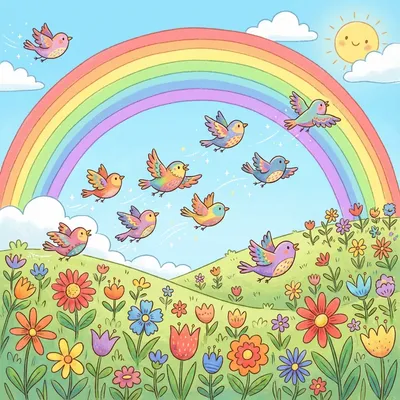
De colores,De colores se visten los campos en la primavera.De colores,De colores son los pajarillos que vienen de afuera.De colores,De colores es el arco iris que vemos lucir.
English Translation
Of colors,Of colors the fields dress in the springtime.Of colors,Of colors are the little birds that come from outside.Of colors,Of colors is the rainbow that we see shining.
Translation Notes
Vocabulary
colores - colors campos - fields primavera - spring pajarillos - little birds arco iris - rainbow lucir - to shine, to look bright
Grammar Notes
"De" for "in colour": the phrase de colores literally means "of colours," but it works like the English "all coloured" or "in many colours." Spanish often uses de to say what something is made of or covered in.
Reflexive verbs: se visten los campos means "the fields dress themselves." Vestirse (to get dressed) is reflexive, so the song pictures the fields pulling on their spring colours like clothes. The little word se is what makes the action turn back on the subject.
The diminutive "-illo": pajarillos is pájaros (birds) plus the warm ending -illo, giving "dear little birds." Spanish leans on these small, affectionate endings constantly, especially in songs for children.
History and Meaning
De Colores is a Spanish folk song that simply lists the colours of spring: fields turning green and gold, bright birds arriving from afar, a rainbow shining overhead. It is centuries old, but in the 1960s it took on a second life in California as the anthem of César Chávez's farm workers, who sang it on the picket line. A song about a rainbow became a song about many different people standing together.
Origins
The exact origins of the song are traditional and unconfirmed, but it is believed to have been brought from Spain to the Americas in the sixteenth century. The song circulated widely in Mexico during the colonial era, passed down through oral tradition. It entered modern prominence in 1944 when it was adopted as the theme song of the Cursillos de Cristiandad, a lay Catholic movement founded in Mallorca, Spain. In the 1960s and 1970s, it became the unofficial anthem of the United Farm Workers union in the United States, sung by César Chávez and farmworkers at labor rallies.
Meaning & Interpretation
The lyrics are simple and poetic, describing the vibrant colors that dress the fields in spring, the colorful feathers of migrating birds, and the bright colors of the rainbow. On a spiritual level within the Cursillo movement, the colors represent the joy of living in God's grace. In the context of the labor movement, the song represented hope, unity, and the diverse backgrounds of the farmworkers uniting for their rights.
What is the meaning of the song "De Colores"?
"De Colores" translates to "Of Colors" in English. The song celebrates the arrival of spring, praising the beauty of colorful fields, birds, and rainbows. It is a song of joy, community, and appreciation for the natural world.
How did "De Colores" become associated with labor rights?
In the 1960s, the United Farm Workers union, led by César Chávez and Dolores Huerta, adopted the song as their unofficial anthem. They sang it at farmworker strikes, meetings, and protest marches to foster solidarity, express hope, and celebrate the diverse cultural heritage of the workers.
Lyrics from nurseryrhymes.info