

The Elves and the Shoemaker
 1812
1812  Germany
 Story
Once upon a time, there lived an honest shoemaker and his good wife. Though the shoemaker worked hard every day, times were difficult, and they had become very poor. One evening, the shoemaker found he had only enough leather left to make one pair of shoes.
With a heavy heart, he carefully cut out the pieces for the shoes and laid them on his workbench. "I will finish these in the morning," he said to his wife. "It is too dark to work now." They said their prayers and went to bed, worried about what the future might hold.
When the shoemaker came down to his workshop the next morning, a wonderful surprise awaited him! There on the bench sat a perfectly finished pair of shoes—the finest he had ever seen. Every stitch was tiny and neat, every seam perfectly smooth. "Who could have done this?" he wondered in amazement.
A wealthy customer soon came into the shop and was so delighted with the beautiful shoes that he paid handsomely for them. With the money, the shoemaker could buy leather for two more pairs of shoes. That evening, he cut out the pieces and left them on his bench, just as before.
The next morning, he found two magnificent pairs of shoes waiting for him! Again, they sold quickly and for a good price. With each night that passed, the same magic happened. The shoemaker would cut the leather, and by morning, beautiful shoes would appear. Soon, the shoemaker and his wife were prosperous once again.
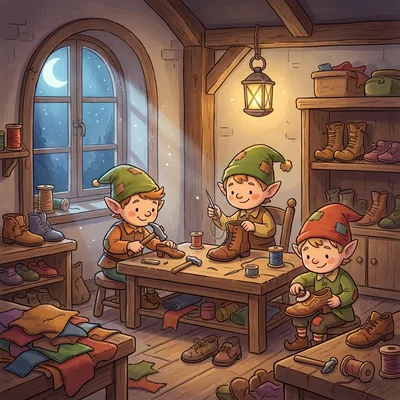
One evening, as Christmas approached, the shoemaker said to his wife, "Let us stay awake tonight and discover who has been helping us." They hid behind a curtain in the workshop and waited. At the stroke of midnight, two tiny elves appeared! They were dressed in rags and looked quite cold, but they set to work immediately, stitching and hammering with incredible speed until the shoes were done. Then, just as quickly, they vanished.
"Those kind little creatures have helped us so much," said the wife, "and they have no warm clothes! Let us make something for them." The shoemaker agreed, and together they worked. The wife sewed two tiny green coats, two little waistcoats, and two pairs of trousers. The shoemaker made two pairs of the smallest, finest shoes you ever saw.
On Christmas Eve, instead of leather, they left the tiny clothes and shoes on the workbench. At midnight, the elves appeared. When they saw the beautiful gifts, they danced with joy! They dressed themselves in their new clothes and shoes, sang happily, and danced out the door into the snowy night.
The elves never returned, but the shoemaker and his wife never forgot their kindness. They continued to prosper and were generous with all they had, living happily ever after.
History and Meaning
"The Elves and the Shoemaker" (Die Wichtelmänner) was collected by the Brothers Grimm and published in their 1812 collection. It is actually the first of three stories about helpful elves in their collection. The tale draws on Germanic folklore about house spirits who help with labor when treated well.
The tradition of leaving clothes for helpful sprites is ancient. In many European tales, giving clothes to such beings frees them from their service—a motif later made famous in J.K. Rowling's Harry Potter series with the character Dobby the house-elf.
Symbolism and Meaning
Kindness Begets Kindness: The story illustrates the virtuous cycle of generosity. The shoemaker is good and honest, which seemingly attracts supernatural help. When he and his wife show gratitude, they complete the circle of kindness.
Gratitude and Recognition: The shoemaker and his wife don't simply accept their good fortune—they take time to discover their benefactors and thank them properly. The tale encourages appreciation for those who help us, whether seen or unseen.
Hope in Hard Times: Even when the shoemaker is at his lowest point, good fortune finds him. The story offers hope that goodness and perseverance will be rewarded, a comforting message especially during the winter season when the tale is often told.