

The Emperor's New Clothes
 1837
1837  Denmark
 Story
Once upon a time, there lived an emperor who loved fine clothes more than anything else in the world. He had a different outfit for every hour of the day and spent nearly all the kingdom's money on elegant robes, magnificent capes, and splendid shoes. He cared little for his army or the theatre—unless he could show off a new costume there.
One day, two clever swindlers arrived in the kingdom. They claimed to be master weavers who could create the most extraordinary fabric in the world. "Not only are the colors and patterns exceptionally beautiful," they said, "but clothes made from this fabric are invisible to anyone who is unfit for their position or hopelessly stupid!"
The emperor was delighted. "With such clothes," he thought, "I could discover which of my ministers are unfit for their jobs!" He gave the two men a large sum of gold and ordered them to begin work immediately. The swindlers set up two looms and pretended to weave, though there was nothing on the looms at all.
The emperor sent his most trusted minister to check on the progress. The poor man stared at the empty looms and saw nothing—but he dared not admit it! "I must be unfit for my position," he thought fearfully. "Magnificent!" he declared. "The colors are exquisite!" And he reported the same to the emperor.
Official after official visited the weavers, and each one, afraid to appear stupid or unfit, praised the invisible cloth extravagantly. Finally, the emperor himself came to see. He saw nothing at all, but he would never admit to being unfit or foolish.
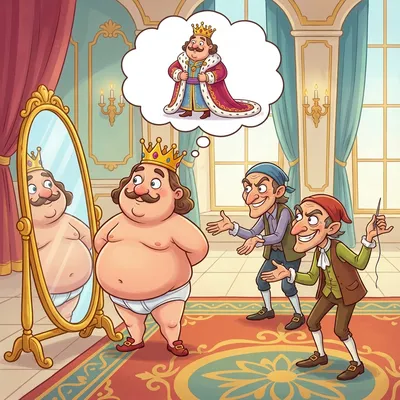
"Splendid! Remarkable! Stunning!" the emperor exclaimed, and he ordered that his new clothes be finished in time for the grand procession. On the day of the parade, the swindlers pretended to dress the emperor in his magnificent new outfit—invisible, of course, to all but the wise.
The emperor marched through the streets in his underwear, and all the people cheered and praised his clothes. No one would admit they saw nothing, for fear of being thought stupid. Then a small child in the crowd called out, "But he hasn't got anything on!"
The child's words spread through the crowd like wildfire. "The emperor has no clothes!" the people whispered, then spoke, then shouted. The emperor shivered, realizing the truth, but he held his head high and continued the procession—for he knew a true ruler must never falter, even when caught in a foolish mistake.
History and Meaning
"The Emperor's New Clothes" was written by Hans Christian Andersen and published in 1837. Andersen adapted the story from a Spanish tale by Don Juan Manuel called "Of What Happened to a King and Three Impostors," written in the 14th century. In the original, the cloth was invisible to those of illegitimate birth rather than the foolish.
Andersen's version, with its biting social satire, has become one of his most enduring and quoted tales. The phrase "the emperor has no clothes" has entered common language as an expression meaning that an obvious truth is being ignored or denied.
Symbolism and Meaning
The Danger of Vanity: The emperor's excessive concern with appearance makes him vulnerable to the swindlers' trick. The tale warns against excessive pride and the foolishness of caring more about how we look than about reality.
Social Conformity: Adults in the story are so afraid of being judged that they refuse to speak the obvious truth. Only the innocent child, unburdened by social pressure, speaks honestly. This celebrates the value of childlike honesty and the courage to speak truth to power.
Speaking Truth: The tale encourages readers to question authority and trust their own eyes rather than simply believing what they are told. It remains relevant as a reminder that sometimes the most powerful people can be the most easily deceived—especially when surrounded by those afraid to contradict them.