

The Nightingale
 1843
1843  Denmark
 Story
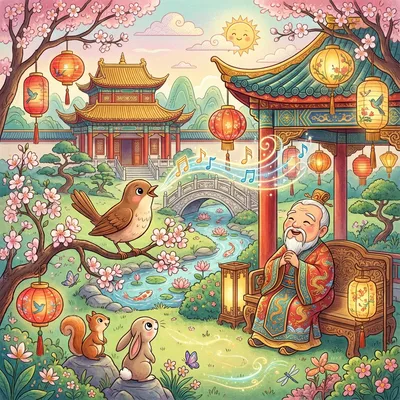
Long ago in China, there lived a mighty Emperor in the most magnificent palace in all the world. The palace was made of the finest porcelain, and its gardens stretched so far that even the gardeners didn't know where they ended. Beyond the gardens lay a beautiful forest that reached down to the deep blue sea.
In this forest lived a little nightingale with a plain brown coat. The bird sang so beautifully that fishermen would stop their work just to listen. Travelers from around the world wrote about the wonders of China's palace, but they always said the nightingale was the best of all.
One day, the Emperor read about this nightingale in a book. "How is it that I have never heard this bird?" he demanded. "Bring the nightingale to me at once!" His courtiers searched everywhere until a little kitchen maid showed them the way to the forest where the nightingale lived.
The nightingale agreed to come to the palace, and when she sang for the Emperor, tears rolled down his cheeks. The song was so beautiful that it touched his heart. The Emperor was so pleased that he wanted the nightingale to stay at the palace forever.
But soon, the Emperor of Japan sent a gift—a mechanical nightingale covered in diamonds, rubies, and sapphires. When wound up, it sang one of the real nightingale's songs. Everyone at court was enchanted by the glittering bird, and the real nightingale quietly flew away, back to her green forest.
The mechanical bird sang and sang until one day, with a whirr and a clatter, its spring broke. No one could fix it properly. Years passed, and the Emperor grew very ill. He lay in his bed, cold and pale, with no one to comfort him.
Then, through the window, came the most beautiful song. The real nightingale had heard of the Emperor's illness and had come to sing for him once more. As she sang, color returned to the Emperor's cheeks, and strength flowed back into his body.
"Thank you, little bird," whispered the Emperor. "I sent you away and replaced you with a toy. How can you forgive me?" The nightingale replied, "You gave me your tears when I first sang, and I have never forgotten. Those were the jewels that touched my heart." From that day on, the nightingale visited the Emperor often, and he became the wisest and kindest ruler in all the land.
History and Meaning
"The Nightingale" was written by Hans Christian Andersen and first published in 1843. The story is believed to have been inspired by Andersen's relationship with Swedish opera singer Jenny Lind, known as "The Swedish Nightingale."
The tale explores the difference between natural beauty and artificial imitation. The mechanical bird, despite its jewels and gold, cannot match the sincere, heartfelt song of the real nightingale. Andersen suggests that true art comes from the heart and cannot be manufactured.
The story also reflects on themes of loyalty, forgiveness, and the fleeting nature of material possessions versus the lasting power of genuine connection. The nightingale's willingness to forgive and help the Emperor shows the transformative power of compassion.
"The Nightingale" has been adapted into operas, ballets, and films. The composer Igor Stravinsky created a famous opera based on this story in 1914, and it remains one of Andersen's most beloved tales about what truly matters in life.