

Thumbelina
 1835
1835  Denmark
 Story
Once upon a time, a lonely woman longed for a child of her own. She visited a wise old witch who gave her a magical barleycorn. "Plant this in a flowerpot," said the witch, "and see what grows." The woman carefully planted the seed and watered it every day.
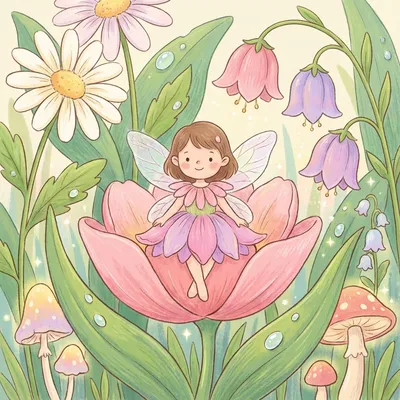
Soon, a beautiful flower bloomed, its petals tightly closed like a tulip. The woman kissed the petals, and they opened to reveal the tiniest, most beautiful little girl—no bigger than a thumb! The woman named her Thumbelina and loved her dearly. Thumbelina slept in a polished walnut shell lined with rose petals and sailed on a plate of water in a boat made from a tulip leaf.
One night, while Thumbelina slept, an ugly toad hopped through the window. "What a perfect wife for my son!" the toad croaked. She carried Thumbelina away to a lily pad in the middle of a stream. When Thumbelina awoke, she wept to find herself alone and far from home. The fish in the stream took pity on her and nibbled through the lily pad's stem, setting her free to float away.
Thumbelina drifted until a cockchafer beetle swooped down and carried her to the treetops. But the other beetles thought her strange because she had only two legs, so the cockchafer left her in a meadow. All summer, Thumbelina lived alone among the flowers, drinking dewdrops and eating pollen, but when winter came, she grew cold and hungry.
A kind field mouse found the shivering girl and took her into her cozy underground home. "You may stay with me," said the mouse, "if you keep house and tell me stories." The field mouse had a neighbor, a wealthy mole with a velvet coat, who became quite fond of Thumbelina. Soon, the mole asked for her hand in marriage.
In the mole's tunnel, Thumbelina discovered a swallow who had collapsed from the cold. While the mole thought the bird was dead, Thumbelina secretly nursed the swallow back to health throughout the winter. When spring came, the swallow flew away, calling back his thanks.
The wedding day with the mole approached, and Thumbelina was miserable. She would have to live forever underground, never seeing the sun or flowers again. On the morning of the wedding, she stepped outside for one last look at the sky—and there was the swallow!
"Come with me to the warm lands where the sun always shines!" called the bird. Thumbelina climbed onto his back, and they flew far away to a land of eternal flowers. There, in the heart of a white bloom, she met the flower fairy prince—a tiny winged man exactly her size. He placed a crown of gold upon her head and asked her to be his queen. At last, Thumbelina had found where she truly belonged, and she lived happily ever after.
History and Meaning
"Thumbelina" (Tommelise) was written by Hans Christian Andersen and first published in 1835. Unlike many of his tales that adapted traditional folklore, Thumbelina was entirely Andersen's original creation, though it draws on the fairy tale tradition of miniature people.
Andersen wrote the tale during a productive period in his career and dedicated the collection containing it to a young girl named Ida Thiele. The story reflects Andersen's recurring themes of the outsider seeking belonging and the triumph of gentleness over adversity.
Symbolism and Meaning
Search for Belonging: Thumbelina's journey represents the universal human search for a place where we truly fit in. Throughout her adventures, she is claimed by those who see her only as they wish—a wife, a pet, a curiosity—until she finally finds others like herself.
Kindness Rewarded: Thumbelina's compassion for the swallow, shown when no one else cared, is ultimately what saves her from a life of underground darkness. The tale reinforces that acts of kindness, even small ones, have far-reaching consequences.
Nature and Freedom: The contrast between the dark, confining underground world of the mole and the bright, open realm of the flower fairies speaks to the importance of living in harmony with one's nature and finding freedom to be oneself.