

Tom Thumb
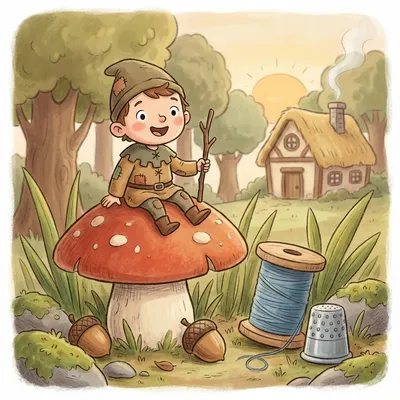
 1621
1621  England
 Story
Once upon a time, in the days of the great King Arthur, there lived a poor plowman and his wife who longed for a child. One day, the wife made a wish to a fairy: "If only we could have a son, even if he were no bigger than my husband's thumb, we would be the happiest people in all the land!"
The fairy granted her wish, and soon a tiny baby was born to them—no larger than a thumb! They named him Tom Thumb and loved him dearly. Tom grew in wit and cleverness, though he never grew in size. His mother dressed him in an acorn cap and a coat made from a spider's web.
Despite his small size, Tom was brave and adventurous. One day, while riding in his father's pocket to watch him plow the fields, Tom tumbled out and was carried away by a raven who mistook him for a kernel of corn! The bird flew over a giant's castle and dropped Tom right at the giant's feet.
The giant picked up the tiny fellow and was about to eat him when Tom cried out, "Wait! I am Tom Thumb, the smallest and cleverest man in all the kingdom! Swallow me, and I shall cause you nothing but trouble!" The curious giant laughed and kept Tom as a pet instead.
Tom soon escaped the giant's castle by hiding in the giant's dinner and causing such a commotion in his stomach that the giant sneezed him right out the window! Tom floated down on a thistle seed and landed safely in a meadow.
His adventures continued as he was swallowed by a cow while sleeping on a blade of grass, caught by a fish, and finally served at the table of King Arthur himself! When the king cut open the fish and found Tom inside, he was so delighted that he made Tom a knight of his court.
Sir Tom Thumb became a favorite of the king and queen. He rode a mouse as his steed and carried a needle as his sword. Though he faced many dangers from spiders, rats, and careless servants, his quick wits always saved him.
Eventually, Tom wished to see his parents again. King Arthur gave him a gold coin—which was so heavy Tom could barely carry it—and sent him home in a grand procession. His parents wept with joy to see their tiny son again, and Tom lived happily, splitting his time between adventures at the palace and cozy evenings in his parents' cottage.
History and Meaning
"The History of Tom Thumb" was first published in 1621, making it one of the first English fairy tales to appear in print. The story was remarkably popular in England for centuries and was referenced by Shakespeare and other writers of the period. An earlier verse version was registered in 1579.
Tales of tiny heroes appear across many cultures, from the Germanic "Daumesdick" (Tom Thumb) collected by the Brothers Grimm to Japanese folklore's "Issun-bōshi" (One-Inch Boy). These stories often feature small heroes who succeed through cleverness rather than strength.
Symbolism and Meaning
Size Doesn't Determine Worth: Tom Thumb embodies the idea that great things can come in small packages. Despite being tiny, he achieves fame, becomes a knight, and has more adventures than most full-sized people ever dream of.
Wit Over Strength: Unable to use physical force, Tom must rely on his intelligence and quick thinking to survive. The tale celebrates mental agility and resourcefulness as heroic qualities.
Perseverance and Courage: Tom faces dangers that would terrify anyone— giants, wild animals, and being eaten multiple times—yet he never gives up. His bravery inspires readers to face their own challenges, no matter how overwhelming they may seem.