
Upar Pankha Chalta Hai

Urdu Nursery Rhyme
Original Lyrics
Urdu script
اوپر پنکھا چلتا ہےنیچے مُنّا سوتا ہےسوتے سوتے بھوک لگیکھا لے بیٹا مونگ پھلی
مونگ پھلی میں دانہ نہیںہم تمہارے ماما نہیںماما گئے دلیوہاں سے لائے دو بلی
بلی نے مارا پنجہماما ہو گیا گنجا!
Romanized (pronunciation)
Upar pankha chalta haiNiche munna sota haiSote sote bhook lagiKha le beta mungphali
Mungphali mein daana nahiHum tumhare mama nahiMama gaye DilliWahan se laye do billi
Billi ne maara panjaMama ho gaya ganja!
English Translation
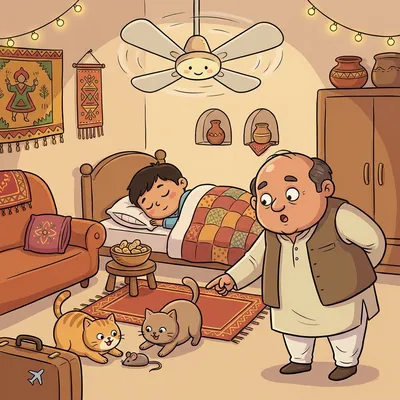
The fan is running aboveLittle Munna is sleeping belowWhile sleeping, he got hungryEat some peanuts, my child
There are no kernels in the peanutsWe are not your maternal uncleUncle went to DelhiFrom there he brought two cats
The cat swatted its pawUncle became bald!
Translation Notes
Vocabulary
upar (اوپر) - above pankha (پنکھا) - fan niche (نیچے) - below sota (سوتا) - sleeps mungphali (مونگ پھلی) - peanut mama (ماما) - maternal uncle billi (بلی) - cat ganja (گنجا) - bald
Grammar Notes
Habitual present: chalta hai (runs) and sota hai (sleeps) join a verb form ending in -ta with hai ("is") to describe what usually or currently happens. The -ta ending is masculine, matching the fan and the little boy.
Reduplication: sote sote literally doubles "sleeping" to mean "while in the middle of sleeping." Repeating the verb like this to mean "as he was doing it" is a common Urdu and Hindi pattern.
Negation with "nahi": daana nahi (no kernel) and mama nahi (not the uncle) place nahi after the word to cancel it out, where English puts "no" or "not" in front.
Compound verb "ho gaya": ganja ho gaya means "went bald." Ho (become) teams up with gaya (went) to say the change happened suddenly and completely, the perfect punchline verb for a rhyme that ends with a bald uncle.
History and Meaning
Upar Pankha Chalta Hai (The Fan Runs Above) is gleeful nonsense. It opens gently, a fan turning overhead and little Munna asleep below, then tumbles through one non-sequitur after another: he is hungry, eat peanuts, the peanuts are empty, an uncle storms off to Delhi, comes back with two cats, and one of them claws him bald. The lines are held together by rhyme, not logic, which is exactly why children in Pakistan and India love it.
The song is exceptionally popular in early childhood classrooms in Pakistan and India. Children enjoy its playfulness and the silly narrative structure.
Origins
The song has its origins in the oral children's poetry of Northern India and Pakistan. Like most traditional balgeet (children's songs), it has no documented author or creation year, having developed within the oral storytelling traditions of South Asian families.
It has been published in numerous Urdu and Hindi primary school books and is standard reading material for young children learning the alphabet and basic vocabulary.
Meaning & Interpretation
The primary appeal of the song is its nonsense structure. The poem connects logically unrelated events (sleeping under a fan, eating peanuts, an uncle traveling to Delhi, and a cat clawing him bald) purely through rhyming sounds.
Psychologists note that such nonsense verse plays a crucial role in language development. By prioritizing rhythm and rhymed endings over strict logic, the song makes language playful and easy for toddlers to memorize. The humorous, surprising ending where the uncle becomes bald invariably makes children laugh.
Why is Upar Pankha Chalta Hai considered a nonsense rhyme?
The rhyme is considered a nonsense verse because its narrative events do not follow a logical sequence. It transitions rapidly from a sleeping baby to eating peanuts, to an uncle traveling to Delhi and returning with a cat that scratches him bald, connecting these ideas solely through rhyme.
What are the traditional lyrics of Upar Pankha Chalta Hai?
The lyrics describe a baby sleeping under a fan who gets hungry and is told to eat peanuts. Finding no kernel in the peanut, the child calls on his maternal uncle (mama), who travels to Delhi, brings back two cats, and is scratched bald by one of them.
Lyrics from nurseryrhymes.info