

Where Are You Going My Pretty Maid
 England
 Lyrics
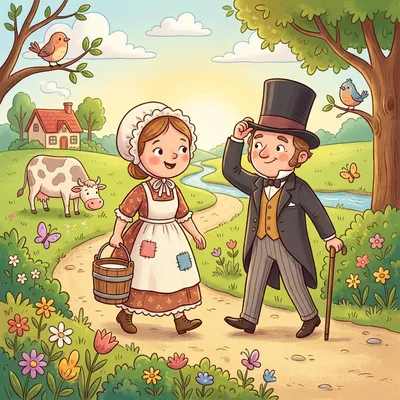
"I'm going a-milking, sir," she said.
"May I go with you, my pretty maid?"
"You're kindly welcome, sir," she said.
"What is your father, my pretty maid?"
"My father's a farmer, sir," she said.
"What is your fortune, my pretty maid?"
"My face is my fortune, sir," she said.
"Then I can't marry you, my pretty maid."
"Nobody asked you, sir," she said."
History and Meaning
This old Mother Goose rhyme is believed to date back to at least the 18th century and is considered to be a cleaned-up version of an older Tudor song that featured a milkmaid and a man with potentially dishonorable intentions. The dialogue of the rhyme unfolds as a conversation between a gentleman and a milkmaid, concluding with the famous exchange where the man asks about her fortune and she replies "My face is my fortune, Sir," followed by his statement "Then I can't marry you, my pretty maid," to which she delivers the classic put-down "Nobody asked you, Sir." The rhyme was notably popular during the lifetime of Edward Jenner (1749-1823), the doctor who developed the smallpox vaccine, partly inspired by milkmaids' immunity to smallpox due to prior cowpox infection. In some parts of England, asking a maid to go "milking with her" was historically akin to a marriage proposal, adding deeper meaning to the dialogue. The milkmaid's final retort serves to reclaim the conversation and assert her independence, highlighting themes of confidence and self-respect over wealth, making it a witty response to unwanted attention or assumptions.