

As I was going to St Ives


Lyrics
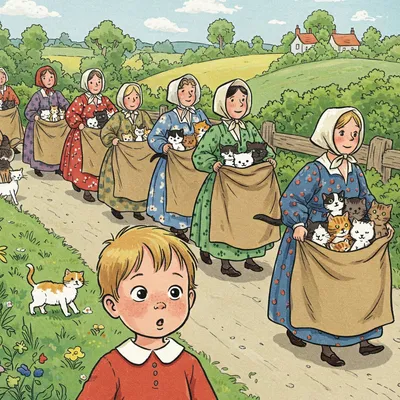
As I was going to St. Ives,Upon the road I met seven wives;Every wife had seven sacks,Every sack had seven cats,Every cat had seven kits:Kits, cats, sacks, and wives,How many were going to St. Ives?
Answer: only one is going to St Ives, the narrator. All of the others are coming from St Ives
History and Meaning
"As I Was Going to St. Ives" is a traditional English nursery rhyme and riddle. It is famous for its trick question structure, which challenges listeners to use mathematical logic rather than simple calculation.
The riddle has been used for centuries as a playful exercise to teach children and adults to listen closely to details rather than jumping to conclusions.
Origins
The oldest known written version of the riddle is preserved in a manuscript from approximately 1730. However, the mathematical concept of using successive powers of seven to construct a puzzle is far older. Similar problems have been found in the Rhind Mathematical Papyrus, an ancient Egyptian document dating back to around 1650 BC, and in the Liber Abaci written by the medieval mathematician Fibonacci in 1202. The riddle became popular in printed form when it was published in the Weekly Magazine in August 1779.
Meaning & Interpretation
The riddle works by listing a series of groups of seven (seven wives, seven sacks, seven cats, and seven kits) that the narrator meets along the way. While many listeners begin calculating the total number of people and animals (which equals 2,802 if all items are summed), the phrasing of the first line reveals that only the narrator is going to the town of St. Ives. The groups of seven are met along the road, implying they are traveling in the opposite direction.
How old is the As I Was Going to St. Ives riddle?
The oldest manuscript containing the rhyme dates to circa 1730, making it at least three centuries old in its current English form. The mathematical principles behind the riddle date back over 3,500 years to ancient Egypt.
Music Video
If the player is unavailable, watch this video on YouTube.
Lyrics from nurseryrhymes.info