

As I was going by Charing Cross


Lyrics
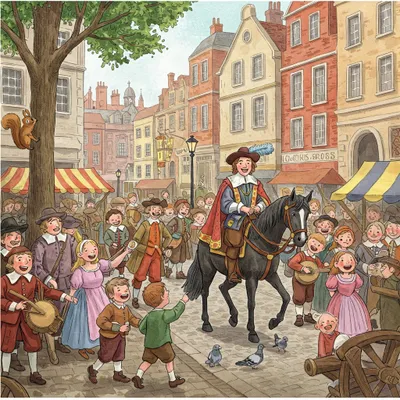
As I was going by Charing Cross, I saw a black man upon a black horse; They told me it was King Charles the First- Oh dear, my heart was ready to burst!
History and Meaning
"As I Was Going by Charing Cross" is a traditional English nursery rhyme that references a specific, real-world historical monument in London. The song describes a passerby who recognises a dark statue on horseback as the executed King Charles I.
Origins
The earliest documented printed version of the rhyme appears in James Orchard Halliwell's 1842 compilation, The Nursery Rhymes of England. The rhyme is listed under number 20564 in the Roud Folk Song Index. While standardized in the nineteenth century, the song's subject matter dates back to the seventeenth century. It directly references the bronze equestrian statue of King Charles I, which was cast in 1633. During the English Civil War, the statue was hidden by Parliamentarians to prevent it from being melted down. Following the Restoration of the monarchy, it was finally erected at Charing Cross in 1675.
Meaning & Interpretation
The lyrics describe seeing a "black man upon a black horse." This is a literal description of the bronze statue, which had darkened significantly over time due to weather exposure and London soot. The speaker identifies the figure as King Charles I, who was executed in 1649 at nearby Whitehall.
The final line, "Oh dear, my heart was ready to burst," is open to multiple historical interpretations. In a Royalist context, it represents deep sorrow and grief over the execution of the king. In a broader civic context, the line reflects the shock of seeing a public monument tied to civil war, rebellion, and regicide.
Who is the black man in As I Was Going by Charing Cross?
The "black man" refers to the dark bronze equestrian statue of King Charles I located at Charing Cross in London. The bronze naturally darkened due to weathering and soot.
What is the history of the Charing Cross statue in the nursery rhyme?
The statue was cast in 1633 but was hidden during the English Civil War to protect it. It was eventually installed at Charing Cross in 1675 after the restoration of the monarchy.
Music Video
If the player is unavailable, watch this video on YouTube.
Lyrics from nurseryrhymes.info