
Arthur O'Bower


Lyrics
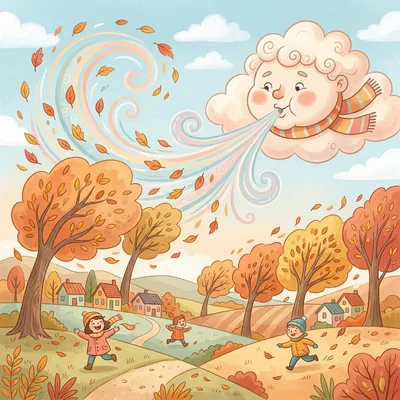
Arthur O'Bower has broken his band,He comes roaring up the land.The King of Scots with all his powerCannot turn Arthur of the Bower.
History and Meaning
Four lines, and not one of them says what Arthur is. That is deliberate. "Arthur O'Bower" is a riddle rhyme from the north of England, first printed in 1805 and clearly older than that, and it works by describing its subject purely through what it does. It breaks loose. It roars. It comes up over the land, and no king can stop it.
Children in Cumberland were reciting it long before anyone put it in a book. William Wordsworth, who grew up in Cockermouth, recorded in 1823 that he had heard the rhyme as a boy "in the time of a high wind". That single phrase both dates the rhyme and hands over a very large hint about the answer.
Origins
The earliest known printing is in Songs for the Nursery, Collected from the Works of the Most Renowned Poets, published in London by Benjamin Tabart in 1805. Wordsworth's recollection pushes it back into the late eighteenth century and roots it in Cumberland, in the far north west of England, where weather comes off the Irish Sea and hits the fells with nothing in the way.
Iona and Peter Opie, the folklorists who assembled the standard scholarly collection of English nursery rhymes, judged it to be a good deal older still. They pointed out a resemblance between its opening and the opening lines of the ballad Robin Hood and the Tanner, printed around 1650. They also offered a plain explanation for the strange name: "Bower" may come from the Scots word bowder, meaning a blast or squall of wind. If that is right, Arthur o' Bower is Arthur of the Squall, and the title is half the answer.
A more romantic reading links the name to King Arthur himself, in his folklore role as a storm figure or leader of the Wild Hunt. There is no direct evidence for that, and it rests mainly on the name and on the raiding imagery of the third line.
Meaning & Interpretation
Every image in the rhyme is a clue. A band is a bond, a tether, a strap, so "broken his band" means something that was tied up has got free. "Comes roaring up the land" supplies a sound and a direction of travel, moving inland from the coast the way real weather does. The last two lines then measure the thing against the greatest human power the rhyme's first listeners could picture. A Scottish king with an army at his back could take a town on the border. He could not turn this.
That is the whole method of the riddle. You never see the subject. You only hear what it does and see what it breaks, which happens to be exactly how the answer behaves in life. The same trick runs through other old weather verses, from the forecasting couplet Red Sky at Night to Christina Rossetti's Who Has Seen the Wind?, which asks its question and then answers it by pointing at trembling leaves instead of at the wind itself.
What is the answer to the riddle?
The wind. Arthur O'Bower is a storm wind, personified as a giant or a raider who has snapped his tether and gone roaring inland. Each line describes wind without naming it. The broken band is the gale getting loose, the roaring is its noise, and no king with any amount of power can turn a storm aside. The Opies' suggestion that "Bower" derives from the Scots bowder, a squall of wind, fits the solution neatly.
Did Beatrix Potter use Arthur O'Bower?
Yes. In The Tale of Squirrel Nutkin (1903), Nutkin pesters Old Brown the owl with a run of traditional riddles, and "Arthur O'Bower has broken his band" is the last one he tries. Potter has Nutkin make a whirring noise like the wind and then take a running jump onto the owl's head. That is where the game ends. Old Brown catches him, and Nutkin gets away only by leaving his tail behind. Potter set the story on Derwentwater in the Lake District and drew St Herbert's Island as Owl Island, so a Cumbrian rhyme found its way into a Cumbrian story.
What does "broken his band" mean?
A band here is a fastening, the sort of rope or strap used to tie something down. The line pictures the wind as a creature that has been restrained and has now torn free, which is why the rest of the rhyme reads as a warning rather than a description. Older English riddles often work this way, giving an invisible force a body and a temper so that a child can picture it.
Related Nursery Rhymes

Lyrics from nurseryrhymes.info