

Red Sky at Night
Lyrics
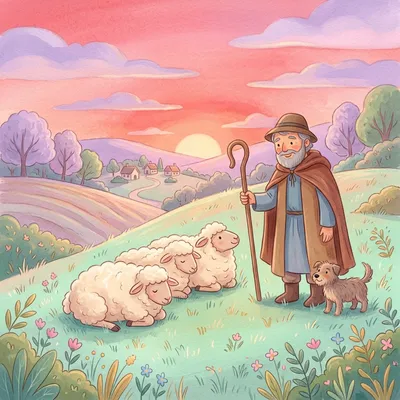
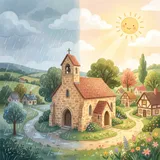
Red sky at night, shepherd's delight.Red sky in the morning, shepherd's warning.
History and Meaning
This one is at least six hundred years old in English and much older than that elsewhere. John Wycliffe's Bible translation of 1395 puts it into Middle English, and the passage being translated, Matthew chapter 16, already treats it as something every listener knew by heart. Very few rhymes children learn can be traced that far back. Fewer still turn out to be scientifically defensible, which this one, at middle latitudes, largely is.
Origins
Matthew 16:2-3 has Jesus answering a group of Pharisees and Sadducees who were demanding a sign from heaven. In the King James wording, they say "It will be fair weather: for the sky is red" in the evening, and in the morning "It will be foul weather to day: for the sky is red and lowring". The passage is a rebuke about reading signs, but along the way it records a piece of first-century weather lore that was clearly common property.
Wycliffe's 1395 English Bible carries the same lines into English: "Whanne the euentid is comun, ye seien, It schal be clere, for heuene is rodi", followed by the morning warning of tempest. That is the oldest English form usually cited for the saying.
Shakespeare used the idea in Venus and Adonis, published in 1593: "Like a red morn that ever yet betoken'd / Wrack to the seaman, tempest to the field, / Sorrow to shepherds, woe unto the birds". Worth noticing that Shakespeare names both the seaman and the shepherd, the two figures the modern versions would later split between.
The neat rhyming couplet children recite now is later folk shaping. The observation underneath it has been running continuously for two thousand years.
Meaning & Interpretation
British speakers say shepherd's delight and shepherd's warning. Americans nearly always say sailor's delight and sailor's warning:
Red sky at night, sailor's delight. Red sky in the morning, sailors take warning.
Each version fits the people who repeated it most. Britain's rural economy ran on sheep, and shepherds slept out with their flocks on exposed hillsides where tomorrow's weather mattered a great deal. The American form spread through a coastal and seagoing culture, where a wrong guess about the next morning could sink a boat. The prediction being made is identical in both. Only the person who needs it changes.
Is red sky at night actually true?
Yes, more often than not, if you live in the middle latitudes. Weather systems there travel broadly west to east on the prevailing westerly winds. A red sunset means the sun, low in the west, is reaching you through clear dry air, which usually indicates high pressure to the west, and that is the air heading your way overnight. A red sunrise means the sun is low in the east instead, lighting the underside of cloud while the clear high-pressure air has already moved past you to the east. What follows behind it is often a low-pressure system with rain and wind. It is a rule of thumb with decent odds, not a forecast, and it says nothing about weather more than a day out.
Why does the sky turn red at all?
When the sun sits near the horizon, its light travels a much longer path through the atmosphere than it does at midday. Air molecules scatter short blue wavelengths far more strongly than long red ones, a process called Rayleigh scattering, so the blue is scattered away along that long path and mostly red and orange light survives to reach your eye and to light up any cloud overhead.
Does the rhyme work everywhere in the world?
No. It depends on weather systems moving west to east, which is a feature of the middle latitudes. Nearer the equator the trade winds blow the other way, east to west, and monsoon regions run on an entirely different seasonal pattern. In those places a red sky carries no reliable message about tomorrow.
Related Nursery Rhymes

Lyrics from nurseryrhymes.info