

Remember, Remember the Fifth of November

Lyrics
Remember, remember the fifth of November,Gunpowder treason and plot.We see no reasonWhy gunpowder treasonShould ever be forgot.
History and Meaning
In the early hours of 5 November 1605, a search party working through the storerooms beneath the House of Lords found a man standing guard over 36 barrels of gunpowder. He gave his name as John Johnson. He was really Guy Fawkes, and the gunpowder was meant to destroy Parliament and kill King James I later that same morning. The plot failed. Britain has marked the date ever since, and this short verse is the reminder that grew up alongside the bonfires.
The rhyme is unusual among nursery rhymes because the history behind it is not guesswork. The Gunpowder Plot is one of the best documented events of its century, with surviving letters, trial records and Parliament's own account of what happened.
Origins
The event is precisely dated. The rhyme is not. The earliest known printed version dates from around 1742 and begins differently: "Don't you remember, the fifth of November, 'twas gunpowder treason day." The familiar wording that opens "Remember, remember" is recorded in the nineteenth century, roughly two hundred years after the plot itself. Because the verse passed from voice to voice for generations before anyone wrote it down, no author is known, and Victorian folklorists collected dozens of local variations across England.
The commemoration itself began as law rather than folk custom. A bill introduced in Parliament on 23 January 1606 required an annual church service of thanksgiving for the plot's failure, and that act stayed on the statute book until it was repealed in March 1859 by the Anniversary Days Observance Act. The official services ended. The bonfires did not.
Some traditional versions of the rhyme continue into further verses that reflect the bitter conflict between Protestants and Catholics in England at the time. Those verses are not sung today and are not reproduced here.
Meaning & Interpretation
The verse is a memory aid, and it is built like one. "November" and "remember" lock together in the first line, and "reason", "treason" and "forgot" carry the rest. There is no story and no characters, only an instruction: do not forget what happened on this date.
It is written from the point of view of the people who survived the plot, which is why it reads as a warning rather than a ballad. For most families now the words are simply what gets said before the first firework goes up, and children learn them the way they learn a countdown.
Who was Guy Fawkes?
Guy Fawkes was a soldier from York, born in 1570, who had fought for Catholic Spain in the Netherlands, where he used the name Guido and gained his experience with explosives. He was one of thirteen conspirators and he was not the leader. The plot was organised by Robert Catesby, a Warwickshire gentleman. Fawkes was given the job of guarding the gunpowder and lighting it, and because he was the one found in the cellar, his name is the one attached to the day.
What was the Gunpowder Plot?
It was a plan by a small group of English Catholics to blow up the House of Lords on 5 November 1605 during the State Opening of Parliament, killing King James I and much of the government, and then to put a Catholic monarch on the throne. The group rented a storeroom directly beneath the chamber and filled it with barrels of gunpowder. An anonymous letter delivered to Lord Monteagle on 26 October warned him to stay away from Parliament, the authorities searched the building, and Fawkes was arrested. Catesby was killed days later resisting arrest at Holbeche House in Staffordshire, and the surviving plotters were tried in January 1606 and executed as traitors.
What is Bonfire Night?
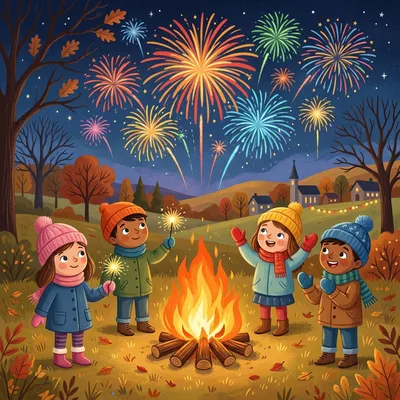
Bonfire Night, also called Guy Fawkes Night, is the British observance held every 5 November with bonfires, fireworks and food eaten outdoors, such as toffee apples and baked potatoes. Lewes in East Sussex holds the largest processions in the country, and Ottery St Mary in Devon runs flaming tar barrels through its streets. Children traditionally made a "guy", a figure stuffed with newspaper and dressed in old clothes, wheeled it around the neighbourhood asking for "a penny for the guy" to pay for fireworks, then placed it on the bonfire. That custom has faded in recent decades, though the effigies are still burned at the big organised events. The English word "guy", meaning any man at all, came into the language from those figures.
Related Nursery Rhymes




Lyrics from nurseryrhymes.info