

All Things Bright and Beautiful


Lyrics
Chorus
All things bright and beautiful,All creatures great and small,All things wise and wonderful,The Lord God made them all.
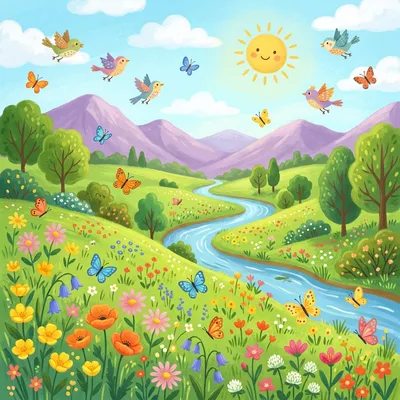
Each little flower that opens,Each little bird that sings,He made their glowing colours,He made their tiny wings.
The purple-headed mountain,The river running by,The sunset and the morningThat brightens up the sky.
The cold wind in the winter,The pleasant summer sun,The ripe fruits in the garden,He made them every one.
History and Meaning
A Yorkshire vet named Alf Wight, writing under the pen name James Herriot, took the titles of four books straight out of this hymn's refrain: All Creatures Great and Small, All Things Bright and Beautiful, All Things Wise and Wonderful, and The Lord God Made Them All. Millions of readers know those four phrases without ever having sung the hymn they came from. It was written in 1848 by an Irish woman who was trying to teach small children the Apostles' Creed.
Origins
Cecil Frances Humphreys was born in Dublin in 1818 and was living in Strabane, County Tyrone, when she published Hymns for Little Children in 1848. She married the clergyman William Alexander soon after, and he later became Bishop of Derry and Raphoe and then Archbishop of Armagh. She died in Londonderry in 1895.
The book was printed in London by Joseph Masters, with a preface by John Keble, and the profits went to support an Irish school for deaf children. Its plan was systematic. Each hymn illustrated one line of the catechism. "All Things Bright and Beautiful" was written for "Maker of heaven and earth". "Once in Royal David's City" covered "born of the Virgin Mary", and "There Is a Green Hill Far Away" covered "suffered under Pontius Pilate, was crucified, dead and buried". Three of the most sung hymns in English came out of a single small volume aimed at children.
Two tunes carry the words. William Henry Monk wrote a setting in 1887. The one most people picture is "Royal Oak", adapted by Martin Shaw in 1915 from a seventeenth-century English melody called "The Twenty-ninth of May", found in Playford's The Dancing Master in 1686. It is a dance tune underneath, which is part of why the hymn bounces.
Meaning & Interpretation
The verses are a list. Flowers, birds, a purple-headed mountain, a river, a sunset, winter wind, summer sun, ripe fruit. Alexander is doing one job over and over: pointing at ordinary things a child can actually see and attaching them to the idea of a maker. There is no abstraction in it, which is why it works with four-year-olds.
The hymn as printed in 1848 also contained a verse that begins "The rich man in his castle, the poor man at his gate, God made them high and lowly, and ordered their estate". It presents the Victorian class system as part of the created order, in the same breath as birds and mountains. That view was ordinary among the English-speaking gentry of 1848 and unremarkable to Alexander's first readers. Essentially every modern hymnal omits the verse, and it is not printed above.
Did James Herriot get his book titles from this hymn?
Yes. The American editions of Alf Wight's veterinary memoirs were titled All Creatures Great and Small (1972), All Things Bright and Beautiful (1974), All Things Wise and Wonderful (1977), and The Lord God Made Them All (1981). All four phrases are lines of the hymn's refrain, in order.
What is the missing verse of All Things Bright and Beautiful?
A verse about "the rich man in his castle, the poor man at his gate" appeared in the 1848 original and described rich and poor as placed in their stations by God. Hymnal editors dropped it during the twentieth century, and it is absent from current hymn books, so most singers have never encountered it.
What else did Cecil Frances Alexander write?
She wrote "Once in Royal David's City", sung as the opening carol of the Festival of Nine Lessons and Carols at King's College, Cambridge, and "There Is a Green Hill Far Away", a Good Friday hymn. Both appeared in the same 1848 collection. She wrote around 400 hymns and poems in total.
What does "purple-headed mountain" mean?
It describes a hill whose upper slopes look purple, the effect of heather in flower or of distant light on bare rock. Both are common sights in Ireland and Scotland, and Alexander was writing about the kind of landscape her young readers walked past.
Related Nursery Rhymes


Lyrics from nurseryrhymes.info