

The Erie Canal


Lyrics
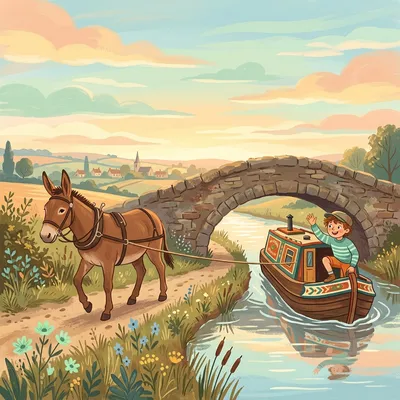
I've got a mule, her name is Sal,Fifteen miles on the Erie Canal.She's a good old worker and a good old pal,Fifteen miles on the Erie Canal.We've hauled some barges in our day,Filled with lumber, coal, and hay,And we know every inch of the wayFrom Albany to Buffalo.
Chorus
Low bridge, everybody down!Low bridge, for we're coming to a town!And you'll always know your neighbor,You'll always know your pal,If you've ever navigated on the Erie Canal.
We better get along on our way, old gal,Fifteen miles on the Erie Canal.'Cause you bet your life I'd never part with Sal,Fifteen miles on the Erie Canal.Git up there, mule, here comes a lock,We'll make Rome 'bout six o'clock,One more trip and back we'll go,Right back home to Buffalo.
Chorus
Low bridge, everybody down!Low bridge, for we're coming to a town!And you'll always know your neighbor,You'll always know your pal,If you've ever navigated on the Erie Canal.
History and Meaning
Sal is the mule. Readers regularly assume Sal is the singer's wife or sweetheart, but the second line settles it: she is a good old worker who hauls barges filled with lumber, coal, and hay. The song goes by three names. Sheet music calls it "Low Bridge, Everybody Down", schools usually print it as "Fifteen Miles on the Erie Canal", and most people just call it "The Erie Canal".
The setting is a real waterway with a real job. The Erie Canal opened on October 26, 1825, running 363 miles across New York State from Albany on the Hudson River to Buffalo on Lake Erie. Before it existed, moving a ton of freight from the Great Lakes to the East Coast cost around a hundred dollars. After it opened, the same ton cost about six. Boats had no engines. Mules and horses walked a packed dirt towpath beside the water, harnessed to a rope, pulling loaded barges along at roughly four miles an hour. The whole route from Albany to Buffalo is exactly the trip the singer says he and Sal know every inch of.
Origins
Thomas S. Allen wrote both words and music. Allen was born in Natick, Massachusetts in 1876 and made his living as a working musician: orchestral violinist, trick violinist in vaudeville and burlesque, theatre music director, and a composer of rags, marches, and songs to order. He copyrighted the piece in manuscript in 1912 and published the sheet music in 1913. He died in 1919.
The date matters more than it looks. By 1913 the mule era on the canal was closing. New York State was well into building the Barge Canal, a wider, deeper replacement route designed for engine-powered vessels, and towpath animals were on their way out. So Allen was not writing down a song he heard from boatmen. He was a professional songwriter in Massachusetts writing a backward glance at a way of working that was already ending, and selling it as sheet music. The nostalgia is baked in from the first printing.
Allen's original chorus line was "fifteen years on the Erie Canal", the boast of a man counting his working life. The version children sing now says "fifteen miles", which is commonly explained as the stretch a mule could pull before needing rest or a swap. Both readings are in circulation, and the sheet music itself carried "Fifteen Years on the Erie Canal" as an alternate title.
Meaning & Interpretation
The verses are a boatman talking to his animal, and the tone is companionable rather than grand. He praises Sal, refuses to part with her, urges her on toward a lock, and estimates they will reach Rome around six o'clock. Rome, New York is a genuine town on the canal route, which anchors the whole song in a real map.
The chorus does something different. It shifts from the driver's private talk to a shouted public warning, then to a line about knowing your neighbor and knowing your pal. Canal boats moved slowly and stopped constantly at locks, so the same crews and towns saw each other over and over. That is the sociability the chorus is describing.
Why does everybody have to duck?
Because the bridges over the canal were built low, and passengers rode on the cabin roof. Canal boats were slow and the cabins were cramped, so travellers sat up top for the air and the view. Road bridges crossing the water often left very little clearance above a boat's roof. The call of "Low bridge, everybody down" was a genuine safety shout from the crew, telling everyone on deck to flatten themselves or climb off the roof before the bridge arrived. It has nothing to do with a drawbridge being lowered.
Is Sal a person or a mule?
Sal is a mule. The opening line says so directly, and the rest of the verse describes her hauling barges and knowing the route. Mules were preferred over horses on the towpath because they ate less, tolerated long hours of steady pulling, and held up better on rough ground.
Is The Erie Canal a real folk song?
Not in the strict sense. It has one known author, Thomas S. Allen, and a copyright date of 1912 with sheet music in 1913, so it was written commercially rather than passed down anonymously by canal workers. It behaves like a folk song now, though, because singers changed it as it spread. "Years" became "miles", verses were added and dropped, and no two songbooks print quite the same text.
What did the canal boats carry?
The song names lumber, coal, and hay, which were all standard cargo. The canal also moved wheat and flour east from the farms of the Midwest and carried manufactured goods and settlers west. That two-way traffic turned Buffalo, Rochester, Syracuse, and other stops along the line into fast-growing cities, and helped make New York City the busiest port in the country.
Related Nursery Rhymes




Lyrics from nurseryrhymes.info