
Fee-Fi-Fo-Fum

Lyrics
Fee-fi-fo-fum,I smell the blood of an Englishman,Be he alive, or be he dead,I'll grind his bones to make my bread.
History and Meaning
Almost everyone meets these four lines inside "Jack and the Beanstalk", growled by the giant at the top of the vine. The chant is far older than that story. Thomas Nashe quoted it in a pamphlet in 1596, and Shakespeare put a version of it into "King Lear" around 1605, while "Jack and the Beanstalk" did not reach print in any form until the 1730s. The giant's line was already a well-worn saying more than a century before the tale that made it famous.
Origins
The earliest known printing is in George Peele's play "The Old Wives' Tale", published in 1595, where a giant enters saying "Fee, fa, fum, here is the Englishman." One year later Thomas Nashe used it in "Have with You to Saffron-Walden", his last broadside in a long feud with the scholar Gabriel Harvey. Nashe jeers that his pedantic opponent could spend a whole day lecturing on "the first invention of Fy, fa, fum, I smell the blood of an Englishman". The joke only lands if readers in 1596 already knew the words by heart, and Nashe treats the origin as obscure even then.
Shakespeare's turn comes in "King Lear", Act III, Scene 4, written around 1605. Edgar, disguised as the mad beggar Poor Tom, rambles about the old story of Childe Rowland and finishes: "Fie, foh, and fum, I smell the blood of a British man." The wording is not the nursery one. "Fee-fi" becomes "Fie, foh", and the victim is British rather than English. That looseness is itself evidence: the chant was floating around in spoken versions rather than being copied from a fixed printed text.
The Jack stories collected it later. "The History of Jack and the Giants" was printed at Newcastle in 1711, and a skit called "Enchantment Demonstrated in the Story of Jack Spriggins and the Enchanted Bean" appeared in 1734. The familiar beanstalk tale did not settle into its standard shape until Benjamin Tabart published "The History of Jack and the Bean-Stalk" in London in 1807. Joseph Jacobs printed the best-known telling in "English Fairy Tales" in 1890, with the last line as "I'll have his bones to grind my bread", a variant still heard alongside the more common "I'll grind his bones to make my bread".
Meaning & Interpretation
The chant is an ogre announcing that he can smell a human intruder, and it ends with the threat to grind bones into bread. That is ordinary fairy-tale giant material, and children usually take it as the noise a giant makes rather than a plan.
What keeps the words alive is the sound. The same consonant opens all four syllables while the vowel shifts each time, from the thin "ee" through "eye" and "oh" to the dark "uh" of fum, which closes on a hummed m. English is fond of that pattern, as in ding-dong and tick-tock. Read aloud it lands like four heavy footsteps, each one lower than the last. A phrase built that well travels on its own, which is why it survived detached from any particular story and got borrowed by whichever giant needed a line.
Is Fee-Fi-Fo-Fum older than Jack and the Beanstalk?
Yes, by a wide margin. George Peele printed a version in 1595, Thomas Nashe quoted it as an old saying in 1596, and Shakespeare used it in "King Lear" around 1605. "Jack and the Beanstalk" first appeared in print as a 1734 skit and only took its standard form in Benjamin Tabart's 1807 booklet. The chant was proverbial long before the beanstalk story attached itself to it.
What does Shakespeare's version say?
In "King Lear", Edgar says "Fie, foh, and fum, I smell the blood of a British man." He is playing the madman Poor Tom and quoting the old tale of Childe Rowland. The first half differs from the nursery wording and the man is British instead of English, which suggests Shakespeare was repeating something he had heard spoken rather than read.
Who says Fee-Fi-Fo-Fum?
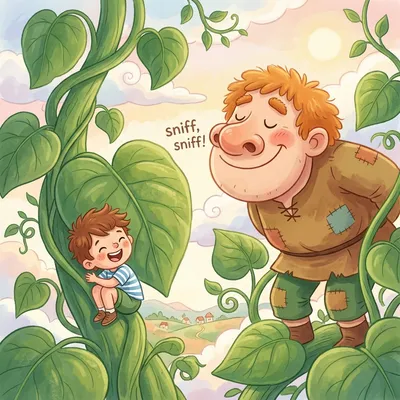
The giant does. In the beanstalk story he chants it when Jack has climbed up and hidden in his castle, because he can smell that a human is nearby. Earlier giants say near-identical lines in "The Old Wives' Tale" and in the Jack the Giant-Killer chapbooks, so the words belonged to giants in general before they belonged to this one.
What does "grind his bones to make my bread" mean?
It is the giant's threat to mill the intruder's bones into flour, the way a miller grinds grain. Giants and ogres in European folk tales are routinely cannibals, and the line is the shorthand for it. Most retellings keep the words unchanged, since the giant never actually catches Jack.
Related Nursery Rhymes

Lyrics from nurseryrhymes.info