

Elsie Marley

Lyrics
Do ye ken Elsie Marley, honey?The wife that sells the barley, honey;She won't get up to serve her swine,And do ye ken Elsie Marley, honey?
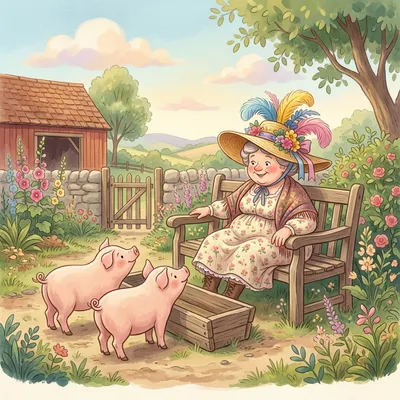
Elsie Marley's grown so fine,She won't get up to serve the swine,But lies in bed till eight or nine,And surely she does take her time.
Elsie Marley is so neat,It's hard for one to walk the street,But every lad and lass they meetCries, do ye ken Elsie Marley, honey?
Elsie Marley wore a straw hat,Now she's gotten a velvet cap;The Lambton lads mun pay for that,Do ye ken Elsie Marley, honey?
History and Meaning
The woman in this rhyme existed. Alice Marley, known as Elsie, kept a public house at Picktree near Chester-le-Street in County Durham, and she drowned on 5 August 1768. That makes Elsie Marley one of a very small group of nursery rhymes about a named, traceable, ordinary person. Most rhyme "originals" are guesswork attached long after the fact. This one runs the other way: the song was written while she was alive and famous enough that the newspaper report of her death mentioned it.
The rhyme is not a story. Nothing happens in it. It is a comic character sketch, four lines at a time, of a woman who has done well enough out of the beer trade to stop doing the dirty jobs. She will not get up to feed the pigs. She lies in bed until eight or nine. She has swapped her straw hat for a velvet cap. That is the whole joke, and it is a joke about class as much as about laziness.
Origins
Elsie was born Alice, probably around 1713, though the name was common enough in the area that no christening record can be matched to her with certainty. In 1735 she married Ralph Marley, who kept the public house at Picktree. The couple had eight children. Nineteenth century antiquarian notes give the inn's sign as the Swan, with the motto "The Swan doth love the water clear, and so does man good ale and beer".
The words first reached print in Joseph Ritson's collection The Bishopric Garland in 1784, sixteen years after her death, and the song then turned up in most later Northumbrian collections, including Bell's Rhymes of Northern Bards in 1812 and Northumbrian Minstrelsy in 1882. The four-line nursery version, the "grown so fine" verse on its own, was pulled out of the full song by Victorian editors and printed for children, appearing in books such as Kate Greenaway's Mother Goose in 1881. It is catalogued as Roud 3065.
Several colourful details belong to local legend rather than to the record. The often repeated claim that the song was composed after Elsie had her pocket picked of twenty guineas at a Newcastle fair comes from later antiquarian retelling, not from any document of her lifetime. The same goes for descriptions of her as a handsome, bustling hostess who made the inn prosper. Those may well be true. They are simply not evidenced the way her marriage and her death are.
The verse naming the Lambton lads hints that young men of the local gentry family paid for her finery, and early printers appear to have left it out to avoid giving offence. Some scholars think the straw hat and velvet cap verse was added later.
Meaning & Interpretation
The humour depends on knowing exactly how much work an alewife did. She brewed, she served, she kept accounts, and she fed the pigs on the spent grain left over from brewing. Refusing to serve the swine is the sharpest possible way of saying she has got above herself, because it is the one task nobody does for pleasure.
Read kindly, the song is affectionate ribbing of a popular landlady by her own customers. Read less kindly, it is the standard eighteenth century complaint about a woman with money of her own. Both readings sat happily in the same pub.
Was Elsie Marley a real person?
Yes. Alice "Elsie" Marley was the wife of Ralph Marley, who kept a public house at Picktree near Chester-le-Street in County Durham. Their 1735 marriage is recorded, and her death in 1768 was reported in the Newcastle Chronicle, which described her as remarkable for the celebrated song composed upon her. Her biography beyond those anchors is thin and mixed with local tradition.
What do the dialect words mean?
ken - know honey - Tyneside term of affection, also spelled and said as "hinny" barley - the grain ale is brewed from, so "sells the barley" means sells beer swine - pigs mun - must so fine - grand, dressed up, too important for rough work neat - smartly turned out, not merely tidy velvet cap - expensive headwear, the opposite of a working woman's straw hat alewife - a woman who brewed and sold ale, a normal trade for women at the time
How did Elsie Marley die?
She drowned on 5 August 1768 in an old flooded coal pit near Birtley. The contemporary account says she was ill with a fever, left her house, wandered into a field and fell into the water-filled pit. It was recorded as an accident.
Is the tune still played?
Yes. Elsie Marley survives as a fast jig in the Northumbrian smallpipes repertoire and is still played in sessions across the north east of England. The piper Tom Clough recorded it for HMV in 1929, and Kathryn Tickell is among the later players who have put it on record. The tune is name-checked in the traditional song Byker Hill.
Related Nursery Rhymes






Lyrics from nurseryrhymes.info