

Camptown Races


Lyrics
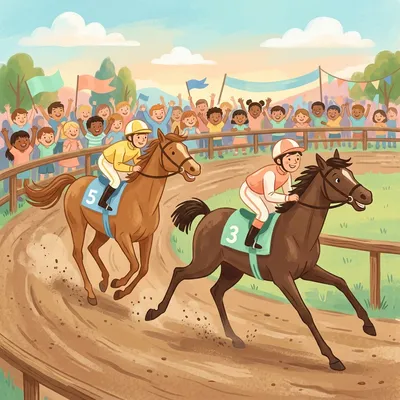
The Camptown ladies sing this song,Doo-dah, doo-dah,The Camptown racetrack's five miles long,Oh, doo-dah day.
Chorus
Going to run all night,Going to run all day,I bet my money on the bob-tail nag,Somebody bet on the bay.
The long-tail filly and the big black horse,Doo-dah, doo-dah,They fly the track and they both cut across,Oh, doo-dah day.
The blind horse stuck in a big mud hole,Doo-dah, doo-dah,Can't touch bottom with a ten-foot pole,Oh, doo-dah day.
Old muley cow came onto the track,Doo-dah, doo-dah,The bob-tail flung her over his back,Oh, doo-dah day.
Then he flew along like a railroad car,Doo-dah, doo-dah,Running a race with a shooting star,Oh, doo-dah day.
I went down there with my hat caved in,Doo-dah, doo-dah,I came back home with a pocket full of tin,Oh, doo-dah day.
History and Meaning
The racetrack in the song is five miles long, which is roughly ten times the length of a real one. That is the joke, and everything after it follows the same logic. Horses leave the track entirely. One goes blind and sinks into a mud hole too deep for a ten-foot pole. A cow wanders on and gets thrown over a horse's back. By the last verse the winning nag is racing a shooting star. Between every line of this, a chorus that means nothing at all: doo-dah, doo-dah.
Stephen Foster published it in February 1850, and the nonsense refrain did most of the work. "Doo-dah" is easy for a crowd to shout back, easy for a child to learn before the words make sense, and it turns a five-verse story into something singable by people who only know two syllables of it.
Origins
Foster wrote the song in 1850 and it was published that February by F. D. Benteen of Baltimore. Christy's Minstrels, the most successful blackface troupe in the country, put it in front of American audiences, and it spread from there into songbooks, schoolrooms, and army camps. It was widely sung on both sides during the Civil War.
Historians point to Camptown, a village in the mountains of northeastern Pennsylvania, as the likely setting. Horse races were run between there and Wyalusing, and the distance between the two town centres is about five miles. So the famous line may be a straight description of a real course rather than an exaggeration, with the comedy coming from the wreckage along the way.
Foster wrote the song for the minstrel stage, and the original published text used the exaggerated dialect spellings that blackface performance relied on, including in the title. Modern printings put the words into standard English, and the version sung today, in schools and songbooks, is the standardised one. The lyrics above follow that standard text.
Meaning & Interpretation
The song is a comic sports report delivered by an unreliable witness. He is at the track, he has money down on a bob-tail nag, and the race he describes falls apart almost immediately. Two horses cut across the field. Another gets stuck. A cow interferes. None of this is presented as a problem. The singer simply keeps counting off the disasters between choruses.
The betting is what holds it together. "I bet my money on the bob-tail nag, somebody bet on the bay" sets up two sides, and the last verse settles it: he arrived with a battered hat and went home with a pocket full of tin, tin being slang for coins. He won. Given what the horse went through to get there, the win is as ridiculous as everything else in the song.
A bob-tail nag is a horse with a docked or cropped tail, an ordinary working animal rather than a fine one, which is part of why backing it is funny. Children usually get none of this and do not need to. What survives is the shape: a fast tune, a shouted refrain, and a list of things going wrong.
Who was Stephen Foster?
Stephen Collins Foster, born near Pittsburgh in 1826, is often called the first person in the United States to make a living purely as a songwriter, and he is sometimes called the father of American music. He wrote more than 200 songs, including "Oh! Susanna", "Old Folks at Home" and "Beautiful Dreamer", many of which passed into common currency and are still sung by people who have never heard his name. He died in New York on 13 January 1864 at the age of 37, at Bellevue Hospital, after a fall in a Bowery hotel while ill with a fever. He had earned only about fifteen thousand dollars in royalties across his whole catalogue, and accounts of his death say he had well under a dollar in his pocket.
The reason a hugely popular songwriter died with nothing is structural. In the 1850s there were no performance royalties. A songwriter earned a small percentage of sheet music sales and nothing else, so every minstrel troupe, theatre band and rival publisher who used his work paid him nothing.
What does "doo-dah" mean in Camptown Races?
Nothing. It is a nonsense refrain, a placeholder syllable that fills the gap after each line and gives the audience something to sing back. Foster used the same technique in other songs. Its only job is rhythm, and it is the reason children can join in before they have learned a single verse.
Why is the Camptown racetrack five miles long?
Because that may have been the actual distance. Races were run between Camptown, Pennsylvania, and nearby Wyalusing, and the two town centres sit about five miles apart. A five-mile course is far longer than a standard race, which is what makes the line sound like a tall tale even if it was literally true.
Related Nursery Rhymes




Lyrics from nurseryrhymes.info