
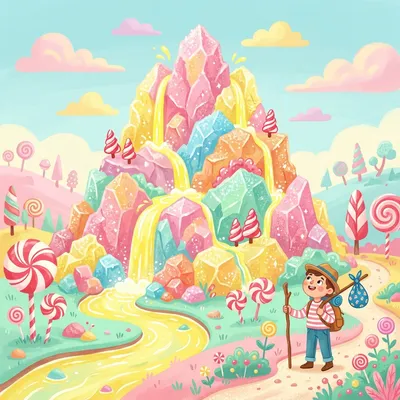
The Big Rock Candy Mountain


Lyrics
One evening as the sun went downAnd the jungle fire was burning,Down the track came a hobo hiking,And he said, "Boys, I'm not turning.I'm headed for a land that's far awayBeside the crystal fountains,So come with me, we'll go and seeThe Big Rock Candy Mountains."
In the Big Rock Candy MountainsThere's a land that's fair and bright,Where the handouts grow on bushesAnd you sleep out every night.Where the boxcars all are emptyAnd the sun shines every dayOn the birds and the bees and the cigarette trees,The lemonade springs where the bluebird sings,In the Big Rock Candy Mountains.
In the Big Rock Candy MountainsAll the cops have wooden legs,And the bulldogs all have rubber teethAnd the hens lay soft-boiled eggs.The farmers' trees are full of fruitAnd the barns are full of hay.Oh, I'm bound to go where there ain't no snow,Where the rain don't fall and the wind don't blow,In the Big Rock Candy Mountains.
In the Big Rock Candy MountainsThe brakemen have to tip their hatsAnd the railroad bulls are blind.There's a lake of stew,You can paddle all around in a big canoe,In the Big Rock Candy Mountains.
In the Big Rock Candy MountainsThe jails are made of tin,And you can walk right out againAs soon as you are in.There ain't no short-handled shovels,No axes, saws or picks.I'm going to stay where you sleep all day,Where they hung the jerk that invented work,In the Big Rock Candy Mountains.
History and Meaning
Harry McClintock recorded "The Big Rock Candy Mountain" in Hollywood on September 6, 1928, and the Victor Talking Machine Company put the single out that November. McClintock performed as Haywire Mac and had spent years riding freight trains and singing for coins, so the song's world of boxcars, camp fires and railroad police was one he actually knew. What he sang about was a hobo's paradise: a country where food grows wild, nobody works, and the law is too broken to bother anyone.
This page prints a selection of verses and lines from that 1928 original, because some of what McClintock recorded and sang on the street was written for adults rather than children.
Origins
The idea behind the song is much older than 1928. Medieval Europe had a standing joke about Cockaigne, an imaginary country of endless food and no labour, where roast birds flew into your mouth and rivers ran with wine. English broadside printers kept the joke alive. "An Invitation to Lubberland", first printed in 1685, describes a land where the streets are paved with pudding pies and roasted pigs walk about with knives in their backs. Lubberland is simply the English name for the same fantasy.
McClintock said he wrote his version around 1895 while busking. Folklorists have long pointed out that it borrows heavily from earlier hobo songs in that Lubberland line, including "The Appleknocker's Lament", "Hobo's Paradise" and "Hobo Heaven". He copyrighted the song in December 1928 and quickly sued a ukulele player named Billy Mack, who had copyrighted sheet music for his own version that same year. In court McClintock produced an unpublished final verse as proof that the words were his. Accounts of how the case ended do not agree: some say the court treated the song as public domain, others say McClintock won. The authorship is best described as disputed rather than decided.
The song reached a much larger audience in 2000, when the Coen brothers used McClintock's original 1928 recording over the opening credits of "O Brother, Where Art Thou?". It appeared on the film's soundtrack album alongside newly recorded folk and bluegrass tracks.
Meaning & Interpretation
Every wish in the song is a reversal of something specific and unpleasant. Hobos begged for food, so the handouts grow on bushes. They were thrown off trains by railroad police, so the railroad bulls go blind and the brakemen tip their hats. They were arrested for vagrancy, so the jails are made of tin and you can walk straight out. They were put to work on chain gangs and road crews with short-handled shovels, so there are no shovels at all.
Children hear the food and the animals first. Adults hear a joke about hunger. Both readings are correct at the same time, which is a large part of why the song lasted. The hobo hiking down the track is inviting the other men round the fire to come with him, and the invitation is knowingly impossible.
The word "jungle" in the first verse is hobo slang. A jungle was a camp near a rail yard where travelling men cooked, slept and swapped news, usually around a shared fire and a communal pot.
Who wrote The Big Rock Candy Mountain?
Harry McClintock recorded and copyrighted it in 1928 and claimed to have written it in the 1890s, but his claim was challenged in a copyright suit and the song clearly draws on older hobo ballads and on the Cockaigne tradition. Sources disagree about how the court case ended, so the authorship remains disputed.
Is The Big Rock Candy Mountain a real place?
No. It is an invented country, part of a long line of imaginary lands of plenty running back through the 1685 broadside "An Invitation to Lubberland" to the medieval Cockaigne. A real Big Rock Candy Mountain in Utah, along Highway 89, was named after the song rather than the other way round.
What is a railroad bull?
A railroad bull was a private police officer hired by a rail company to keep people from riding in freight cars without paying. They were the main hazard of hobo travel, which is why the song imagines them all going blind.
Why do children's versions leave out some verses?
McClintock's 1928 recording includes verses about streams of alcohol trickling down the rocks and a lake of whiskey, and the version he sang as a busker in the 1890s ended with material far coarser than that. Songbooks aimed at children print only the verses about food, animals and weather.
Related Nursery Rhymes

Lyrics from nurseryrhymes.info