
Bill Grogan's Goat

Lyrics
Leader sings each line, and everyone sings it straight back.
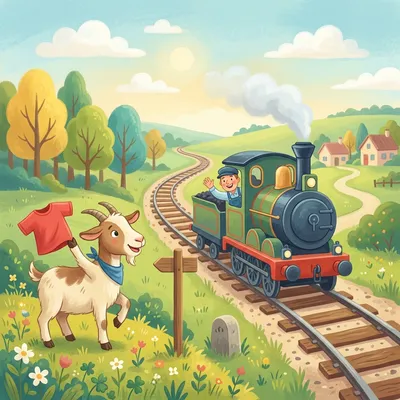
Bill Grogan's goatWas feeling fine,Ate three red shirtsRight off the line.
Bill took a stick,Gave him a whack,And tied him toThe railroad track.
The whistle blew,The train drew nigh,Bill Grogan's goatWas doomed to die.
He gave a groanOf awful pain,Coughed up those shirtsAnd flagged the train.
History and Meaning
The oldest known printing of this song is a piece of sheet music from 1904 called "The Tale of a Shirt". Everything since has moved by ear, mostly through summer camps, Scout meetings and school music rooms, where it survives as an echo song. One person sings a short line, everybody sings it back, and the plot advances four beats at a time.
The story is quick. A goat eats three red shirts off a washing line, its owner loses his temper and ties it to a railway track, and then the goat coughs the shirts back up and waves them at the oncoming train, which stops. The goat rescues itself. Most children work out the trick about half a line before the ending arrives, which is exactly where the laugh comes from.
Origins
No author is known for the words camps sing. The 1904 sheet music is the earliest dated copy, and the folk music scholar Norm Cohen has pointed out that its text differs a good deal from the short four-verse version in circulation now. The earliest version taken down from a singer rather than a publisher was collected in North Carolina in 1913, for the folklore collection assembled by Frank C. Brown. Folklorists index the song as Roud 4574.
It travelled widely and quickly. Fiddlin' John Carson recorded a long comic version as "Papa's Billy Goat" in November 1923, issued the following year on OKeh 4994. In 1960 Kenneth Peacock collected a Newfoundland version, "Joey Long's Goat", from Joshua Osborne of Seal Cove, White Bay, and printed it in Songs of the Newfoundland Outports.
One frequent suggestion is that the song grew out of "O'Grady's Goat", a comic piece by the Louisville songwriter Will S. Hays that was in print by 1890 and also features a destructive goat and red flannel shirts. Hays's goat never goes near a railway, so the resemblance may be coincidence rather than descent. Treat the connection as unproven.
Meaning & Interpretation
There is no moral tucked inside this one. The joke is structural: three verses build a problem, and the fourth solves it with the same object that caused it. The shirts are the crime and the rescue. Children find that satisfying in the way a good punchline is satisfying, and the goat gets to be the clever one rather than the victim.
The third verse sounds grimmer than the song is. "Was doomed to die" is a setup line, delivered flat, and it exists so the last verse can cancel it. Leaders who worry about the peril usually find that singing the last verse briskly and with a bit of goat-flapping mime settles the room. Some groups add gestures: a chewing motion for the shirts, a whack, a train whistle pull, and a big two-handed wave at the end.
The echo format is the other half of the appeal. Because nobody has to know the words in advance, a group of strangers can sing it within thirty seconds of hearing it, which is why it turns up on the first day of camp far more often than the last.
How do you sing an echo song?
The leader sings one short line alone, then stops and lets the whole group sing the same line back at the same pitch and speed. In "Bill Grogan's Goat" every line is four syllables, so the pattern is steady: leader sings "Bill Grogan's goat", group repeats "Bill Grogan's goat", leader sings "Was feeling fine", group repeats it, and so on to the end. The leader should sing out clearly, keep a strict beat, and use a hand signal or a nod to hand the line over. Speeding up slightly with each verse is the usual way to raise the energy. There is no need to teach the words first, because the teaching happens inside the singing.
What happens to the goat at the end of Bill Grogan's Goat?
The goat survives. Tied to the railway track with a train approaching, it brings the three swallowed shirts back up and uses them as a red signal flag, and the train stops in time. Red flags were a real trackside danger signal, which is why the shirts have to be red in every version. The song ends there, with the goat safe and Bill Grogan presumably still short three shirts.
Why does the goat's owner have so many different names?
Because the song spread by singing rather than by print, and each region kept its own name. Collected versions include "Old Hogan's Goat", "Papa's Billy Goat", "Rosenthal's Goat", "Thorne's Goat" and the Newfoundland "Joey Long's Goat", among others. Details drift too, with the number of shirts and the goat's exact fate varying between versions. None of these is the original, and "Bill Grogan's Goat" is simply the title that became standard in American camp songbooks.
Related Nursery Rhymes


Lyrics from nurseryrhymes.info